Cooking: A Means of Relationship Building

Everybody eats, and when we are together it makes sense to share the job of getting a meal together. It’s called cooking, most of the time, and it’s one of my least favorite jobs. Knowing that I have to think of something to eat, two or three times every day, for the entirety of my life sounds like cruel punishment to me – made tolerable only by sharing the load.

My children have sometimes made the job easier, but a lot of our bonding over food is because they have made it more complicated. Youngest daughter E decided to be vegetarian in her early teens. My memory of those years is foggy, but there were a lot of brownies, and peanut butter/jelly sandwiches for her. The rest of us ate everything, but it was hard for me to think I might be shortening her life by not feeding her better.

Oldest daughter J, on the other hand, was early into amateur chef behavior. Even on our hike on the Appalachian Trail, she was the one who had to bring real coffee, and fixings for blueberry pancakes. Now I have given up learning how to use all the machines she has in her kitchen. Electric crepe griddle, blenders, choppers, mixer, espresso machine, ice cream maker, air fryer, steamers, driers, toasters, more – I just can’t think of them all. I find cooking with her very interesting because it’s about the only time I really use a recipe, and I get to learn a new gadget. I am in awe of her knife collection, and her many pans.
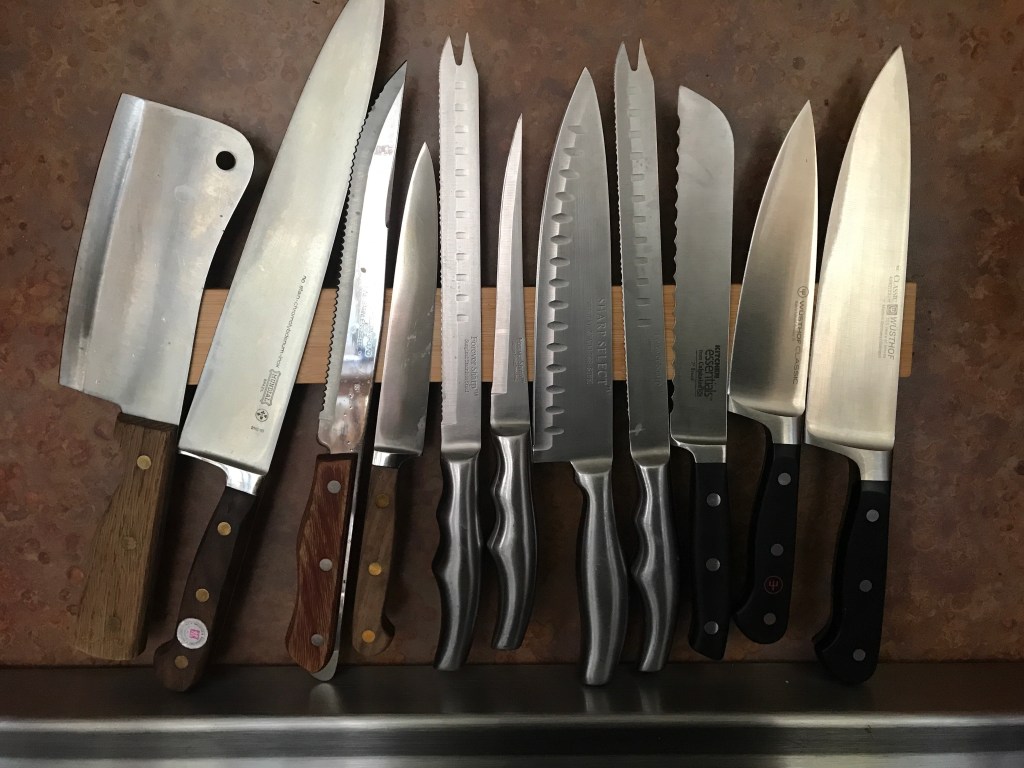
Looks dangerous, I know. What are all these?

Cooking with E became easier when she started eating more food and searching out some of her health problems. We spent time on special diets like the autoimmune protocol, where we did things like making spaghetti sauce out of beets, and talking about umami, and boiling bones for hours and hours. One of her favorite recipes from childhood is still the meatloaf made out of everything except meat.

We had fun making ordinary food. No beets were involved.

Even though I don’t like to spend hours in the kitchen on fussy food, I have inherited a gene that demands food on social occasions. I get it from Mom, better known in the family as Cinnamon Girl. She always make the cinnamon rolls for our family gatherings and although we have all tried to learn, no one does it quite like she does. The feature film “Cinnamon Girl”, made by my marketing guru brother, is a family treasure. It was supposed to be a tutorial for us all, but we laugh so much that it’s more of a comedy documentary.

I find that bonding and relationship building over and around food is really pretty available, easy and satisfying. I text the daughters and send pictures when I make milk soup. We laugh over our dinner menu of popcorn, just popcorn. We have rituals involving donuts and ice cream. Maybe it’s not all technically “cooking” but that’s where I put it. Just sayin’… close enough.
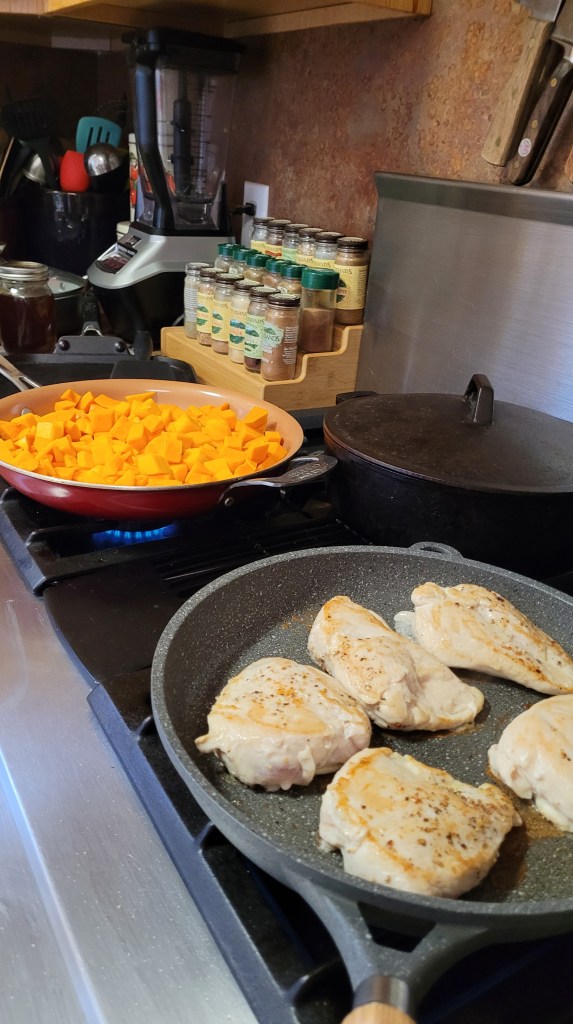
The chicken is sitting in a really awesome pan! Also, all those spices in matching bottles – I’ve never been able to do that…

A to Z Challenge: Letter F for Food

Food Can Be a Problem

People who need our caregiving are probably people who have issues with food. For one reason or another, they may not have the energy to shop and cook. Often they need special diets. Often nothing sounds appetizing to them or the opposite – food is one of their few comforts and everything sounds good. Whatever the case, what happens in the kitchen is very important in caregiving. It’s true, food is medicine that you as a caregiver can give. (Different perspective, yes?)

It is also true that a lifetime of eating poorly can’t be turned around in meal or two. There will be some foods that take effect more quickly than others (ask anyone who likes prunes) but complex processes like weight loss or building strong bones, strong immune system, a resilient nervous system, etc… take lots of time. My role as “caregiver in the kitchen” is one of the hardest for me. Maintaining consistency, making meals attractive, serving a good variety – a real challenge when life gets busy.

Places to Find Help

What a surprise it was to learn that the gut is like a second brain, and it needs to be treated as special, and fed with care. This is an area where it will serve you well to become a learner – first of the diagnosis of the person you care for, and second of the current diet recommended for that diagnosis.

Medical schools do not spend a lot of time teaching about the role of diet in disease so your doctor may not have a lot to say about specific nutritional guidelines. There are specialties in the areas of functional medicine, naturopathic medicine, and integrative or wholistic care that will spend a lot more time with you on the subject of food. Dietitians and nutritional specialists will be more helpful if they follow current research. Be proactive and ask them to work with you. Don’t be lazy about this, and don’t let them be either.

You can find much of the latest research on diet yourself, if you have a computer. There are some tremendous changes coming in the Standard American Diet and the Food Pyramid due to discoveries about the causes of many chronic diseases (including the big ones like heart disease, diabetes, cancer and dementia). It’s an exciting field. I’m posting links to some of my keto meal discoveries as well as listing some of our most helpful references at the end of this post.

Food is pretty, and pretty amazing.

Five (easy) Guidelines

This is such a big topic, and new changes and discoveries are frequent, but here are some things I’ve found to be basic for most chronic conditions:

– avoid processed foods as much as possible. If there are more than two ingredients it’s probably processed.

– buy organic when you can

– increase eating of fresh vegetables and fruits with bright colors. It’s hard to go wrong with this.

– decrease carbohydrates, which includes anything containing large amounts of sugar (soda, desserts, alcoholic drinks) and also breads, pastas, rice and white potato

– don’t give up if things don’t go well for a few days. Return to sensible eating as soon as you are able.

A keto salad lunch

My husband has Lewy Body Dementia/Parkinson’s and he is a researcher of his own remedies. We have seen promising results from his diet which is built on a conservative approach. Lots of colorful vegetables, moderate amounts of clean protein (eggs and meats) and as much healthy fats as we can get (avocado, coconut and olive oils, animal fats, butter, etc…). We also addressed our magnesium and vitamin D levels after finding out that we were low in those nutrients, as are most people these days.

We’ve tried some extreme diets, but found we just couldn’t build a life around weird food choices. The desire to eat has to be kept alive.

Our Ketogenic Strategy

The Keto Plate

  • “The Grain Brain Whole Life Plan” by Dr. David Perlmutter
  • “Fat for Fuel” by Dr. Joseph Mercola
  • “The Paleo Approach” by Sarah Ballantine, PhD
  • “The Ketogenic Kitchen” by Dominic Kemp and Patricia Daly

Your Best Advocate

Of course I’d like to be a better writer. For a while, as I try to be better, I’m going to at least try to be prolific. They say that if you write a lot, you have a much better chance that some of it will be good. If you write seldom (or not at all), none of it will be, so be writing. That’s my goal.


You have to be your own health care advocate. If you find that impossible, make one good choice – someone you trust to advocate for you. This is not a new revelation to me, but newly reinforced by my recent wellness checkup with my primary care office.

I’m somewhat of a rebel, offspring of a family that believed that 99% of what’s wrong with us heals itself if not aggravated by medicine. This mindset was pretty well in place in my high school years so I don’t know what made me choose nursing as a career. It was mostly that I was fascinated by how complex human anatomy, biology and physiology were, and because someone gave me “Cherry Ames, Student Nurse” for Christmas one year. Cherry was the medical world’s answer to Nancy Drew.

Nursing has given me an inside look into the strange reasons why some things are done the way they are. The reasons are many and complex. You can’t always figure them out. What’s more, sooner or later, what’s good for you is going to come into conflict with what’s good for someone else. It’s nice to know at that point if you have options and what they are.

The husband and I are at the age where we have more time to devote to our physical condition, and it’s a good thing being that it’s also the age where there’s some new thing going wrong every week. We are still moving around under our own steam and able to read so we are researching. I read to him in the evenings, after we walk, and we discuss health issues and diets, sleep, exercise, medicines – all of that.

Without going into too much detail in this post, suffice it to say that we see a lot of new research that flies in the face of traditional thought about these issues. It seems that what we’ve been doing traditionally for the last half century or so has created an epidemic of obesity, diabetes, heart disease and depression. Oh, and Alzheimer’s dementia. Oh, and autism. Oh, and autoimmune disorders. And cancer. At some fundamental level, we are a very sick country.

Having decided to get smarter about simple things we could do to help ourselves avoid as much sickness as possible, we are starting with eating differently.

I was sitting with the PA who was doing my wellness questionnaire and telling him some of these things. I told him how I was limiting carbohydrates by cutting out most bread and sources of sugar. I mentioned ketogenic diet and how I’d lost ten pounds on it.  I told how it was a high fat, moderate protein, lo-carb diet, and that I was feeling pretty good overall. He nodded and appeared to be listening (how do I know what he’s thinking…). We talked about stress relief and I told him that I dispelled it by writing for my blog. Then he wrapped up the interview with “Okay, just keep doing what you’re doing and keep on that low fat diet.” Sigh.

Traditional advice is not always for everyone. Sometimes, it’s not even true or based on real evidence. I’m going to end this post in the same way I started it. You have to be your own health care advocate because no one doctor or health professional can concentrate on what’s good for you. You are it.

More to come on this and related subjects.

20170630_132136-1
Blood pressure gradually creeping up – that’s what first caught my attention. Just sayin’…