Being your own health advocate means searching and researching. I’m following this new trail hoping to keep my hands functional for a few more years.
Needles, pain. I was all prepared for it. July 11, 2017 I was scheduled for my Regennex procedure on my thumb joint, left hand. I felt a little like a guinea pig, but this whole area of the body healing itself really appeals to me. As I said, I was all prepared for an afternoon in the recliner, watching NCIS reruns through a narcotic induced aura.
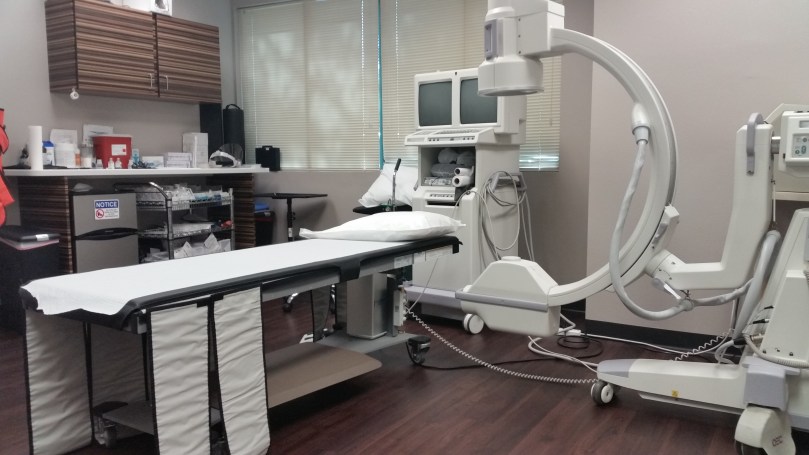
I arrived ahead of time and did a few inches of knitting in the waiting room, followed by a few inches of knitting in the procedure room. Next, I was ushered out of the procedure room and did another inch or two in another room while an emergency fluoroscopy on someone else happened. Then I was taken back to the procedure room and “laid out” next to a tray of needles and syringes. I laid there listening to the sound track to “Sense and Sensibility” for close to an hour. I practiced my deep, slow breathing which I supposed would keep me calm.
And then in they came, two nurses and the doctor. I told them I was driving myself home, didn’t want a nerve block, and to go ahead and hurt me. When asked, Dr. L said he frequently did thumbs, so I relaxed and let them position my hand and start injecting. He was very good with the local anesthetic. Those tiny needle pricks were really the only “hurts” I felt. The rest of the injections were more about pressure as the platelet infused plasma filled the joint spaces. And then it was done.
I drove myself home. The local anesthetic wore off and it still hasn’t started hurting. I think I’m in the clear. Now to wait and see if healing takes place. The only thing that bothers me is that it was supposed to hurt… and what if “no pain” means “no gain”? Just sayin’.
I can see a series of posts taking form on this subject, since I don’t want any of them to be overly long. I’m going to keep coming back to the subject because my passion is growing…
It’s fuel.
Food is fuel.
I don’t cook for fun. I cook because people have to eat. It’s more about fuel for life than what it used to be – for me anyway.
I didn’t used to think about food very much at all in my younger years. If it tasted good, I ate it. I knew about the rudiments of nutrition and ate what I thought was good for me, along with other things that I knew probably weren’t. My philosophy was that happiness was like a medicine, and if a food made me happy, it was probably canceling out any poor nutritional qualities. I had the benefit of growing up on a farm where my family grew/raised a lot of unprocessed food too. I was seldom sick and never had a problem with weight control.
For a few years in the early 2000’s I worked for the FNP, Food and Nutrition Program, of the University Extension Service of the University of Florida. I started taking the Food Pyramid, dictated by the government food police (kidding) into elementary schools and teaching it to youngsters. I taught Nutrition and Food Preparation to young mothers in a Head Start program. I started becoming aware of the problems Americans were having with food. Obesity at young ages, hyperactivity and ADHD were prevalent in so many schoolrooms. Even when presented with a decent school lunch, children were turning up their noses and throwing away the most nutritious foods. Often families in trouble with Social Services were being court ordered to learn how to prepare meals to feed their children properly.
By default, people were eating the Standard American Diet, acronym SAD, and it was sad. When I started having health problems that I could relate to diet and lifestyle, I started getting a bit more serious about what I fed myself. The overweight husband also developed problems with blood pressure and needed medicines which were hard to regulate. Friends and family members started getting diagnoses of GERD and cancer and diabetes. Time started wearing out our natural defenses. I began to hear more about food as therapy. I also began hearing about how many times nutritional advice was influenced by factors other than benefits to health – like, who decides what the Food Pyramid looks like and funny how it keeps changing…
I guess what I think now can be illustrated with the example of a machine, say a really nice new car. If I take it in on schedule to be serviced I’m doing good. But, the thing that I do most often, and that will make the most difference, is to put fuel in it. Different cars have different fuel requirements that are important to follow. If I put in a grade of gasoline other than what is recommended for clean burning, I’m going to see problems after a while. Waste products build up in the engine. The car gets sick.
Friends, readers, we are that complex, finely designed machine. Our computer, our emissions systems, our energy production equipment, our whole body is affected by every little thing we put in our mouth.
We are designed to take a lot of nutritional abuse – there are buffering systems, safeguards of all kinds in place – but sooner or later those back-up systems will have taken all the abuse that they can. If we don’t want to be sick or prematurely dead, we must study what’s happening in our “machine” with the fuels we use.
This was the beginning of my journey into food research and the resulting health trends. I don’t have to spend hours at it. I don’t have to spend a lot of money to do it. I don’t have to wait until I’m sick with a serious problem. I don’t have to ask my doctor for every new pill I see advertised in the media. I eat every day, and that is where the changes should, and can, start.
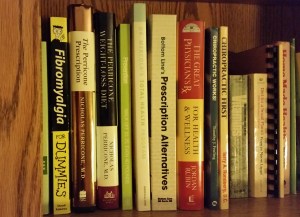
I’m not necessarily recommending any of these older books – some of the best and newest information is free on the internet, or at the library.
I started by saying that I don’t cook for fun, when I actually do have fun doing it sometimes. But fun is not the main point anymore. Getting the best fuel possible has become the point, just sayin’…
Whatever your hand finds to do, do it with all of your might… Ecc. 9:10
That’s been my mode of operation for physical activity pretty much all my life. As a result, I have hands that are wearing out a little faster than the rest of me. I didn’t realize how serious a matter this was until recently when both of my hands were too painful to use for much regular activity. Count the number of joints in your hands and fingers and that’s how many sources of pain you can have if those joints are inflamed or worn. We use our hands for nearly everything we do and yet hardly ever give them a thought, until they hurt. Even something simple like holding a book and turning the pages can be too painful to bother.
I am aware that I must be my own health advocate, and I’m trying to encourage others to do the same. I’ve been researching what’s new in treatment of joint pain. Since I view surgery as a last resort, and never without its own bad consequences, the new information on stem cell therapy caught my attention. I’m convinced it’s worth a shot and I want to share the information with any readers who struggle with any level of arthritis or joint damage.
I’m scheduled to begin therapy next week, and I’ll be recording what happens as the days unfold. It’s not an immediate process since it involves healing over time. Here’s the basic outline of stem cell therapy, as I understand it without getting too technical.
We all have stem cells, lots of them when we are born and fewer as we age. They are produced in bone marrow and that’s where most of them are concentrated. Adult stem cells are the template from which other more specialized cells are made. The body signals when and where stem cells are needed to regenerate and heal damage. It’s pretty simple and it’s part of the awesome way we were designed.
These are not stem cells from human embryos, and no babies will be harmed in the publishing of this post. Much controversy has been raised over the use of embryonic stem cells, and rightly so. But, as I said, we all have our own stem cells and don’t need to use anyone else’s.
I happen to live in an area where there is a stem cell therapy practitioner. I had an initial appointment where my hands were tested and viewed with ultrasound. I am a candidate – both of my thumb joints are lacking the lining that makes things move smoothly. I have chosen the first level of treatment, mostly because it’s the one I can afford right now. Because this therapy is new, my insurance does not cover it. Technically, it’s better to call it PRP or Platelet Rich Plasma therapy.
I will go on Monday to have blood drawn, and they will extract my platelets from the blood. On Tuesday those platelets will be injected into the joint, guided by ultrasound for accuracy. Platelets in large numbers signal stem cells to get on the job. Hopefully I have enough of them to respond and make a difference. Meanwhile the doctor has recommended a new brace for me. I have had it for several weeks and it has made a lot of difference – the best one I’ve ever tried and I recommend it highly. It is small enough to allow full use of my hand, doesn’t have to be removed when I’m doing wet things, and can be washed easily.
small, water proof, allows use of hand
adjustable, washable
After treatment I will be sore for the rest of the week but that will wear off. The hoped for results are that the joint will be strengthened, and possibly some of the lining will be restored. I do want to tell about the other two levels of treatment too, but not today. Check in again for tomorrow’s post. It’s fascinating stuff. More information at this link Regenexx.
Of course I’d like to be a better writer. For a while, as I try to be better, I’m going to at least try to be prolific. They say that if you write a lot, you have a much better chance that some of it will be good. If you write seldom (or not at all), none of it will be, so be writing. That’s my goal.
You have to be your own health care advocate. If you find that impossible, make one good choice – someone you trust to advocate for you. This is not a new revelation to me, but newly reinforced by my recent wellness checkup with my primary care office.
I’m somewhat of a rebel, offspring of a family that believed that 99% of what’s wrong with us heals itself if not aggravated by medicine. This mindset was pretty well in place in my high school years so I don’t know what made me choose nursing as a career. It was mostly that I was fascinated by how complex human anatomy, biology and physiology were, and because someone gave me “Cherry Ames, Student Nurse” for Christmas one year. Cherry was the medical world’s answer to Nancy Drew.
Nursing has given me an inside look into the strange reasons why some things are done the way they are. The reasons are many and complex. You can’t always figure them out. What’s more, sooner or later, what’s good for you is going to come into conflict with what’s good for someone else. It’s nice to know at that point if you have options and what they are.
The husband and I are at the age where we have more time to devote to our physical condition, and it’s a good thing being that it’s also the age where there’s some new thing going wrong every week. We are still moving around under our own steam and able to read so we are researching. I read to him in the evenings, after we walk, and we discuss health issues and diets, sleep, exercise, medicines – all of that.
Without going into too much detail in this post, suffice it to say that we see a lot of new research that flies in the face of traditional thought about these issues. It seems that what we’ve been doing traditionally for the last half century or so has created an epidemic of obesity, diabetes, heart disease and depression. Oh, and Alzheimer’s dementia. Oh, and autism. Oh, and autoimmune disorders. And cancer. At some fundamental level, we are a very sick country.
Having decided to get smarter about simple things we could do to help ourselves avoid as much sickness as possible, we are starting with eating differently.
I was sitting with the PA who was doing my wellness questionnaire and telling him some of these things. I told him how I was limiting carbohydrates by cutting out most bread and sources of sugar. I mentioned ketogenic diet and how I’d lost ten pounds on it. I told how it was a high fat, moderate protein, lo-carb diet, and that I was feeling pretty good overall. He nodded and appeared to be listening (how do I know what he’s thinking…). We talked about stress relief and I told him that I dispelled it by writing for my blog. Then he wrapped up the interview with “Okay, just keep doing what you’re doing and keep on that low fat diet.” Sigh.
Traditional advice is not always for everyone. Sometimes, it’s not even true or based on real evidence. I’m going to end this post in the same way I started it. You have to be your own health care advocate because no one doctor or health professional can concentrate on what’s good for you. You are it.
More to come on this and related subjects.
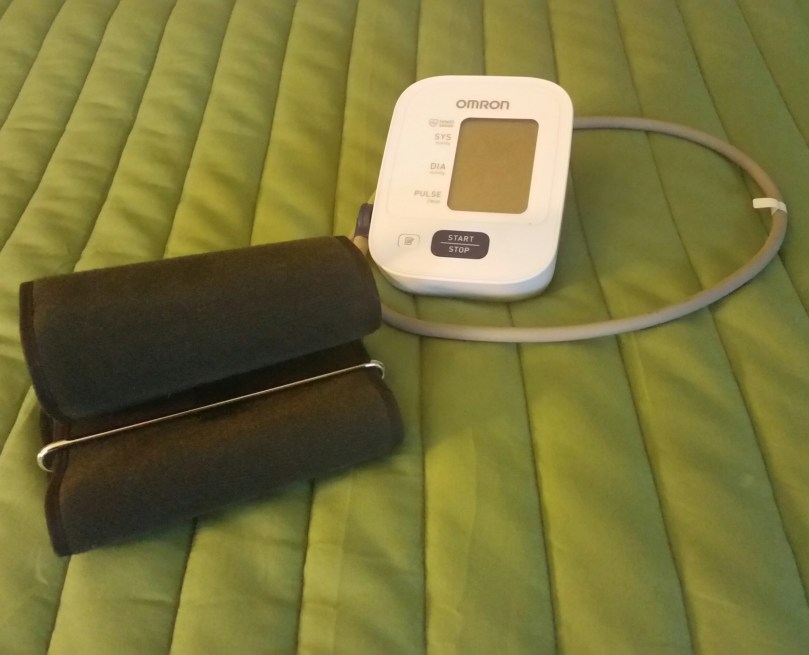
Blood pressure gradually creeping up – that’s what first caught my attention. Just sayin’…
“This is the first time in my 35 years that I have heard that peanuts are not nuts.” he said.
Esther’s friend made dinner for us tonight and we were standing around in the kitchen talking about “the diet project”, the AIP. He had been interested enough to read up about it and had chosen a couple recipes from our cookbook to make, giving us the night off. He did a bang up job and we appreciated it, a lot!
We have been following the AutoImmune Protocol for almost two weeks now, and although I think it is going fairly well, we are starting to have serious cravings for things on the “no” list, things we used to love to eat, things high on fun, satiety and comfort, but low (possibly devoid of…) nutrients. It’s a little early to know if we feel healthier, but how could we be otherwise? That’s what I’m asking myself.
For certain, more food has come through the door of this house in the last two weeks than in similar time periods. We seem to be shopping all the time. Yet, it’s a struggle to figure out what to eat when mealtimes come around. Sometimes what we have is not the mental picture of a meal that we have been used to, so it doesn’t seem like a meal. Thankfully, mental pictures can be changed – in fact, that is what it’s all about when you decide to take on a new way of eating. Can we stick with it until we’ve had time to change our ideas of satisfying eating? Good question.
Yum?
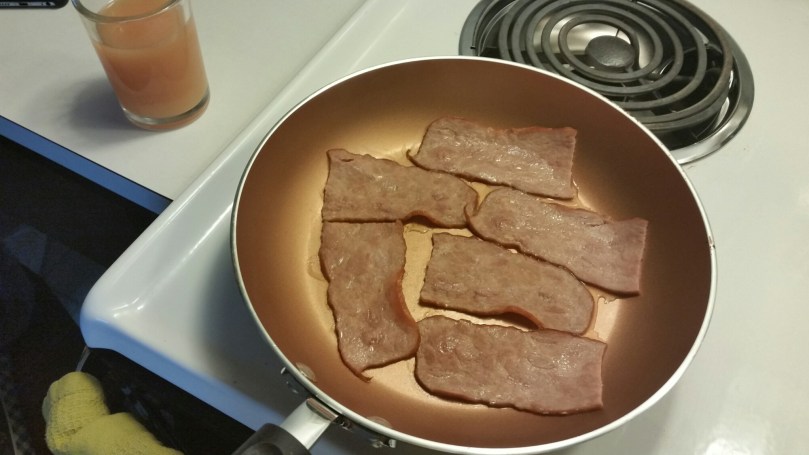
Breakfast is a difficult meal because traditionally, it’s all about grains, dairy and eggs of some sort, none of which are on our diet. We have avocado, sweet potato, turkey bacon. We need to work on our smoothie repertoire a little more.
The lovely, nontraditional breakfast
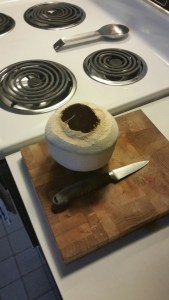
We knew we were going to have to use more coconut in various ways so Esther ordered two young coconuts in our Amazon Fresh order. I googled instructions on how to get into them because, frankly, looking at them doesn’t give a clue. The steps seemed simple, just hack away the outer white layer until you see a light colored “spot” where you can press your knife and make a hole. I made quite a mess doing all that cutting and got to a rock-hard layer where no more cutting was possible. But, someone forgot to put a “spot” on my coconut and I had to drill a hole with the tip of my knife. So I had a hole, but nothing was coming out of it – until I made a second hole for air to come in. See, when you learn stuff like that in Physics class they don’t tell you that you’ll need it when you encounter coconuts.
There was at least 10 ounces of coconut water inside this coconut so Esther and I both had a good drink. However, there had to be more to eat than just the water. I knew it would take more than tiny holes to get the insides out so I took it out on the sidewalk and smashed a big hole with a hammer. The inside of a young coconut is soft, shiny, semi-translucent and white (pretty really). I like it. Esther… not so much.
Esther’s fake bacon substitute.
Esther has discovered which meats she is able to tolerate most easily, and I have to hand it to her. For a vegetarian, she is doing great. She has had some kind of meat protein almost twice every day. As a vegetarian, she would eat burgers made of soy or black beans, and she would eat fake bacon, also a soy product. As an AIP girl she is bothered least by fake soyburgers (read real beef burgers) and fake soy bacon (real meat bacon) because they look similar to what she has grown accustomed to eating. See, it’s all in your mind. She eats tuna. I don’t know what it is about chicken though. For her, it begins with the smell and only gets worse with the sight and taste. I’m afraid I will be eating the roast chicken all by myself. Getting to like chicken will take some work.
I love meat and have no problem with cooking it, but I wish it were less messy. What to do with all the fat and how to get it off the dishes and counters is a battle. I’ve made three batches of bone broth but so far, no one has gotten into drinking it straight. It is kind of piling up in the fridge. I froze some of it in our ice cube trays, causing a near unhappy moment when Esther went to get ice cubes.
What else hasn’t worked… yes, the coconut Greek yogurt. I’m not sure you can make yogurt out of anything other than real milk, but there was a recipe, so Esther tried it. The black probiotic culture she added to it looked strange but we were able to think of it as specks of vanilla bean (also not on the diet). After culturing overnight in a warm place it was still coconut cream liquid. But it tastes great poured over bananas or the apple/cranberry compote we made. Fake yogurt, this also will take some work.
I don’t mean to say that we haven’t discovered some really good, simple recipes that I am happy to add to my regular cooking line up. I wrote about the Nomato Sauce in a previous post. Tonight we had a cauliflower dish that easily takes the place of fried rice, and some steak flavored with coconut aminos that was so flavorful. One good thing we have both noticed is that we do not feel distressed after eating, no uncomfortable fullness, and of course, we are not gaining weight. I am happy to see Esther able to tolerate meals without pain, and she is eating more good, nutritious food than I have ever noticed before.
Youngest daughter and I are tackling a big project. We are learning about and transitioning to the Auto-Immune Protocol (AIP). There are many autoimmune conditions these days, growing in number all the time. There are so many things in our food and our environment that cause inflammation in different parts of our bodies. We have increased stress in our lives. These things get our immune systems ramped up and so sensitized that they turn against us – they think our own bodies are the enemies and start attacking. Have you noticed the numbers of people who are gluten intolerant? How about psoriasis and eczema? Rheumatoid arthritis, Lupus, irritable bowel syndrome, GERD, digestive issues, allergies, asthma, frequent infections… all of these can be conditions of autoimmunity.
For years as a teen, my daughter experienced stomach pain in conjunction with meals, fatigue, and mild depression. We went to doctors looking for answers but it is difficult to diagnose a problem that presents itself differently depending on the person, their particular genetic predisposition, their stage of life, their lifestyle, and many other varying factors. She’s had other symptoms since, and many more doctors, but no real solutions.
Putting the pieces together has taken years for Esther, but maybe she is getting closer, understanding more. We are trying the AIP because it is an elimination diet – it will help us identify the foods that are causingher symptoms of inflammation. Initially, all foods known to cause inflammation are excluded, giving the body time to heal. Then some of those foods are carefully re-introduced in order to identify the culprits.
Yes, it’s a modified Paleo diet.
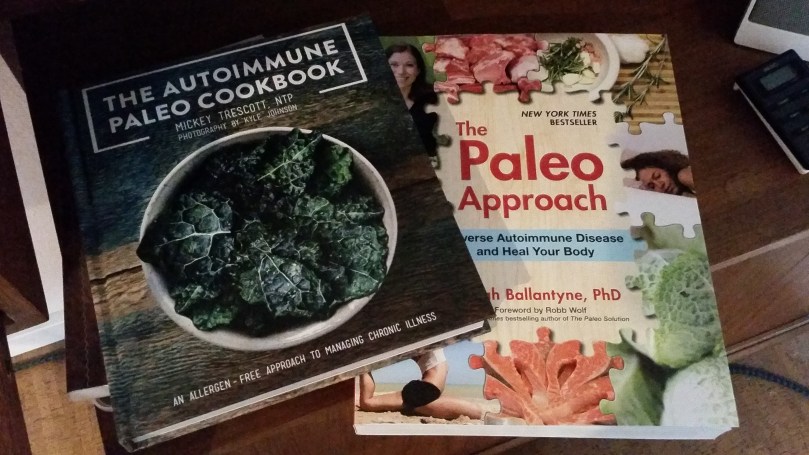
We have several good books to teach us and provide meal plans and recipes – that makes it a bit easier – but it is still a hard transition. Enter bone broth, one of the “good” foods allowed on this diet.
I have heard for years that chicken soup is good for us when we are sick. Turns out, properly made meat broths are healing for us for quite a few reasons. I decided to get right into it and make some bone broth for us. I’ve never had to hunt grocery stores for bones before, but I found some. I think bone broth is becoming a trend and the ingredients are more widely available. I found beef short ribs and beef marrow bones, brought them home and put them in the pot to cook for 24 hours, along with some vegetables for flavor. I’m not giving specifics here because you can google the recipe if you desire.
Youngest daughter is not used to eating this way at all (neither was I) and that is why it was suggested that we investigate the diet, together, while I was visiting this December. It involves cooking your own food at home, which is hard for Esther with her work schedule. It involves not eating any processed foods. And it involves eating meat, which is a real problem because she has been a vegetarian for many years. I think the way she describes it is being “existentially opposed” to eating animals, so it is rather daunting for her to look at, buy, touch, smell, or eat any meat. I made her stay away from the broth makings.
I stored the broth in quart jars and refrigerated it. Most of the fat from the meat had been skimmed off but the part remaining came to the top of the jars and solidified. I opened a jar this morning and saw this.
Honest, I did not do this. It just happened.
Although I do not believe in omens, this pretty much symbolizes Esther’s view of a diet with a preponderance of animal products . But for the sake of feeling better at long last, she eats what I make for her. I’m just sayin’, this is going to be a project, for sure.
Considering that the brain is the consistency of soft butter (eeek…) and any blow to the head can jostle it against the skull, not to mention that the skull is not indestructible itself, I decided that today, before my ride, I would dig out the old bike helmet. This is also part of my heightened awareness campaign.
The thing is so awfully uncomfortable that I went to the internet to see if I could figure out a better adjustment. Of course there were many good tutorials there, but I still couldn’t quite be satisfied. This is my helmet.
Title is good. At least they mean well…Just poly foam, that’s all. Might make a good container for an orchid plant…
Amidst all the instructions on knob turning, strap shortening and pad fitting I discovered my helmet is the simple version – no knobs, no stabilizing strap, no pads. Pretty much no protection. I wore it anyway, just in case it might ward off a falling tree limb or something. It makes me look like a serious biker, kind of. Lol. I will be putting a new one on my Amazon wish list.
Here are some more of my rules for sharing the roadway with whatever is out there.
Always assume you are invisible to everyone especially cars driven by the very young or very old. Everyone.
Signal your intentions clearly, especially when there is someone who needs to know.
Always know who is behind you – use your mirror.
Aim for intersections with stoplights to cross busy roads.
If there are two or more cars waiting to do something at an intersection, stop, feet on the ground and wait it out.
Wear a helmet, don’t wear floppy things that will get caught in gears or wheels.
Check tire pressure and brakes before starting out.
Can you think of more? I need all the help I can get.
This is more about my recent excitement after watching a PBS presentation by Dr. Daniel Amen. I don’t know why I had never heard of his research before, since it is not new or hidden. First, look at all these acronyms and think of how many of them have affected you or people you love:
OCD – obsessive compulsive disorder
ADD – attention deficit disorder
PTSD – post traumatic stress disorder
TBI – traumatic brain injury
and then there’s also depression, anxiety, epilepsy, dementia, Alzheimer’s and a whole range of behaviors that we call mental illness and that are becoming common words in our society. The science of mental health was always kind of mysterious to me in nursing school, and since then as well. Sometimes therapies worked, sometimes worked for a short while, sometimes not at all. Medications were so “trial and error” oriented that they were discouraging. Many of them produced side effects worse than the condition they were treating. What I saw had me thinking that having a brain problem was a sad and permanent downhill course. And that is why I am so thankful for this research that shows otherwise.
Dr. Amen is a clinical neuroscientist, a psychiatrist and a brain imaging expert. His research includes over 83,000 of a particular kind of nuclear medicine images called SPECT or (get ready for big words) single photon emission computerized tomography. What this is, according to WebMD, a gamma camera that rotates around the patient taking pictures from many angles which a computer then uses to form a cross sectional image.
When I saw the before and after images of brains having some of the above listed mental health diagnoses and saw visible improvement that correlated with behavior improvement, I became a believer in what he was saying. You need to go look at these images, seriously. He explains it very well in some of his TEDx talks (like this one, click here). A couple of his most important and revolutionizing statements are “When your brain is not right, your relationships won’t be right” and “Change your brain – change your life, and here’s proof”.
I’ve not been diagnosed with a mental health issue. I’ve never been in therapy (although I’ve wished many times to have been) but I’ve had mild concussions, PMS, headaches, periods of anxiety, deep sadness. Who hasn’t? I’ve watched patients with dementia and worried that I would someday struggle with that. I’ve watched friends go through the stages of Alzheimer’s dementia and cried with their families. This is the first time I’ve heard that we can see even these things before they happen and do something about them. We can understand what’s going on and counter with proven strategies instead of “shooting in the dark”, as Dr. Amen puts it.
(Btw, if you are a parent with a child who plays football, you need to hear about his treatment of professional football players with brain injuries. Even supposedly mild blows to the head create some images that show amazing amounts of damage, but the improvement that can be made is equally amazing.)
So that’s what has me excited. I’m going to watch more of his presentations. A lot of his treatments are related to exercise, good nutrition, good sleep, and good thoughts. In other words, it’s do-able and we should be doing it. Again, just sayin’.
Today I got back on my bike, avoiding falling down, and traveled 10.5 miles through 5 different trailer parks. I ride with heightened awareness, of course, because that’s what an accident/mishap should do for you if you survive it. I did this for my physical health and my mental health, which brings me to the topic I’m interested in today.
Some things appear on the radar in a way that warrants more attention – like maybe they appear from a couple different directions within a short time period. I always pay attention when this happens because I’m a person who prays for God’s direction, any way he cares to give it. I think if I ask for help, I’d better be looking out for it, duh?
Here it was, the first thing, an appointment with my doctor that was made so long ago I couldn’t remember why it was made. But I went. It was part of my “welcome to Medicare” physical. Several months ago I had the first part where you answer a lot of questions, get lectured on how you should be keeping healthy, and have $700 worth of tests ordered (that figure is low and doesn’t count the bone density test and mammogram…). The last part is when your doctor goes over the results of the tests with you and gives recommendations. My doctor was so booked up that I didn’t get the second part until 6 months after the first part.
So far in my aging process, I’ve been able to avoid medications except for a few supplements that I take sporadically. But I have been concerned about my blood pressure gradually creeping up and my cholesterol numbers as well. I am doing some lifestyle alterations to deal with the blood pressure but the cholesterol is a bit more complicated of an issue. There is a group of medications called “statins” that I am pretty convinced are not good for people and that I do not want to take. Is my supposedly bad LDL cholesterol sticking to the insides of my coronary arteries? Not necessarily, and I am going to find out for sure in a week.
Do you get check ups? Do you know your cholesterol numbers? If you have high LDL levels, you might be interested in the test called Coronary Calcium Scan. It is an x-ray that shows whether there are calcium deposits or plaque building up in the arteries of your heart. In some people high LDL cholesterol leads to plaque, which leads to blockage and a heart attack eventually. In other people the LDL’s just slip on through and don’t stick to the insides of the arteries – because it’s complicated and involves a lot of other factors (that you don’t want to hear now). It is very helpful to know which kind of person you are for obvious reasons. Insurance doesn’t always cover this test, but for some reason a couple labs in my area are running sales – $50. There is almost nothing available in health care that only costs $50, so I am springing for it out of pocket. As I said, that’s the first thing.
The second thing that popped on the radar was brain health. The husband and I were watching PBS last night and they were fundraising. But their fundraising is less tortuous than some. Here is the question that struck me as we watched this special. We expect to be told to have a baseline EKG (heart health). We expect to be told to have a colonoscopy after the age of 50 (gut health), we expect to be looked over for skin cancer, and we expect mammograms and bone density. So what is missing from this picture, something important to every one of the aforementioned systems? Your brain! We don’t hear much about checking our brain and attending to its health – and the good news is, there are ways to do it and ways to help your brain be healthy.
I am truly excited to know this. Today I got some exercise so my brain would have a healthier body in which to live. I’ll share a little more next post – I have an aversion to writing anything over 700 words. Just sayin’…











 Today I got back on my bike, avoiding falling down, and traveled 10.5 miles through 5 different trailer parks. I ride with heightened awareness, of course, because that’s what an accident/mishap should do for you if you survive it. I did this for my physical health and my mental health, which brings me to the topic I’m interested in today.
 I Just Have to Say...