I have a talented daughter who is an equine veterinarian. Although I am a registered nurse for people, she occasionally allows me to ride on calls with her as she treats animals. We have adventures. I call myself VetMa. (OK, it’s a bit dramatic. So what?)
It was Thursday evening, the first of the long weekend on call. It was getting dark. As often happens two emergency calls came in at the same time, but this time the triage decision was easy. The horse with the eye laceration would have to wait, because the one with the heel bulb laceration would not. The heel bulb is the area directly above the hoof of the horse and in this case, the owners reported fairly heavy bleeding. An artery had likely been severed.
The horse was standing in the driveway surrounded by a small crowd of people. A blood soaked wrap was around it’s left front hoof and ankle. It became apparent that there was no lighted barn in which to care for the horse, not even a floodlight over the drive so cars were pointed with headlights shining on the horse.
Almost all work done on large animals that involves pain, requires some degree of sedation and although this patient was standing fairly quietly, he would definitely need something for the treatment ahead. Just like people, animals respond differently to sedatives. The doc estimated the animal’s weight and gave a starting dose before cleaning the wound. As it began to take effect, the bandage was removed.
Lacerations in this area are always going to be contaminated and prone to infection. This one was in the fleshy area in the back of the bulb and there were arteries involved. Just cleaning and examining the area was difficult – a tranquilized horse has trouble standing on three legs so holding it’s leg up in a convenient position proved impossible. Our doc decided to let the horse stand on all four while she worked. That meant working in an unexplainable position close to the ground, nearly under the horse, in the dark with flashlights to guide the way.

The area around the laceration was blocked with local anesthetic and scrubbed clean. As the horse shifted its weight the laceration would open and close, each time making the small arterial bleeders spurt blood. It was difficult to see where to tie them off, but little by little the laceration was closed and the bleeding stopped.
While the tranquilizer was still in effect, the doc wrapped the ankle in batting and layers of gauze. A fiberglass cast was applied like a small boot to protect the area and allow the horse to stand and move while the cut healed. As the crowd dispersed, the doc gave instructions for care and dispensed antibiotics (and stretched her aching back).

It was back in the truck and on to the next call. Fortunately, the horse with the eye laceration was at an equine event where they had found another vet who was a participant. He was willing to stitch up the laceration so we went home, hoping for a quiet night.
 I don’t remember if I did this when I was a child or if others did it to me, but, the memory is there of orange peel being squeezed in my face and of feeling the light, stinging spray of citric acid -my first introduction to citrus zest.
 My food choice for Y is yogurt. I have been eating a lot of it lately since doing a round of antibiotic. It is made with a lot of active bacterial cultures (good ones) that are naturally found in our intestines and which are a vital part of a healthy immune system and digestive system. Because it is more economical I have developed my own way of making yogurt at home. Here is how I do it.


 X is for xylitol. Xylitol is a chemical called a sugar alcohol (the “ol” suffix gives that away). It is a substance found naturally in many plants. It has lately become a popular choice of sweetener because it does not affect blood sugar the way other sugars do, and it has some anti-viral and anti-bacterial properties that are beneficial in cases of ear infections and tooth decay.
 I am so grateful for water. I was thinking about that while washing dishes the other night. We use water to carry the dirt away from everything we wash – our dishes, our clothes, our cars, our pets, our bodies, everything. If that were the only benefit of water, that alone would be enough.


 Starfruit or Carambola – you might not have heard of this one if you live in a northern climate. Florida is one of the states where it is grown in the U.S. and it is interesting that one man was responsible for the particular cultivar that is grown commercially and bears his name, Adkin. He was a backyard horticulturist and his work produced this really, tasty and lovely fruit.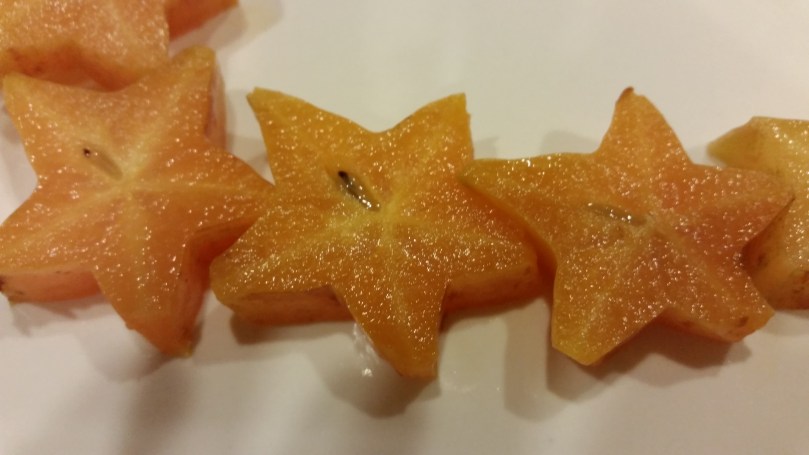


 I Just Have to Say...