A to Z Family Stories: L for Lamb

These stories are part of who we are and I want them recorded. Not all of them are pretty, but that is ok.  This is a collection of family stories that are told repeatedly anytime the Smith clan congregates during a vacation or a holiday.  I’m sure some of them are told more from my perspective than others but I welcome added insight from those involved.

“The farm”, those words will always mean one place to me and my brothers. It was a 320 acre plot in Sawyer County, Wisconsin about 8 miles from the small town of Hayward. My parents moved there shortly after they were married and my father started trying to make a living being a farmer. He tried numerous types of agri-business while we children were young, before he finally gave it up to become an excavator. The northwoods isn’t conducive to most kinds of farming.

One of the first attempts was the raising of sheep. I was too young to remember much of the actual work and this era probably didn’t last very long. What I do remember and what we sometimes talk about is our pet lamb.

There were times when an ewe (mother sheep for you city dwellers) would either die when giving birth or perhaps she would have twins and reject one of them, which would leave a lamb in need of rescue. The lambs were born in spring or early summer – and you know, lambs are really cute when they are little, really cute. I mean really cute. I won’t say that my brother and I were given this lamb, because we were too young to be responsible for it, but we were regularly allowed to feed it. We regarded it as ours. We named it Lambey Dammey. I know, but we were kids and it rhymed.

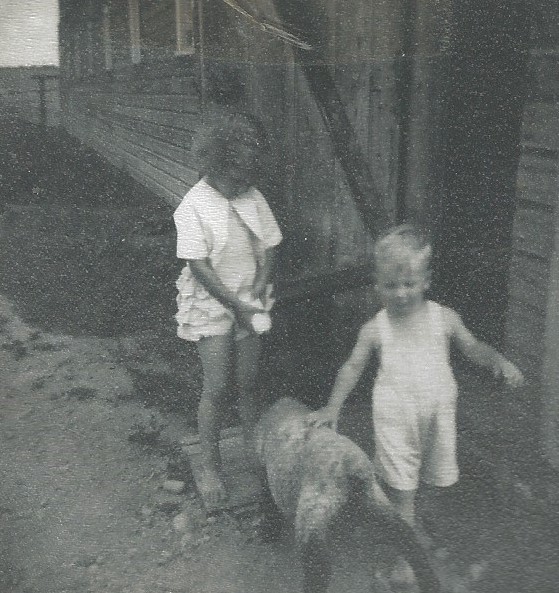
Our lamb, let’s just call him LD, was so cute (I did mention that they were cute, right?) and so much fun for us. When it was time to feed we would be given a bottle of warm milk with a special nipple and told to go find LD. We would call him loudly as we walked around the barn. I know people say sheep are dumb animals, but he would always come running. I think the promise of food makes anyone smart smarter. I was the oldest so I would hold the bottle, at least that’s what the pictures suggest. Much of my early memories are fed by the pictures I’ve seen over and over, and the stories I’ve heard. Here is a picture of me, my brother Ron and LD, the cutest lamb ever. Just sayin’…

PhotoScan (16)

A to Z Family Stories: K for Kitchen Play

Mothers work in kitchens a good deal of the time even if they work outside the home as well.  Long, long ago, before nintendo or play station, or remote control toys children also played in the kitchen while their mothers worked.  This was especially true as my brothers and I were growing up.  We played in the kitchen while mom cooked, baked, washed dishes and ironed clothes.  The radio played, it was warm and cozy since there was always an old-fashioned cook stove or later, a Franklin fireplace to keep us warm.  We emptied drawers, pulled chairs up to the sink to play in the dishwater, and generally got underfoot.  It was very much where we belonged.

Do Moms still work in kitchens?  Do kids still play in kitchens?  Do people still have kitchens?
Do Moms still work in kitchens? Do kids still play in kitchens? Do people still have kitchens?

But my favorite play was “pretend store”.  What better place to do it than the pantry cupboard?  Ours was a double cupboard under the kitchen counter. Two large doors opened up to a joined space with a narrower shelf in the back, and it was not a large space.  Looking at similar spaces now I can’t imagine being small enough to enjoy being in there – but I often have that reaction looking at the places I remember playing.  Crazy, but I know we children did it.

The first step, of course, was to empty the cupboard of all the canned goods and utensils that might be stored there. The next step was to crawl in and set up shop.  The things I wanted to sell would go back in, arranged as the storekeeper wanted them this time. Canned goods, cereal boxes, pots and pans, spoons, measuring cups – ready for business.  This was always a general store so it also sold toys for children (no problem there), clothing for the family (knew where to get that) and ready to eat food which mom would supply.  Paper and pencils for lists and a telephone (toy) for orders that  might be phoned in would always be within reach.  When all was done the final step would be to hang a kitchen towel as a curtain – just shut it in the overhead drawer.

It was such an inviting type of cubby hole that pillow and blanket would eventually find their way in for nap time.  I could have lived there, except I do remember that the shelf was a bit of a problem and I often bumped my head.  When I think about this pastime I have a renewed sense of appreciation for my mom’s patience.  She was probably glad that I was occupying myself with anything that kept me happy.

My children played in the kitchen too, and if I was at home, I would upload a way too cute picture of Esther in a plastic dish pan, boating around the kitchen floor.  I might add that for moms on a budget, don’t tell yourself that kids can’t be entertained with simple, inexpensive things.  They were and they can. Try it.  Just sayin’…

A to Z at AWP! The Letters I and J

I is for I’m here, and I definitely am. I’ve been here for two days, going on the third, and am wearing out a bit. For those of you who don’t know, AWP stands for Association of Writers and Writing Programs, which should probably be AWWP and that is different from what I wrote earlier thinking that the P stood for Professionals. Certainly everyone here is not. It is such a diverse group and a very large one. I haven’t heard the number of conference registrants this year but judging by the lines at the coffee shop and the restrooms there are scads of us.

The conference center is huge, having four levels. Going to the various rooms for different panels and readings, I have no trouble getting in 5,000 steps a day (yes, I have an app on my phone). I’ve gotten lost a couple of times. There are adequate escalators, some quiet areas to get away (if you can find them), fairly good signage, and a covered walkway that goes to almost all the nearby hotels and shops. The center DOES NOT have enough food vendors and you really have to time things right to get a cup of coffee between sessions.

I do a lot of people watching and there is a lot of interesting material walking by at all times. This is a national event, (maybe international, I’m not sure) probably with a larger number of midwestserners attending since it is in Minneapolis. My daughter told me that Minnesota is one of the states with the highest number of educated people with college degrees and evidently many of them are writers and teachers of fine arts and they are here. The major publishing houses are here and have booths in the book fair area. Lots of MFA programs of universities throughout the states are represented. All kinds of writing are being presented and talked about in the readings and panel discussions.

As I said, I am getting a little weary. I often find I’ve chosen a session where the talk is “over my head”. These people who are immersed in reading, writing and publishing have a language I’m not all that familiar with. I’m often made aware of my ignorance and that is a little daunting, but everyone has to start somewhere. I’m coming away with a lot of words to look up, a lot of authors to read, a lot of ideas to implement in my own writing. I’m learning about tweeting (groan…). During the last session I attended I found myself looking at facebook and checking email more than listening, so have ducked out to find this quiet table where I can think and write. I have no MFA, no published books, no large platform but even for me, writing is where it is at.

J is for the things I Just have to say – I’m going to give you some of the quotes that have been meaningful to me from a few of the sessions, the take-aways that made it into my notes.

“underneath the nothing, there is usually something”

“be harder on yourself than anyone else in your narrative”

“What have I come to tell? Why do I have to tell it? What stands in the way?”

“changing from writing about something to writing to someone allows you to be authentic”

“some suffering demands silence”

“the one person you don’t want to read your memoir is the person who will read it”

“your truth, interpretation and memory are not necessarily facts”

“honesty isn’t just not lying – to be perfectly honest would be to have perfect self-knowledge”

“it is never true that one does not have a story to tell”

“the fact that someone has had something terrible happen to them does not make them a good writer”

“if you want to be creative, write fiction. Creative non-fiction is also called non non-fiction”

“writing should make you a better person”

and many more, I’m just sayin’…  I came and am glad I did.

a good thing to remember when writing memoir
this session was packed and well worth aattending
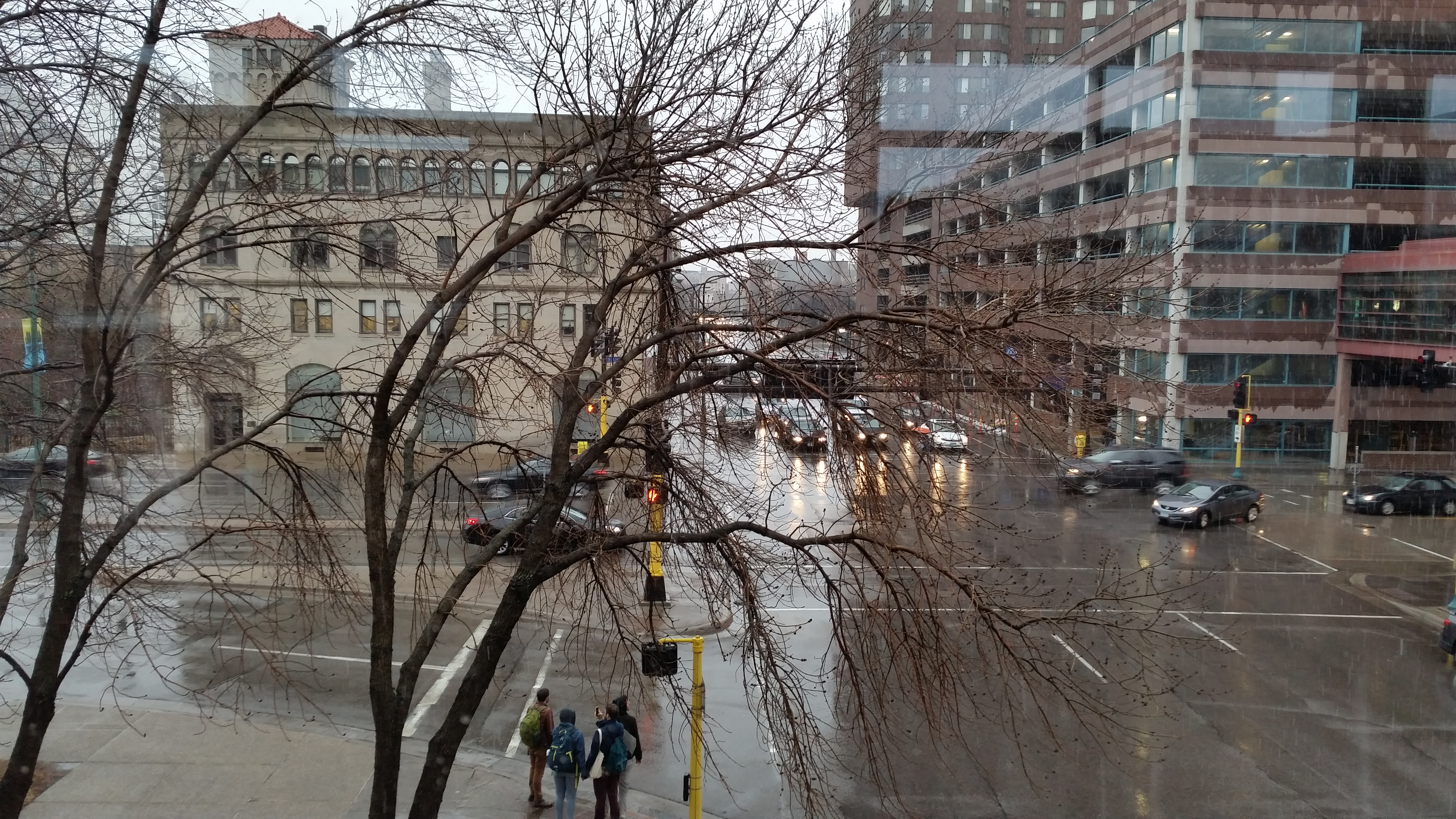
streets of Minneapolis from the skyway (yes it rained)
And yes, it snowed too (but only briefly)


(I regret I did not get the names of the people I quoted – it was often hard to hear it in the first place and get it all down correctly. My notes on each session were done hurriedly and often in awkward circumstances.  If you recognize yourself in any of these quotes please know I would gratefully acknowledge. Thanks)

A to Z Family Stories: H for Home Road

These stories are part of who we are and I want them recorded. Not all of them are pretty, but that is ok.  This is a collection of family stories that are told repeatedly anytime the Smith clan congregates during a vacation or a holiday.  I’m sure some of them are told more from my perspective than others but I welcome added insight from those involved.

Northern Wisconsin is pretty much the heart of nowhere. The small town I grew up near was over three hours from a major airport and two hours from any significant shopping, unless Farm and Fleet was your go-to store – it was only an hour away. When the girls were young we made weekly trips to the city of Duluth, Minnesota to meet with friends for a church service. It was an all day journey, often leaving in the dark early hours of winter, with our thermos of cocoa and breakfast food and not getting back until it was dark again. There were rituals of where to stop for lunch (Pizza Hut, cheese pizza with a pitcher of Mountain Dew} and what to listen to on the radio (Prairie Home Companion all the way home…). The two youngsters would often fall asleep in the back, strapped into their car seats.

But there was always a point at which the road began to sound different. There was a slowing, braking and a particular curve to the road. It was almost like the tires knew that there was no longer a white center line, no longer much traffic. It was “home road”. A voice in the back would start the chant, accompanied by rhythmic bouncing in the car seat. Soon they would both be singing the song, “ho-ome road, ho-ome road” in sleepy voices that got stronger over the last couple of miles. It was the song that signaled one more safe trip nearly ended, with the expectation of being done with that long stretch of forced inactivity. It meant homecoming.

On visits home, I never travel that stretch of country road without hearing that little mantra playing through my mind. We don’t live there anymore. It’s not a road that leads to home. But the funny thing is that the song itself has come to be applied to other places that I’ve called home. The same feelings of welcome and relief from travel are felt as I turn into my present long driveway, and in my mind I hear small voices singing the “home road” song. I’m just sayin’ it is a sweet thing to remember.

wpid-20141009_150338.jpg

G for Going North

This morning once again I’m leaving the “family story” theme behind and writing about present experience. I am going north. The destination is Minneapolis for the Association of Writing Professionals conference. My daughter attended the conference last year when it was in her home town of Seattle and it was an outing she wanted to repeat. So for her April birthday she gave herself a present – the trip to Minneapolis – and for my birthday (which is today) she invited me along. I am masquerading as a real writer for three days and hoping to pick up some interesting experiences, and knowledge.

In the next three or four posts I hope to give a picture of what the conference is like. To be part of it I’ve had to join the Association, of course, and purchase my registration. I have already spent several hours looking at the hundreds of things on the schedule trying to decide what to take in. The online portal allows me to choose and develop my individual schedule which I can access at any time through an app on my phone. The app also links me to others at the conference and gives me a map of the conference center. I say that I’ve spent several hours wading through the many offerings but I’ve only gotten through day 2 of the conference. There are presentations on all kinds of writing and publishing, workshops, author signings and a huge book fair.

As I was getting ready for this trip, I asked my daughter “what do writers wear at these things?” Probably it was a stupid question, but honestly if I’m going to buy new clothes that don’t have stains on them I might as well fit in so I don’t feel conspicuous. As I suspected, writers don’t have a uniform. The most important thing is to have comfortable shoes and a sweater to keep warm. It is still snowing in this part of the country.

But the going part is also interesting. My ticket choices did not include a non-stop so I am airport hopping in what was supposed to be a three city trip. Unfortunatley our plans are “up in the air” so to speak. What do you do when the destination airport closes because of a storm? Evidently you circle until you run out of fuel. Actually, the pilot was kind enough to inform us that if we get close to running out of fuel we will land at another city that is kind of on the way (but not really). I don’t think I’ve ever been on a four city trip, and I’m desperately hoping I’m not on one now. It would mean missing my flight to the final destination for sure.

Maybe this is the start of my first novel!  Will she make it safely to the conference or will the plane mysteriously disappear over the cornfields of the midwest! The turbulence is getting rather dramatic. I’m just sayin’, stay tuned …

A to Z Family Stories: F for Fred and Friend

They just showed up one day and started hanging around our back porch for the shelter, I guess.  Fred and Skippy, two dogs probably out having fun, but of course we thought they were homeless, starving, needing love. So we named the big, fuzzy brown one Fred and the short legged black and tan one Skippy, and adopted them as our new farm dogs.  My brothers were always happy to have a dog or two around to play with and this curious looking pair was friendly and seemed to have adopted the boys too.  Then Fred had puppies.

Obviously, the naming came before anyone cared what gender they were, and looking at them it was much easier to imagine the big one being the boy and the little one being the girl. But, no. We don’t talk about Fred very much past this point and I think it’s because he she ran out on us – too much family responsibility I’m guessing.  My brothers decided to raise two of the puppies, again picking noble doggie names for them – Steve and Andy.

Everyone’s memory is kind of fuzzy about what became of Steve and Andy as well.  One of the problems with farm dogs was that they often craved the excitement of chasing cars. That was a problem with this rambunctious pair and likely the cause of their demise. Which brings me back to Skippy, the one we remember most fondly.

It became apparent that Skippy had at one point been someone’s house dog.  He was very comfortable coming in and generally well behaved.  Even mom liked him.  He was always willing to eat leftovers that no one else wanted and that was his main diet.  No one ever thought of buying food specifically for the dog, not on the farm.  There were always other “things” for them to eat.  And here comes the part of the story that we always laugh at when talking about Skippy.

When we milked cows, the milk was poured into a funnel like strainer with a heavy paper filter at the bottom, and into large metal cans.  Washing up the equipment, we always took the filter out and tossed it – into Skippy’s mouth.  He loved the wet, milky circles and pretty much swallowed them whole.  Evidence of this would come in the spring as the snow melted and exposed the little white piles all over the lawn.  They were composed of milk filter material and tin foil, swallowed with his leftovers.

Skippy was an adventurer though.  He considered us his home but the world was his playground and he would be seen at neighboring farms and sometimes out in the woods. He often came back with wounds and bite marks, looking as if he had been fighting with other dogs.  For a small dog, he had an amazing amount of hormonal motivation leading him to wanderlust.  He may have just disappeared, like he came.  No one remembers exactly.  We’ll just say that maybe he and Fred found each other again and lived happily ever after…

A to Z Family Stories: E for Every Easter

There we were.
There we were.

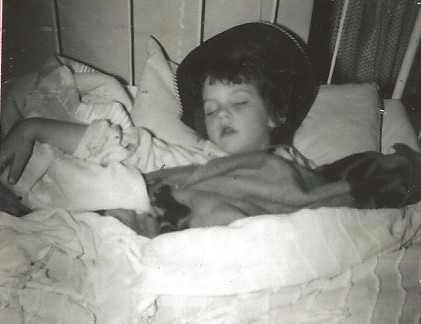
There we would be – however many of us there were at the time.  All lined up, or as close to that as possible, in the moment before the boys got into some dirt, the moment before we were herded into the car – hopefully not late for church.  It was the Easter photo op.

Weeks before the event the planning would begin.  Mom always made a new dress for me and I still have memories of many of them, partly from seeing the pictures so many times but also I remember how I felt in them, what I thought of the fabric, who I was trying to look like.  Little girls always got a hat. Who started the Easter bonnet thing is still a mystery to me but it was a habit that died hard.  Easter was also one of the two times when one might expect to get new shoes to go with the new dress.  And because the snow might be melting by Easter I sometimes got to wear the new shoes without boots over them.  There were so many things about the holiday that spoke of spring freedom.

The real miracle of Easter was getting all my brothers cleaned up and dressed in their church clothes before something tragic happened to one of them. For simplicity’s sake they always had matching outfits in various sizes. Often one component or another would go missing – a sock, a belt, a shoe – adding to the craziness of the morning.  I can remember family routines of getting things ready on Saturday nights (commonly referred to as bath night). Shoe polishing must have been one of my favorite things to do as I have a mental picture of small shoes lined up, last week’s newspaper underneath them to protect the floor.  But it was mom who did most of the work. I think she was the one who took most of the pictures, just to prove she had done the job.

Our church family and the routine of the church calendar added much to my growing up years.  It was a pretty safe place to be, and there weren’t expectations of perfection that left me disillusioned, jaded or burned out.  We were just people and we seemed to know there was something about God that called for our attention.  Sometimes we gave it fully and lots of times we didn’t. I don’t think God was surprised.

D for Detour

  I did not announce “family stories” as a theme for the whole challenge because I knew there would be days when I would depart from it.  Today is one of those days.

Longboat Key – so called because it is shaped like a, well, like a longboat and is about ten miles long with a small drawbridge on the north end and another bigger bridge on the south end going over to Sarasota, the mainland.  I was working today on the very north end.  I finished my job and headed home.  There was a long line of stopped cars as I came to the drawbridge and I assumed a boat was passing through and the bridge was up.  A short wait and we moved forward, and then we stopped again.  This time the wait was unusually long.

An ambulance came up behind me.  The road going over the bridge is only two lanes and the ambulance had no opposing traffic coming from the other direction so it went past.  Then a fire truck also went past, siren going, lights flashing. Two police vehicles followed.  A couple cars in the line ahead of me turned around on the bridge and headed back south.  For me, getting home would be well over an hour if I had to go all the way down to Sarasota to hit the mainland.  Surely whatever it was could get cleared up in less time than that.  I would wait.

I looked at facebook on my phone, I took some pictures of the boats lined up on the sandbar.  About 45 minutes later some pedestrians came across the bridge and were stopping to talk to people waiting in their cars.  “The bridge is closed. They are turning traffic back on both sides. Turn around.” they told me.  I got out and walked a short way, not even to the middle of the bridge and saw what was left of a small bright green moped crumpled in the middle of the lane. Ahead of it was a black sedan with the back window completely smashed out.  A young man was sitting down outside the sedan with his head in his hands.  The policeman guarding the scene, came over and confirmed that the bridge would be closed for some time – best to turn around. There was going to be accident reconstruction which probably meant a fatality had occurred.

I headed south,

thinking about the two hours I was spending making the half hour trip home,

thinking about missing lunch and being hungry,

thinking about the man sitting beside his car,

about the hole in his window and the smashed moped.

Someone’s life took a very unexpected turn on that bridge a few hours ago.  Someone would not be celebrating Easter in the morning, or perhaps ever again.  And yet for me, it was only a detour.  I was shaken.

A to Z Family Stories: C for Cat Tamers

This is a collection of family stories that are told repeatedly anytime the Smith clan congregates during a vacation or a holiday.  I’m sure some of them are told more from my perspective than others but I welcome added insight from those involved. These stories are part of who we are and I want them recorded. Not all of them are pretty, but that is ok. 

Young ones growing up on a farm had an important job. It was taming the kittens.

Cats are an essential element on a farm. Barns and other farm buildings are like hotels for mice if there are no cats around to keep them in check. Most of our cats were not the pampered, brushed and combed, vaccinated and neutered kind that are fed fancy food. Barn cats were and are excellent hunters who feed on small rodents almost exclusively and travel around the farm at will. And even if some cats were neutered or spayed, there was no guaranateeing that the neighbors cats were, therefore … kittens abounded.

You found them in the hayloft. You knew to look because a cat who had been looking kind of hefty for a while was suddenly skinny. We loved going into the loft to look for kittens because it was the ultimate scavenger hunt. You could follow mama cat if you were wiley enough to not let her know, otherwise you just had to start searching the crevices between the bales and hope you got lucky. The prize was finding that sleeping pile of gorgeous kitten fur, four or five of them most of the time. They were often a variety of colors and patterns, tiger stripe, calico, orange tiger, black and white, or maybe even solid black. It was best to find them when they were very young and let them see you often as they grew, but sometimes the mother would be skeptical of motives and move the family to a new hiding place. So the hunt would resume.

Older kittens were more difficult to deal with. They would instinctively hide and bite and scratch, but if they weren’t tamed they would grow up wild and too many wild ones would result in a cat population growing way out of bounds. Our job as children was to find, tame and help the kittens be people friendly so they could possibly go to a new home.

One time, my brother Stubby (we don’t call him that anymore) had been working on an older kitten and was making some headway when he heard of a family in need of a cat. He very much wanted them to take this kitten and was able, with difficulty, to get it into a box. With glowing reports of how pretty this kitty was he took them to the barn to see their new pet. Unfortunately, every time the box was touched it exploded into a shaking, jumping, growling, banshee shrieking package that was not very inviting. Amazingly, they took it.

As a young mom, I was able to live once again on the farm where I grew up. My own children learned the art of cat taming just like I had. They carried kittens in their arms, dressed them up in doll clothes, put them to sleep in dresser drawers (which was the first place we looked when one was missing) and in general subjected them to all sorts of handling. They were gentle and bomb proof by the time they were grown. Caring for them provided many lessons and so much fun for my own two cat tamers.

Esther and White Necklace (they always had descriptive names)
Julia and Rebel, asleep for the moment.

A to Z Family Stories: B for the Basement

Cool. Dark. Smelling of wet earth and cobwebs.

It was the basement, or more commonly, “the cellar”. It was the place mom went to fetch a jar of green beans, or dad went to see if a fuse had blown, or something had gone wrong with the pump for the well. It was the place in my dreams, and sometimes for real, where we went when funnel clouds were feared and things started flying around in the wind outside. I had watched “The Wizard of Oz” religiously for years and knew the cellar was the place to be.

It was a dangerous place for children, or so we were told (until we were old enough to work at cleaning it). It was the cellar steps that scared our parents the most. The only access to the basement was outside – a cement staircase, worn and a bit jagged, descending down into the ground under our house. Retaining walls on either side were probably meant to hold a door that would keep little children from falling into the abyss, but I don’t remember when our doors disappeared or if they were ever there. I remember playing on the steps. It was a cool retreat in the summer. It was my pretend home where I “cooked” mud pies decorated with dandelions and put my dolls to sleep.

At the bottom of the staircase, was a heavy, ill-fitting door with an unusual latch. I remember worrying about opening it, and then worrying again about being able to get it closed. A door left open might be a nocturnal invitation to a skunk, or something bigger. Who knew? And of course, a small child, mistakenly left behind in the cellar might not be discovered for some time

The floor inside was dirt, uneven with cement scraps and piles of “stuff” that kids couldn’t identify. In one corner was old wooden shelving that held dusty jars of produce, canned and stored from previous years gardens. The other corner housed a pump on a cement block. It dripped water and the dampness and faint smell of mold permeated the room. We knew our water came from somewhere under the pump and whether or not it was working was always of great concern to our parents.

Stories of the cellar would not be complete without mentioning it’s most numerous occupants – the family Arachnidae opiliones, Harvestman, or as we called them “daddy long legs”. Somehow we didn’t fear them as we would a spider. Their long spindley legs made them look too clumsy to be vicious. They were interesting and I watched them often. Others were not content to watch and I’m sure some torture occurred during moments of childhood boredom.

I’m just sayin’, I remember the cellar. It was part of our world, our house. Not many of them left.

Our “daddy long legs” looked like this friendly guy