There are two aspects to what I’ve learned. The first is about the value of a writing challenge. Without the challenge I probably wouldn’t have learned that I can write six times a week for four weeks on my blog without dying, not even close. It’s this kind of discipline that I will have to ascribe to if I ever want to write, oh, a book perhaps… You don’t know until you try, and now I know I can do this and probably more.
The second thing of note came through the theme I chose, that of recording family stories. Memory alone can not be relied upon to preserve a record of meaningful events. Some things have to be written down in a record or they will be forgotten or remembered wrongly/imperfectly. Reflecting on things as they happen also helps cement events and lessons learned in one’s mind. That’s why this reflection I’m doing now on the challenge is helping me. I’m giving what I’ve learned some structure and planning how to use it in the future.
And speaking of the future, one realization that makes me sad is that I do not remember ever sitting down and having a one on one conversation with any of my four brothers when we were young. I find that really strange, since we enjoy talking with each other now. We lived our lives watching each other but I can’t recall the challenges they went through growing up, nor do I think I shared my ups and downs with them. We were only two years apart from each other. Was that difference so much that we couldn’t identify, or was I just too busy and wrapped up in myself to notice them. Now I am eager to record some of our conversations, the subjects of them and what we thought. I’m sure this will prove interesting in the future as our thinking evolves and we ourselves change and grow (old).
And of course it goes without saying that I respect and am thankful for the community of writers that I’ve met, whether seasoned in the craft or new to it. What we do together and for each other is important. Thank you all.
To all of you who moderated, administered the rules and checked up on us – you did such a good job! It really helped to know that you were watching and reading, as well as doing your own writing. You rock!
They are all biblical characters. Zedekiah was a king of the country of Judah and the other two, Zephania and Zechariah,were prophets delivering messages from God to his people – they have books of the Bible named after them. My brothers and I knew who these guys were so when the minister told us to look up Zedekiah 5:14 we did not panic trying to find it. It was a trick.
Soon after she found herself with a small tribe of children to read to, my mother found a children’s version of the Bible and read it to us every night at bedtime. I say it was a child’s version but I call it that only because it was more story centered and spoke our language. I don’t remember any parts that required scholarly understanding. It was a thick book, with an occasional illustration. It was opened only after we all had our jammies on and were ready to be tucked in, sitting on our beds. She would sit in her chair and open the book to the bookmarked page. We were transfixed. She would always stop right at the good part before something was going to happen.
Unlike many simplified versions for children, this Bible did not leave out anything. The good, bad and ugly were all there. The stories portrayed God’s nature, but more vividly they portrayed the nature of people who were always trying to “one up” God. There was drama, mystery, romance, and beauty. When we finished the last page, we would start over again on page one and we didn’t mind. I don’t remember when the cover fell off, but it did. When I learned to read I was sometimes allowed to read to us all at night – but more often than not, it meant I could read by myself and not have to wait to find out how the story ended. And read it I did. It gave me an overview of people and events that is still the bedrock of my biblical knowledge today.
The book was still around when I started my own family and the tradition continued. By this time it was looking pretty ragged and I began to hunt for a new one, but could not find the exact edition. We taped it together and kept reading. I looked for it today and am pretty sure I do not have it. I think it might have gone with one of my daughters when they moved out. But I will not forget it because it was a joy and a blessing to our whole family and a very valuable part of my childhood.
The challenge is over! I have the start of a book for my family, and ideas for more stories that didn’t fit in with the alphabet theme. How valuable is that!! What value did you find in the A to Z this year?
A lot of our social life as kids revolved around our neighborhood and our church. Every summer, soon after school was out, we headed to church camp for a week. We saved our own money to pay our way, and hopefully some extra to spend at the snack bar. We planned our wardrobes, we bought a new swimsuit and towel, we studied the list of things to take, we anticipated who else would be there. It was a big deal for us and one of the highlights of the summer.
Camp was not the same as it is today. We rarely paid more than $30 for a week of food and lodging. There was no technology involved, no speed boats pulling skiers, no backpacking into the wilderness. We spent time with our counselors and teachers, we did simple team sports, swam and played in the water, had campfires, memorized Bible verses, and learned to work together.
We were usually housed in cabins with rows of bunk beds. The military atmosphere was accentuated with inspections every morning while we were in chapel. The white glove test was used to see if we had dusted, there were demerits for any little piece of trash under a bed, clothing had to be in the proper place – the results were announced and the first place token was given to one cabin each day.
When bells were sounded for meals, there was always a scramble to see which team could get all their members lined up first at the mess hall. The winning team got to enter first. We sat at long tables together with our team and were also judged on our manners. There were choruses of “get your elbows off the table, Uncle Don” sung by campers whenever we caught one of our counselors or pastors. At the end of the meal we passed our plates and tableware to one end of the table where dish washing took place – and we washed the dishes. The team with the best attitude and behavior would find the award on their table at the next meal. I don’t remember much about the food, but none of us starved. We were always hungry.
After classes and lunch there would always be a “down time” when we would have to stay in our cabins and rest. We could study for our classes, read our Bibles, or if we were really ambitious we could memorize scripture from a list that we were given. When we were ready, we would recite the verse to our counselor and be given credit, and of course there were prizes for that too. As the hour for resting was nearly up we would start getting ready for the active games and swimming which would take most of the afternoon. The afternoon was also the time for the snack bar to open. In those days there were not drink machines and fast food places at every corner. Most of us didn’t get to have a Coke or other soft drink very often so it was a treat to spend our money on something to drink and a candy bar.
I think the pastors and adults who volunteered for camp duty really enjoyed working with us. The younger ones played ball and swam, the older ones had conversations and taught classes. They joked and played games with us. We had our favorites that we played pranks on and teased. Underwear was seen flying from the flag pole on occasion.
The more serious part of the day was our evening service. We always wore our favorite dresses and tried to look our best. I remember how fun it was to trade outfits with friends and wear something different. We sang songs that were contemporary then but seem almost classic now. There were no screens, there weren’t even songbooks. We learned songs either by repeating them or from a huge poster book that would be held up high in the front of the room. The first time I ever heard the song “How Great Thou Art” was at youth camp and I can almost see the illustrations that were in that book. One page had the stars and planets with the words “O Lord my God, when I in awesome wonder,consider all the worldsthy hands have made. I see the stars, I hear the rolling thunder. Thy power throughout the universe displayed.” Our imaginations were stirred by the messages given by the pastors, the skits performed by our counselors, and the invitations to know God better. Young people can make decisions that set the course for the rest of their lives. Many of those decisions were made at camp and they were good ones.
There have been many books written by recent generations of church going youth that talk of their alienation from faith, how they became burned out when life didn’t live up to their expectations, how God seemed distant and hypocrisy was everywhere. I do understand how that can happen, but I don’t have a story like that. I wasn’t taught to have unrealistic expectations of Christian life. I knew there would be easy times and hard times and that I would have to grow by experiencing failure and trying again, and that God would be there to help me in one form or another. Love was there, and I felt it. I am thankful.
Did you attend any kind of summer camp as a child? Did it influence you in any direction?
Whenever we get to know someone well we usually notice something about them that they do in an excellent way – an area in which they excel. These traits or skills come out in the stories we tell, but this post is a way for me to focus on them, and flesh out some of the characters in our family memories. Someday a new generation will want to know where they got their love of music, or why they long to start their own business, why they are so good at playing Scrabble or knitting. Whether these things are passed along through genes or through good teaching, they link us to the past and they give us something to pour into the future.
I have many pictures like this. If he sat still, he couldn’t stay awake. Hard worker.
My immediate family consists of my parents and four brothers. I will start with my dad, and there is no wondering what he contributed. Dad was and still is, king of the work ethic. I never saw him sitting around with no purpose. In fact he worked so hard and continuously that on the occasions he did sit down he usually fell asleep from exhaustion. Even in play, Dad was active and engaged. He modeled that so well that all of us children value honest, hard work and feel obliged to be producers, not just consumers. And hard work does pay off. Thank you Dad.
Mom worked hard as well, but somehow in the midst of all that was required in raising a family of five, she found time to read. She finished high school by correspondence course, and went on to follow her interests in history, theology, psychology and literature. She still reads more than I do and loves to hear what others are reading. Books and the ideas in them are interesting to her and she has worked hard to pass that along. One of her most memorable challenges to her children and grandchildren was to pay $25 to anyone who finished reading “The Seven Habits of Highly Successful People” by Stephen Covey. We are very responsive to bribes and I think nearly everyone read the book.
I was the eldest child and it was probably the perfectionist bent common to the firstborn that made me very competitive academically. I was good at tests and ended up being valedictorian of my class. I loved music and my exposure to church music and piano lessons gave me a medium level of skill in those areas. I was a fair actress and loved being in plays. I was handy at home and can remember being the babysitter when my parents went out. I rushed to get the dishes all washed, the kitchen cleaned up and finished by washing the floor with the dishwater! I read a lot and it was “Cherry Ames, Student Nurse” that made me think that was what I wanted to be.
My brother Ron, the oldest of the boys, was a big thinker and ardent optimist. One of his early goals, which he was sure he could accomplish, was to ride his bike down our hill with five ice cream cones in each hand. Not a very useful goal, but bursting with self-confidence. He was mechanically inclined at an early age, and also loved wood shop in high school. One of his projects was to make a copy of a spinning wheel for my Mom which was beautiful, and probably would have worked if anyone had known how to spin. He has always loved to engage people in conversation. I was always envious of how all the old ladies in the neighborhood thought he was such a charming kid.
Robert was next and he was/is the performer of the family. His ability to let loose, and become a character without inhibition always surprised my Mom. It led to him being emcee of public school functions, a singer and a drum major for the school band. He was a DJ for the local radio station while in high school and went on to establish a mobile DJ service for dances and weddings. To the family he is Bobino, or chef Jean Clauded Pierre (I might have that wrong, but it’s some Frenchy name) who shows up at family gatherings with all the ingredients for fabulous muffins and a great time in the kitchen.
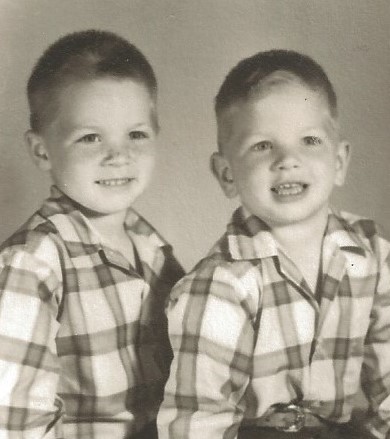
My absolute favorite pic of my middle two brothers. So cute I could hug them. And I did.
Gary, boy number three, was the sensitive, helper type. He would do anything for anyone in need and had no trouble finding projects. All the boys were athletically inclined and great at sports in high school, but Gary especially was a basketball star, starting on the varsity team as a freshman. Being a good helper meant he was good at picking up skills and today he does all kinds of carpentry and has a custom tile business.
All of my brothers work for themselves in their own businesses, but it was Dennis the youngest, who really exhibited entrepreneurial skills early in life. He was a cute kid and could talk people into buying ridiculous things from him. He set up a roadside stand and was always selling something – seashells that we picked from the beach in Florida, huge, yellowing cucumbers from the late garden, and of course lemonade. He was the organizer of the neighborhood, always planning things for himself and his friends to do. Sometimes Mom would tell him he couldn’t do something, but never one to worry, he would just tweak the plan until he could get it to work.
So, for the record, these are some of the ways my family has excelled. I love to name and celebrate their exceptional qualities. I can also see these traits being picked up by the next generation as they get educated, start to work, and raise families of their own. I am grateful for my family and the blessings that God has given us.
Yeah, we were pretty cute. Just sayin’…
What exceptional qualities do you recognize in those closest to you? How could you affirm/bless by acknowledging them?
I am under my usual three or four blankets, listening to the transistor radio I bought with money from my first real job. It is too early to be up, still pitch black and I can tell it’s cold. I am hoping to hear that school is canceled – for the whole day, which it will be if the temperature gets below -30 degrees F. Somehow, someone figured it would be okay for kids to stand out waiting for the bus if it was only -29 degrees. It’s not that the cold bothers me that much either, I just don’t want to go to school. Finally, the weather guy says it is -32 and starts listing the area schools and organizations that will not be asking people to come out. My school is among them. I am glad.
Cold. Long. Cold and long. And very cold for a long time, six months almost. On mornings like the one above, most smart people stayed home and concentrated on staying warm. Those who had to go to work would put their cars in a garage or have a contraption attached to their oil pan that could be plugged in to keep the oil warm enough to circulate. Antifreeze was a given. Tires would be frozen with a flat side. Those who hadn’t prepared might find their water pipes frozen. I remember having to remove ice from the cows watering cups in the barn, and often the large water tanks would have an electric heater attached. Weather like this was hard on the animals but if they were in the barn, their bodies supplied enough heat to keep them safe. Cold nights meant we got to take a quart canning jar filled with hot, hot water up to put at the foot of our bed under the covers.
And the snow. Some years there was snow in November. Some years it never melted until spring and the banks along the roads were higher than the cars making intersections dangerous. We never had to hire someone to plow our driveway at the farm because Dad always had either a tractor with a bucket or a bulldozer to do the job. He would push the snow back as far as he could knowing the piles would get larger and larger as winter moved on. They were snow mountains to us kids and a never ending source of fun. Winter forts could take hours to build. We would cut blocks of snow or roll snow balls if the weather made the snow sticky. Our forts not only had walls, but they had tunnels as well. We would hollow out holes big enough for several of us to crawl inside.
Winter clothes, everyone had them. Mothers knit scarves and for the younger kids, mittens connected with a long string threaded through the sleeves of our coats. Mittens were always getting lost, and soggy wet. Babies had snowsuits and as they outgrew them the “hand me down” would go to the next younger one. Boots were worn over shoes and thick socks. Our house had an unheated hallway where all of this winter gear hung on a row of hooks – sometimes the wet things froze and were icy the next time we got into them. There was panic on mornings when we saw the school bus coming before we had everything on.
One of my favorite winter coats was beautiful tan wool with a soft raccoon fur collar. I remember it because one night our dog cornered a skunk by the house and it saturated everything we had with it’s odor, including our sense of smell. I wore it to school that morning and it wasn’t until everyone started asking where the skunk was that I figured out it was me. I had to call mom to take me home. The wool and the fur in the coat held that smell for a long time.
Keeping warm was and is still a science in progress. My earliest memories are of an oil burning stove in our living room. It sat on a protective mat of some kind (??) and had a stove pipe going up into a chimney. Mom or Dad would turn open a valve on the oil line and we would wait a minute until there was oil in the chamber, then light a match and drop it in. We spent a lot of time close to the stove. Windows that were away from the heat would get ice on the inside from humidity and our curtains would get frozen into the glass.
We also had a wood cook stove to warm the kitchen. The wood pile was most often outside under the snow. We would pile sticks of wood on our sleds and carry it up to dry next to the stove. It was not our favorite chore.
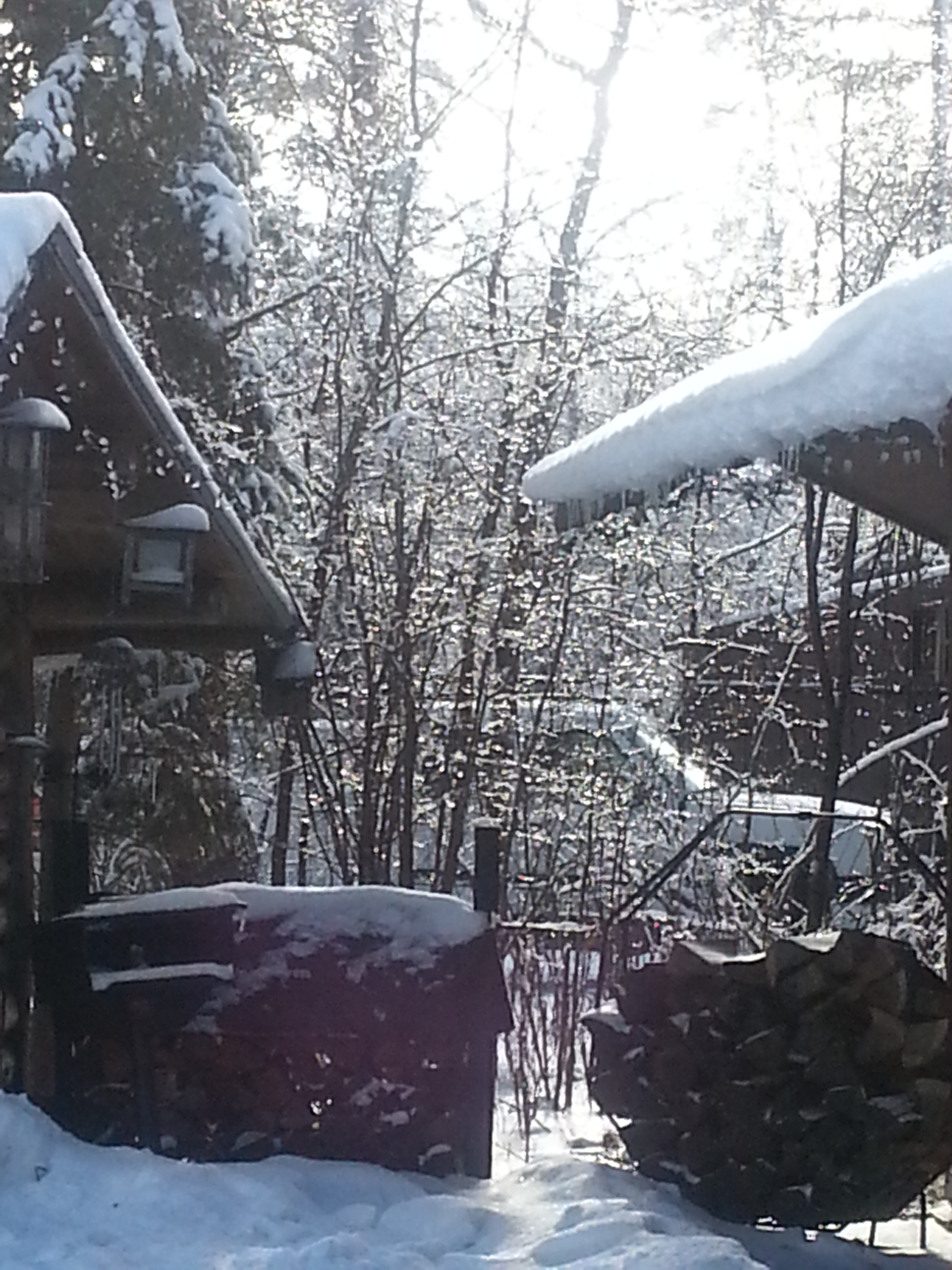
There is a lot more that could be said about Wisconsin winters and much of it is good and beautiful. I wish everyone could experience the felt safety and awe of watching a white-out blizzard from a warm, snug house. I wish I could adequately describe the way new snow glistens on the morning after, or the way light and shadows look completely different when the sun is low in the sky all day long. Snow really does crunch underfoot. The woods are really quiet when there are no leaves rustling and all the animals (almost all) are asleep. But it is cold, and extreme, and white, and beautiful in it’s own way for a very long time, and there are some who choose it for exactly those reasons (and some who tolerate it in spite of, just sayin’…)
My mother wanted this wonderful lady included in our family stories to make sure we remembered her contributions. She didn’t come into the family until most of us children were past the age of spending a lot of time with a grandparent. We knew her a little from seeing her at church and hearing about her at school – although none of us had her as a teacher. She did so much for my grandfather and helped him in a difficult time of life when he suffered from Parkinson’s. She was there when he died.
V for Vera
The Olsons were a Swedish family with nine girls (I know !!) – Esther, Hilda, Agnes, Ellen, Sigrid, Hilma, Bertha, Elvira, and Nina. Elvira Constance Olson or Vera, as she was known, was the next to the youngest of the nine. As the family got older and the girls married, the town became full of related families, the Petersons, the Johnsons, the Goruds, a regular Scandinavian mash-up. Swedish people always had the coffee pot on whenever guests arrived and probably even when there weren’t guests. Coffee at 10 and 2, like high tea, included bread, cheese, donuts, cookies, pickles… a real spread. It was hospitality and just what proper people did. It’s one of the pleasant things we remember about Vera.
Vera and John Boone at a family reunion around 1975.
Vera was 59 and Grandpa was 69 when they married. She was his third wife. Vera had been single until then, perhaps because she was the one who had been “elected” to care for the parents until they died. She was a teacher in an outlying country school until education was consolidated in town. She taught second grade for many years. She was a successful, independent woman who had her own house, her own car and her own money. Grandpa moved in with her at her house in town after their marriage. Even though farming was not her usual aspiration, she did go out to the farm with Grandpa and helped take care of that house too as it was being maintained by a bachelor who needed help of that kind.
Grandpa and Vera were well matched socially. They loved being with others and often got together for rousing games (crazy eights, ha ha). Grandpa loved to participate in fun and Vera’s family seemed to enjoy him. Vera was a fisher woman and it was also something others in her family did so Grandpa learned to add himself to the boat.
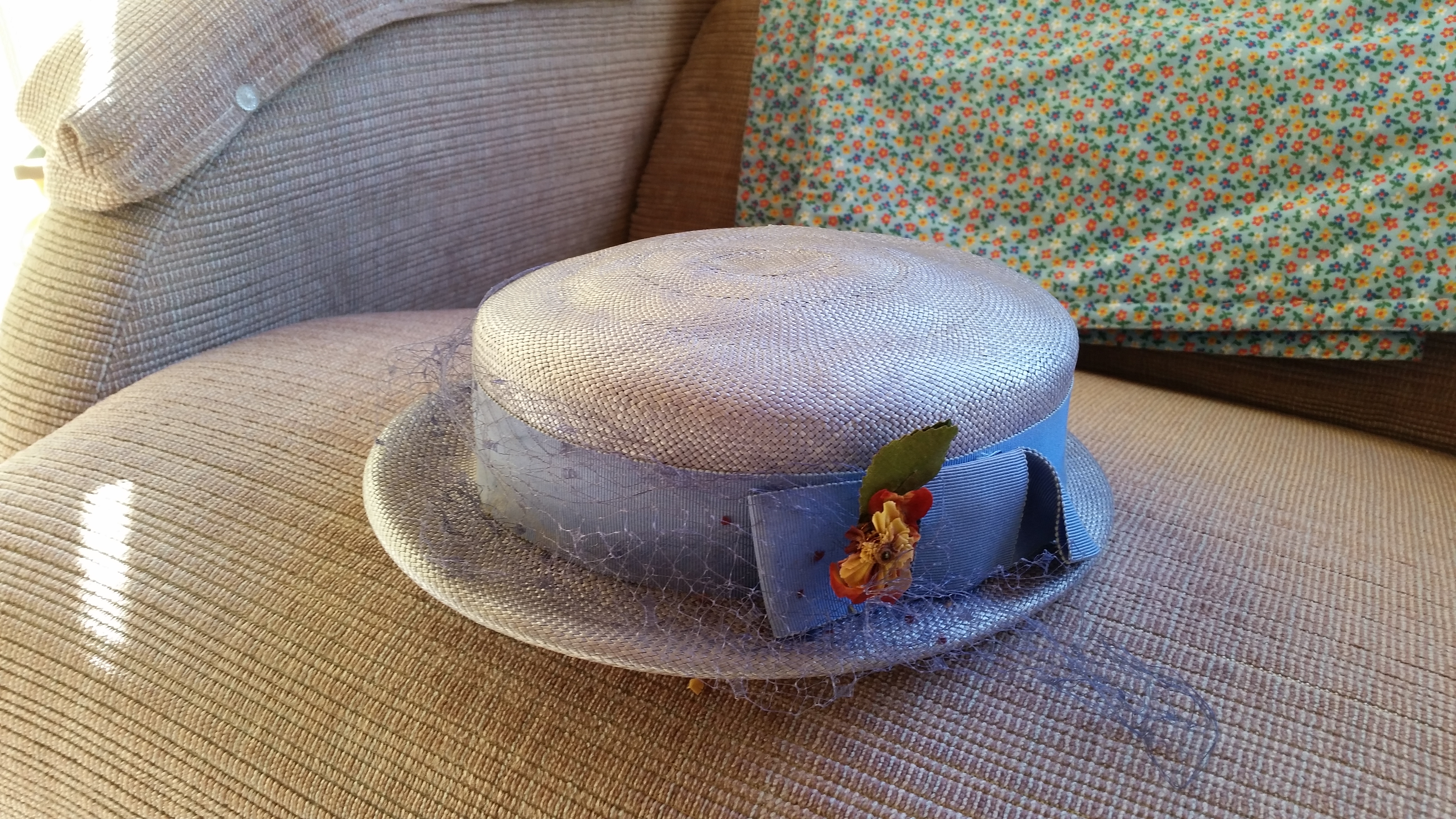
My memories of Vera were often in the setting of church. She was one of those ladies who dressed smartly and wore hats well. Mom helped to distribute the household after both Grandpa and Vera died. She was given one of Vera’s hats.
a “smart” looking hat, although years in the attic have made their mark.
She also remembers finding a small cedar chest full of doilies, tablecloths and linens of all kinds, again accompaniments to the coffee klutch way of life. I grew up knowing that term, coffee klatch, but was never sure where it came from or what it meant until researching this post. I found it had a German derivation having something to do with gossip, which I would alter somewhat in this case. Swedish hospitality, especially for Vera and her family was just sharing life and knowing each other, as all close families should.
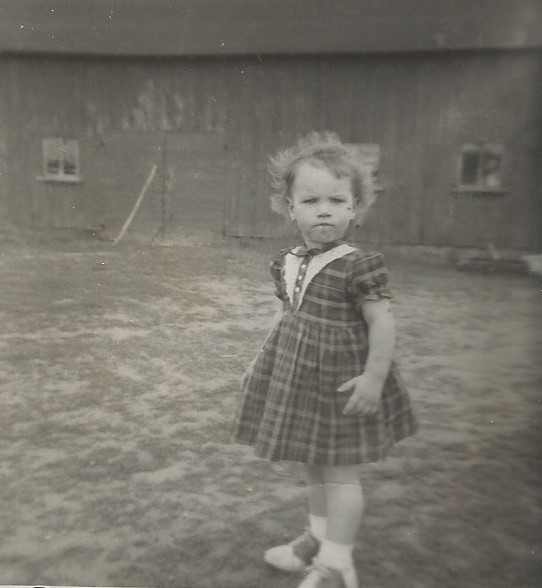
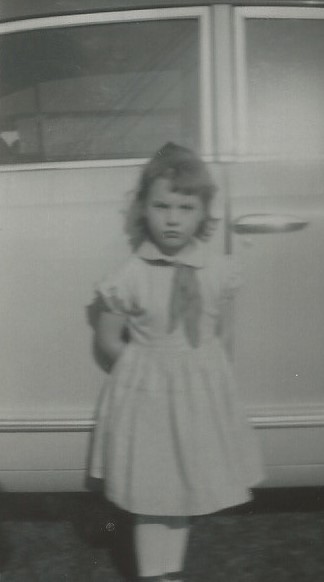
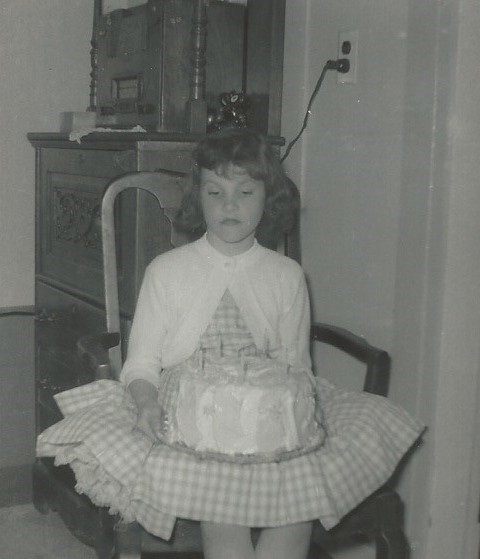
One of my aunts made a comment about me when I was young, about 5 years old. It was something on the order of “she is like a little old lady” – trying to describe a rather unchildlike, serious nature. I could have let that scar me for life, could have spent my days trying to prove her wrong but I decided I would keep on being myself and just grow into my nature. I have however, gone back into my childhood pictures looking for clues as to why someone would say something like that about me. What I’ve found is that I’ve been the victim of a conspiracy to present me, pictorially, in nothing by upset and unhappy moods. I’m still working on the motive…
They send me out to the barn to do chores… IN A DRESS… and are expecting me not to look upset?!Whatever it is, I don’t want to hear it. I’ll stand here but you can’t make me smile.What? Am I supposed to be happy? I’m a year older, a year closer to the grave. But I will face it bravely….Oh please, another birthday? Can’t you take a picture of me when I feel like smiling? Nice cake though.
All this proves is that pictures capture very brief moments when we don’t even realize how we look. You would not know from what you’ve seen that I am a overwhelmingly optimistic person, to the point of probably irritating some people with my “Pollyanna” viewpoint. Ok, I complain once in a while too but I try not to let my picture be taken when I’m doing it… just sayin’, it makes for bad press.
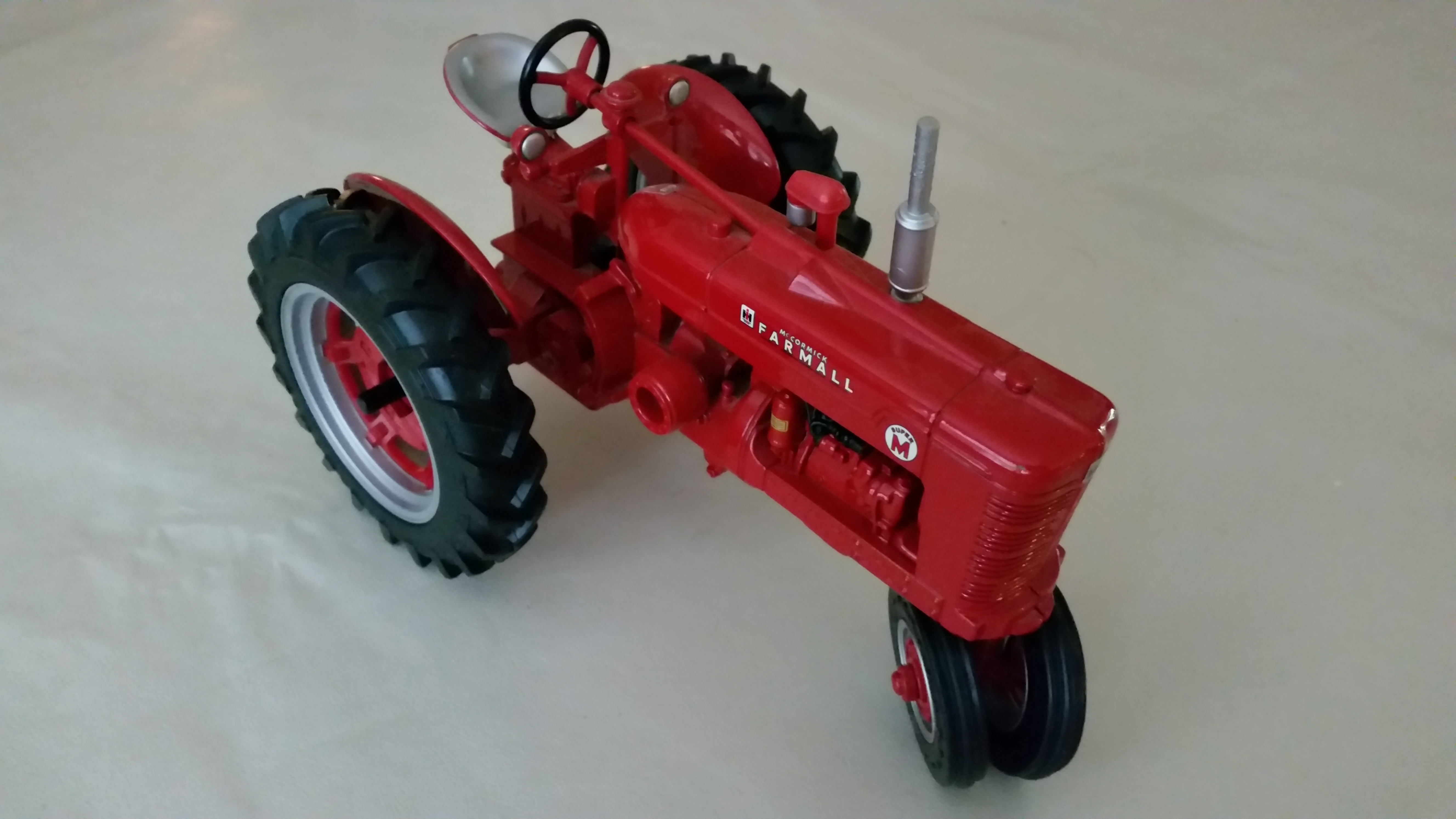
The symbol of power and efficiency on the farm – the tractor. We grew up watching our dad and the hired hands use farm machinery, and probably even more time watching them fix farm machinery, so it was natural that we longed for the day when we’d get to drive the tractor. Driving the tractor meant you were old enough to really help out. A mixed bag, according to my brother Ron (Stubby, at that time) since after he learned to drive the tractor, he had to drive the tractor, even when everyone else was doing things that were more fun.
One of our chores, before the days when hay was baled and shot into a wagon by the baler, was to go out in the field and turn the bales. They were round bales and if the grass was a bit green when baled, or if it had been rained on, the turning allowed more exposure to the sun for drying. Our first tractor driving lessons were always in the open field, pulling a wagon while “big people” walked alongside and hoisted the dry bales up in stacks. All we had to know how to do was push in the clutch and steer, and pay attention. Dad usually put it in the right gear until we learned how to shift. Since that season required all hands on deck, I got to help make hay. Other seasons, like plowing, planting and cultivating didn’t involve as many people so I didn’t get much of those experiences, but my brothers did.
I like all colors of tractors.
I probably inherited a partial tractor gene from birth. Dad had it for sure. His idea of shopping, according to my mom (who would know) was spending several hours in an implement yard looking at machinery. At first it was tractors, but as he got into the excavating business it was bulldozers, front end loaders and dump trucks. Unlike Dad, my version of tractor love involves less grease and gasoline smell. I appreciate the lifestyle behind the tractor, and the clean, solid feel of a well engineered toy. Don’t get me near a John Deere store. (Yes, I collect.)
Ready to gas up…
Even now, I am in awe of the work that can be done by a man on a tractor, whether it be plowing a garden or pulling a car out of the ditch. And every time the Smith men get together there will probably be some talk of “the Alice”, or the old “Massey-Ferguson” or the “A” or whatever letter-name tractor they liked best. Me, I stick to coffee table books, just sayin’…
My idea of a coffee table book. Call me “farm girl”.
Summer is very short in Wisconsin, but often there are a few day of blistering heat and few are prepared with air conditioning. The only good way we had to cool off was to go swimming and our summer life was defined almost as much by the swimming and the lake as it was by the farm. Because of the beautiful area lakes there was an active tourist trade. Summer meant the resorts were full, there were summer jobs of cleaning cabins and babysitting to be had, interesting people to meet, water skiing challenges, and weekend picnics at the beach with friends.
We claimed Round Lake as our own playground. The sandy beach called the Narrows was within walking distance and when we were young it was unregulated and frequented mostly by us locals. Situated on the narrowest part of a peninsula, there was water on both sides of the road, one side being better for swimming and the other side a little more rocky was mostly for boating. The water filling this fairly large lake was clean enough to drink, and very cold. It was our goal to try to go swimming or skiing by Memorial Day but most years, it required a wet suit to be comfortable.
a crude drawing of The Narrows and our Peninsula
Our usual swimming time during the busiest part of summer was evening, right after the last bale of hay went up into the loft – when everyone was still hot, sweaty and dying to get cooled off. Everyone would get into their suits quickly, often neighbor families would stop in on their way, we would load up inner tubes and truck ourselves down to the beach. Ritual dictated that each person run into the water until it got too deep and then dive in quickly. There was no other way to get used to the icy chill. After being in the water a few minutes we all seemed to “get used to” it and didn’t mind. As it got dark, the crayfish in the water and the mosquitoes in the air would get thicker until common sense dictated that we all go home.
There were always a few weeks when visiting relatives were around. My aunt, uncle and cousins from the city would bring their boat up and those were great times when we got to spend hours at the beach with them. My uncle would pull us water skiing behind the boat, always trying to scare us by going over big waves or turning tight circles. We all learned to ski slalom and some of the brothers even went on to kick off the skis and go barefoot. We all have stories about falling, losing our swimsuits as we tumbled in the water, or being dragged and nearly drowned as we tried to “get up”. Skiing is not for the faint of heart.
We would often follow the road to the end of the peninsula, where it curves around and almost forms a complete circle around a small bay. At “the point” as we called it, we would walk the sandbar and swim the channel to the other side. The trees on “the point” have initials carved in them and many memories were made there. I especially remember sitting there looking out at the lake and talking to my mom as we planned my wedding. I wanted to be married at the lake (however it was in January and there was NO SWIMMING.)
Years later my parents moved to a house on the lake. My brothers and I were able to take our families there often and my children have developed their own attachment to Round Lake. That house has been sold again several times but whenever I visit home we take a ride out Peninsula Road and dad makes me drive in to it so he can walk around and look out at the lake (don’t tell the owners please).
Oh yeah, lots of fun at the lakeMy girls and their dad enjoying a moment on the dock after a swim.
Everyone in our family has been to some fantastic beaches in the years since childhood but I think we all put Round Lake and our memories of summer swims right up at the top of the list of special places. We all go back and visit, and remember, and maybe you should too. Just sayin’…


 A lot of our social life as kids revolved around our neighborhood and our church. Every summer, soon after school was out, we headed to church camp for a week. We saved our own money to pay our way, and hopefully some extra to spend at the snack bar. We planned our wardrobes, we bought a new swimsuit and towel, we studied the list of things to take, we anticipated who else would be there. It was a big deal for us and one of the highlights of the summer.