#atozchallenge: Raspberries, the passion and pleasure

20160421_194041.jpg
Here they are, today’s star

I come from northern Wisconsin, and a particular part of it that is extremely cold for a good long time in the winter.  We have three months of growing weather in a good year. It can freeze yet in May and probably will in September so gardens go in quickly and get down to business. We can’t really do apples, or cherries or plums but berries…  We do them pretty well.
My first berry experiences were with wild berries. We were always on the lookout for bushes on the roadside or in the woods. Recently cleared fields and brush piles were likely berry patches. When we started seeing the right color on the berries it was time to get the pails and gear up.
There were all kinds of perils. There were bears, of course, and poison ivy, wicked thorns everywhere, a constant halo of deer flies and my most dreaded one, hornets. Long pants, long sleeves, big hat and a bucket on your belt in July meant we were hot and slow moving.
Thankfully, by the time I was married and living in Wisconsin again we had learned about cultivated berries and had a large patch in the yard. Much easier, but there were still chores every year – cleaning out the old canes and pruning. There was also the new problem of the guilt when you just couldn’t pick and eat that many raspberries. They are still my absolute favorite berry for eating fresh.
I don’t know how they do it these days since they are soft and perishable, but  my store has fresh berries almost all year long. Does anyone go out in the woods anymore? I don’t know. Your reasons to eat raspberries, in addition to their wonderful flavor, are a low calorie, high fiber, high antioxidant source with lots of vitamin C and B complex vitamins and a number of important minerals.  Interestingly, they are a source of xylitol which I will mention again when we get to letter X.  And they’re pretty.  And red.

Happy Letter R, my friends.

#atozchallenge: Somewhat Uncommon Q

There is an ancient pseudo-cereal called quinoa that is very nutritious, high in protein and fiber, with vitamins and minerals a plenty.  It’s not a true grain, not a grass plant, but a member of the amaranth family and although it cooks up much like rice it is a bit different.  I wish I was practiced at using it and knew exactly how to make it a part of a meal.  I don’t.  But I’ve had some recently and the whole experience was so good, I was willing to try to reproduce it at home.

20150709_204435.jpg
The Columbia Building

Location: high in the sky above Seattle.  It you view the Seattle skyline you will see one dark building that rises above all the rest.  At the top of the Columbia building there is an exclusive area for dining and communing and it is there that I found myself a guest, with my daughter.  You would have to say that she has friends in high places, very high places. I could hardly breathe, looking out the full view glass windows over the harbor and Puget Sound.  In order to calm down I had to purposely not think about where I was and what kind of structure was holding me up.

We were advised about the menu items and ordered vegetarian.  The dishes came out looking perfectly cooked and presented in very attractive ways.  Everything was delicious.  It was a wonderful, relaxing evening in every way (as long as I kept my mind off being 80 stories high and on the same level as jets approaching SeaTac airport…).

20150709_203933.jpg

The quinoa was light and fluffy in a creamy sauce – just wet enough to hold it together and make it easier to eat.  The flavor was mild and slightly of salt, like a good comfort food. I wasn’t sure how to  do this at home but a light cream/celery sauce with the quinoa did a pretty good job.  The food was really great but it had a hard time competing with the view.  Just sayin’…


20150709_185347.jpg
The quinoa is in the upper left, accompanied by asparagus and what may have been garlic mashed potato or cauliflower – I don’t remember which.  

#atozchallenge: Pineapple

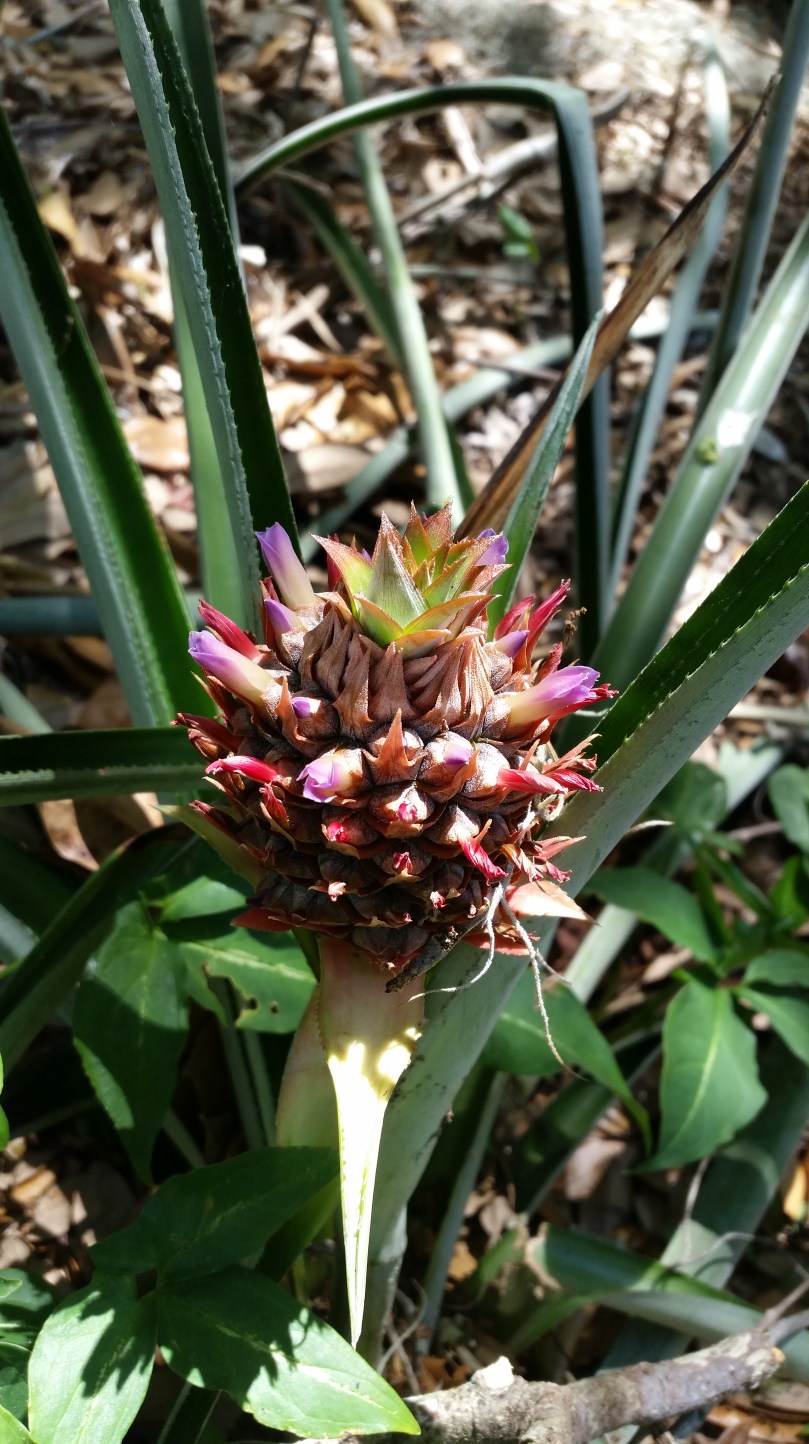
20160419_122041.jpg

I don’t do anything to deserve the many pretty pineapple plants (couldn’t resist the alliteration) growing in my yard.  They are such a forgiving plant.  I started with fresh pineapples from the store, once long ago, and have not bought very many since then.  The tops get cut off and if they are laid on the ground where they can touch soil, they will find a way to root themselves and survive.  They have a life cycle of about 18 months, so depending on when you plant, you can expect some to be coming ripe every 6 months. Right now I am seeing most of my next batch slightly past the flowering stage.  A few are big enough to be ready probably in June or July.  I do not water or weed, although I’m sure the harvest would be better if I did.

The taste of homegrown is exceptional – I rarely find pineapple in the stores that tastes as good.  As they begin to mature they turn yellow, little by little, and become fragrant.  This is when the critters in my yard start to gnaw on them.  I haven’t figured out how to protect the plants yet although I’ve tried a lot of things (wrapping them in cloth, putting cages over them, making sleeves out of plastic milk jugs…  nothing works).  I’m not even sure who the culprits are, but likely squirrels or rats.  Because I have so many plants, probably 3 or 4 dozen, I usually get enough for us to eat.  But I have to be diligent.  Nothing is more disgusting than watching a nice, big pineapple approach picking time and then on the day I go out to pick it, it is half eaten or lying on the ground picked clean.

This is what I’m getting when I eat my pineapples.  They are high in vitamin C, and B complex vitamins. They have some vitamin A as well.  They have a proteolytic enzyme, bromelain, which is a potent anti-inflammatory, anti-clotting, and anti-cancer substance.  They have a large dose of fruit pectin which is a soluble dietary fiber.  Round it out with good amounts of minerals – especially copper, manganese and potassium.

I just enjoy having my own mini-plantation of pineapples.

20160419_121956.jpg


#atozchallenge: Orange

Another departure from nutrition on this day dedicated to the letter O.  April is National Poetry Month. 

Great Grandfather’s Name

The warmth of orange, the rich shades of color

Taken from the sun, from reds and browns and yellows

And transferred to a child to be his name

What could his parents have wished that name would inspire


Could it have been a name from the land

That of an earl or duke from France

And why would that land be named orange

And why would the child inherit the name


Did the land in France, or some other faraway land

Grow the fruit, the tree named orange that takes

Color from the sun and the earth and makes that

Perfect, round fruit which shares name with the child


The child became a husband, a father, a grandfather

Who had children sit on his lap and wonder at

His beard, and the lingering smell not of orange

But of onion, the poultice for his maladies


Orange and onion, memories meld together

The family stories and the continuing wonder

Of why, and would he want to be remembered

For more, and doubtless he was but always

Also for the name, Orange Scott Warner.

©2016


#atozchallenge: Nuts

Writing is continuing to be hard today.  Between fits of coughing and the husband’s requests for records to finish filing our income tax, I’m going nuts.  We hate filling out our tax reports so much that it is almost assumed that we will be late and filing for an extension.  All those statements with tiny numbers and dates that are nearly impossible to find.  Maybe someone else should do our taxes.

As a treat for myself, knowing that this day was coming, I went to the big box store and bought myself some nuts.  And as a treat for my daughter who is getting tired of nutrition information, all I’m going to say is nuts are good for you, in moderation. It’s not like you can’t go look this stuff up yourself, right?

“Can’t you write a story about nuts?”  she wanted to know. And I’ve been thinking of the myriads of times in my life when nuts have figured prominently.

Back in the 70’s when I got married, Gourmet Magazine ran a layout about a wedding that I admired greatly.  It was very “flower child” oriented, woodsy settings, and a beautiful cream colored cake with several tiers.  And decorating the steps of the tiers were little meringue mushrooms and halved walnut shells.  The walnuts were probably in there somewhere too but it is the shells that I remembered. When the cake was refashioned for my wedding I think the walnut shells were replaced by small pine cones.  So much for prominence.

And much more recently, peanuts have saved me from traffic accidents. (I will slip in the fact that peanuts are legumes, not tree nuts, but they have similar nutritional benefits.) Driving home from work in the midafternoon became difficult for me.  My early rising and active physical work day left me quite tired and I would find myself sleeping at stop lights and perilously close to sleeping while moving slowly in traffic.  For probably a year, I would keep a 2 lb. can of peanuts in the car for those times.  I found out I could not eat and sleep at the same time, and although I often got rather sick from too many peanuts, I always made it home in one piece.

Back to the cashews, it seems lots of people like them.  It’s something about the consistency and the salty way they crush in your mouth.  Last year, shopping in Cambodia with my friends Mike and Trish, we found cashews in the Russian Market.  Somewhere in the middle of this vast place there was a candy and food vendor who had 1 lb.measures of cashews all shrink-wrapped up in shiny plastic and Mike decided to get them.  I was skeptical as I am a little fearful of eating from the Market.  Mike said they were pretty good and he didn’t get sick so my daughter and I went back later to buy ours.  The Russian Market is covered, very crowded, very little moving air and probably 100 degrees F. in the summer. Unless you live in it, it is very easy to get lost in the maze of similar looking booths and tables, meals being cooked on hibachis, children napping in corners. It is such an interesting place. We did finally find our cashews.  Mine were not as good as Mike’s.  I’m sticking to nuts from home. End of story.

20160416_161124.jpg
It’s only a 2 pounder – will be gone in no time at all.

#atozchallenge: M for Midway through

And also, sticking with my theme, MANGO, another fruit with a very large seed in the middle.  Mangoes are common in tropic and subtropical climates and have a season – usually January through August in the U.S. because they come from so many different places. They are actually the national fruit of India and several other countries in the east and middle east. The ones in my grocery store were from Nicaragua and Mexico.  I could grow them here in Florida (but I don’t).

20160415_115547.jpg
On the left, the more common type. On the right a different variety called Ataulfo from Mexico.

A really ripe mango is soft, juicy and I think very peach-like in flavor.  Under ripe ones can taste a little like turpentine, especially close to the skin. At full ripeness you can use them like any fruit in pies, cobblers, short-cake or sherbet.  But they are versatile enough to be used green, and I had them that way once in Cambodia. They were cut into spears and dipped in a spice/salt mixture like a vegetable.  Wasn’t bad, really, but very different.

They are a good source of Vitamin C, Vitamin A (that pretty gold color…), niacin and quite a few minerals.  There are different ways to cut them but I’ve pictured one that’s easy. Cut on both sides of the flat seed and then into cubes or spears. Even when not fully ripe, like the one I have pictured, I like to freeze them in chunks and use them in smoothies with milk, or yogurt, or orange juice or a banana or all of those things. There is no way to go wrong with a mango smoothie.  They are soooo good!

20160415_160206.jpg

Some people may have allergic reactions to the stems, leaves, sap, and skin of this fruit, typically a  contact dermatitis. If you are allergic to urushiol, the allergen in poison ivy, you may also have trouble with a similar phytochemical in mangos.  However, even sensitized people can eat peeled mango or drink mango juice.

That’s it for M.  We’re halfway through the A to Z challenge!  Everyone still having fun?

#atozchallenge: Let Us Eat Lettuce

I have returned from a journey, sick and hardly able to think about writing my posts. I am going to be brief.  There are two bits of nutritional advice that have meant a lot to me and they both apply to lettuce. So here goes…

Eat foods that will spoil, and eat them before they do.  We have so many varieties of good tasting but fragile greens available to us in our stores. It is sometimes difficult to eat them before they get limp and dried out, or wet and decomposing.  Do your best to plan but when your plans don’t work out – toss what can’t be cleaned up and used. Buy more fresh stuff.  Inevitably there will be some waste.

Always go for as much color as you can get. Color means a lot. There are nutrients that come with that color and more are being discovered all the time. We now hear about lutein, zeaxanthin, and other carotenoids in regard to eye health and macular degeneration. We hear about resveratrol in plants with deep purple color. There are lots more.  I had to laugh when reading on one website about how these nutrients aren’t essential to life like some of the major vitamins, but that they may be  important for good health.  So the question becomes do you just want to be alive or would you kind of like to be alive and healthy?

Dark green lettuces also contain vitamin A, beta carotenes, vitamin K, vitamin C, folates and a lot of needed minerals. Just eat a salad every day if you can, and consider that you can actually make a salad be the meal.

#atozchallenge: Kiwifruit

Kiwifruit is another fruit that is a berry, sometimes even called Chinese gooseberry. It grows on woody vines and originated in China. The major exporters of kiwifruit now are Italy, New Zealand and Chile. I had never seen a kiwi until the 1960’s when they were introduced to the American market. They are more common now almost everywhere.

They are about the size of a hen’s egg, have a brown skin which is edible but often gets peeled off. There are quite a few different varieties, with slightly different flavors but this is what we see available commercially.

20160406_150124.jpg
Fuzzzy brown skin and edible seeds. They are quite pretty.

They can be eaten raw, juiced or used for garnish.  They do have a substance that dissolves protein so are not usually used in gelatin or dairy desserts. They are highly nutritious, having lots of vitamins C, K and E in particular.  They keep fairly well. Firm ones will ripen at room temperature and will ripen faster  next to other fruits, even in the refrigerator.

If you’ve never tried kiwifruit, slice some up with strawberries, pineapple or whatever fruits you like in a fruit salad.

20160406_145632.jpg

#atozchallenge: Jammin’

20160408_122334.jpg
Raspberry jam, peanut butter, banana #favorite lunch food

Part of my food philosophy (a big part) is that any food can do a good thing for you if you eat it with the right attitude.  An extension of this is that eating a food that is not full of nutrients, on occasion, can still be good for you if it makes you happy (they’re called neurotransmitters and your brain makes them)  Mom and I tell ourselves this every time we have a cookie, and it also applies to jam.

Jam, almost any kind, is pretty, tastes sweet and a little goes a long way. Jam can be made from most any type of fruit, but most easily from those that are high in natural pectin. Pectin can be added to those not having enough of it naturally – it’s a product found in most grocery stores in the U.S. Gelatin can also be used and I will have a recipe at the end that uses it.  Jams are made with crushed fruit which is different from preserves where the shape of the fruit is preserved, duh…

It’s the process of crushing and cooking the fruit that releases natural pectins that thicken your jam, along with the sugar. Some recipes add natural pectin by including lemon juice and rind. The longer you cook it, the thicker it may become so you may need to experiment a little.  I love the frozen spoon test and the whole jam making method found in this link.(Click here to read )

Freezer jam is not cooked as long and has more of the nutrients found in the fruit and is more colorful and fresh tasting in my opinion. This freezer jam recipe has a surprise ingredient – tomatoes! You might not even notice they’re there. Surprise Raspberry Jam

You can make a lot of jam at once or as little as one pint jar if you have a small amount of fruit that might otherwise go to waste. It’s not hard, and fresh jam is so good in the morning with your toast, and your coffee (with half and half). Just sayin’…


#atozchallenge: The I Post

Iron.

20160408_103958.jpg

No not that kind.

The reason iron is interesting to me is that I know quite a few vegetarians and some vegans. I gravitate more toward that style of eating too.

Non-meat eaters need to be sure they have adequate circulating iron and iron stores in the body or they will experience iron deficiency anemia. Without iron to make hemoglobin, the blood can’t carry enough oxygen to properly fuel body cells. What it feels like is weakness, fatigue, inability to keep warm. It shows up as paleness in skin that should be pink.

The bad news is that plant sources of iron are of a form that is not easily absorbed by our bodies. A good deal of the iron in meat, about 40% of it, is a form that is easily absorbed which is why meats are a good source of the mineral.

The good news is that, amazingly, vegetarians and vegans do not have higher incidences of iron deficiency anemia. And no one, whether they eat meat or not, has to worry about it if they follow a few smart eating tactics with their plants sources of iron.  In fact, dried beans and green leafy vegetables are better sources of iron per calorie than meat. Here are some tricks that will help your body absorb it:

  • Combine an iron rich plant food with a source of vitamin C (absorb up to 5 times more iron)
  • Avoid drinking coffee or tea at the same time as iron rich foods (the tannins in those drinks block absorption)
  • Eat less at a time (your body gets overwhelmed with large amounts, as in supplements, and absorption is limited)
  • Cook with cast iron (really, get a well-seasoned iron pan and use it!)
  • Get your iron from a variety of iron rich foods (many of them already come combined with vitamin C – eat that broccoli!)

Here is the list of foods high in iron:

Beans, peas, lentils, blackstrap molasses, dried fruits, green leafy vegetables, potatoes, nuts and seeds, seaweed (kelp and nori), soy products, whole grains.

Click here for today’s iron rich, fast and easy recipe.  Spiced Carrot and Lentil Soup