If you were the missing wedding band, where would you be?
“His ring has disappeared. We can’t figure it out.” This was said by the bride to be as she sat in the kitchen talking with a few family members.
The explanation went on. They had purchased rings months ago, including the engagement ring, with his and hers bands – three boxes in a bag, put in a high place for secure, safe keeping. The boxes were all there when he went for the engagement ring. That was the most recent time anyone had made note. They became engaged in October and now it was May. The box was gone and no one who knew where it had been recalled doing anything with it. It was a mystery.
Searching had been extensive. So many suggestions and she had followed up on them with no results. If a thief had struck, would he not also have taken her wedding band?
With no time to solve the mystery, they went to the jewelry store and bought another band. Will it ever be found? Where do you think it is?
My niece is getting married this afternoon, outdoors in her brother’s back yard. I have traveled the three hours to my brother’s city where all this is taking place, to represent my family at the occasion. It’s been years since I’ve been at a family wedding and I’m aware that my status has changed. Instead of being involved in the necessary prep, I am an elder watching the busy-ness of the younger generation. I hadn’t thought of this as being the case before, and it’s kind of a nice surprise.
Even as I sit down to write in a quiet room, the mother of the bride comes in to take a few deep breaths and we talk for an hour, then the father of the bride also joins us and we talk. The bride comes in and needs to sit for a few minutes even though she has nothing to say. In the managing of a thousand details, people still have the need to step back and evaluate, to hear their thoughts articulated and validated. I get to listen and hear my family.
In the kitchen the groom’s cousin, a chef, is making sauces and marinades for the food. There has been much cooking, baking and tasting going on the past couple of days. It is a hands on wedding with the food being prepared by friends and family. It is also inclusive of a different culinary culture, the Hispanic Miami vibe being present in the background music, the exotic smells, the names of dishes being prepared.
A wedding story in the making.
Yesterday afternoon the decibel level went high in the kitchen and dining room as the friends of the bride gathered to do table decorations. Laughter, loud discussions, and the occasional episode of dog barking sent me looking for a place apart where I could observe and listen without being overwhelmed. Problems with the candles were solved, people were dispatched to pick up needed items. Everyone had a job or was given one.
A wedding story in the making.
When I did venture out I was assigned to watch the frosting on the stove top, which, according to the recipe was supposed to get thick and fluff. Counters were laden with food items and dishes. The sister of the bride was making the cake and stirring up generous amounts of butter, eggs, and flour. Nuts, pineapple, cherries, brown sugar – all this and more adding to the smells to be smelled and the flavors to be tasted. It seemed like each new person who appeared at the door had more food in hand. Throw in a small fire as parchment paper in the toaster oven burst into flames and you have an exciting kitchen.
I finally saw the place where I was comfortable making a difference – the sink full of dirty dishes. I know how to wash dishes. I am a part of this wild, family adventure. It is good.
Oh yeah, a place for someone who likes to wash dishes – me!
If you’ve been asking God to direct you in changing some of your life circumstances, and then change is suddenly presented to you, you’d best not say “no”. I’m just being practical here.
I’m on an early morning drive with three hours to think. It’s a holiday weekend with a wedding to attend. I’m by myself, which was not the plan.
Change started a couple weeks ago when the husband did some work which hurt his back. It’s gotten worse to the point where he is staying home, using a walker, and asking me for help putting on socks and shoes and other bending over activities. He moves at snail pace, not a young vigorous snail either. Although he had planned to travel to this wedding, this morning it was deemed impossible to get in and out of the car without further harm. He stayed home. I wonder if this is the beginning of change for us and I want to say”no!”
Yesterday my daughter called and said that she had a client who was interested in taking my horse. I’ve considered selling him because I have so little opportunity to ride or care for him and I know he is a financial liability for my daughter. It needed to be decided quickly, so I said yes. The only horse I have ever owned has now left the herd. But I know that this makes a much easier situation for my daughter, especially should she ever decide to move.
I have no idea how these two things would work together to answer my recent prayers that we be brought together as a family. Perhaps they won’t. But I am certain that God can be trusted to hear and work out what is best for all of us. With a mixture of excitement, and concern as to what part I am to play, I am waiting for the next thing. I’m saying yes, even before I understand. Maybe that’s what trust is…, just sayin’.
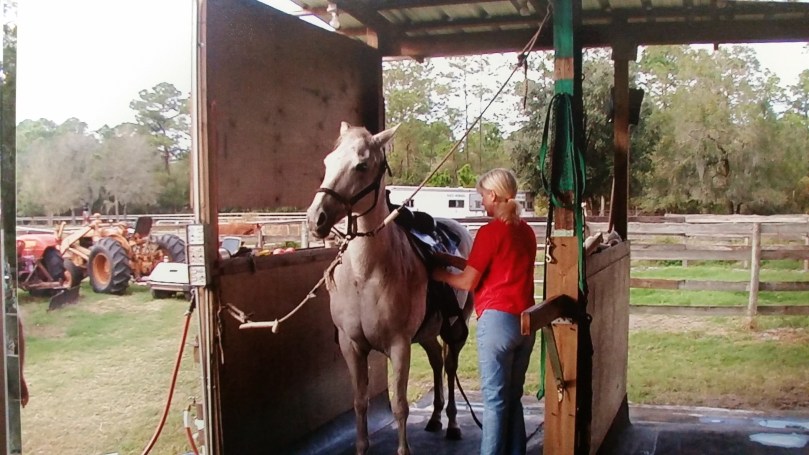
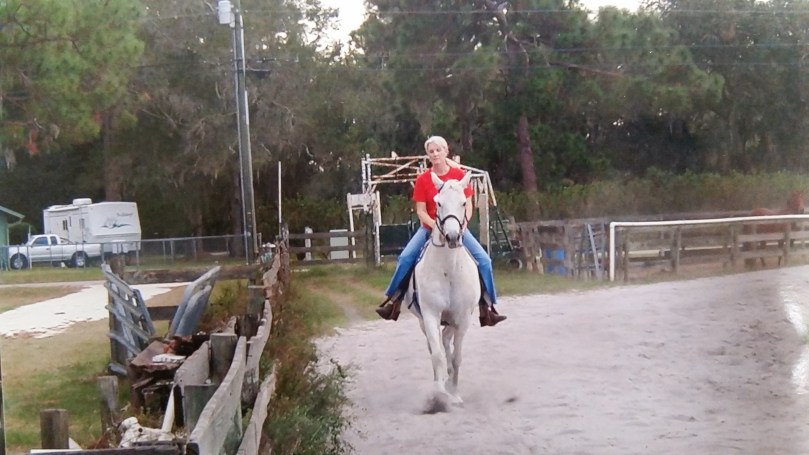
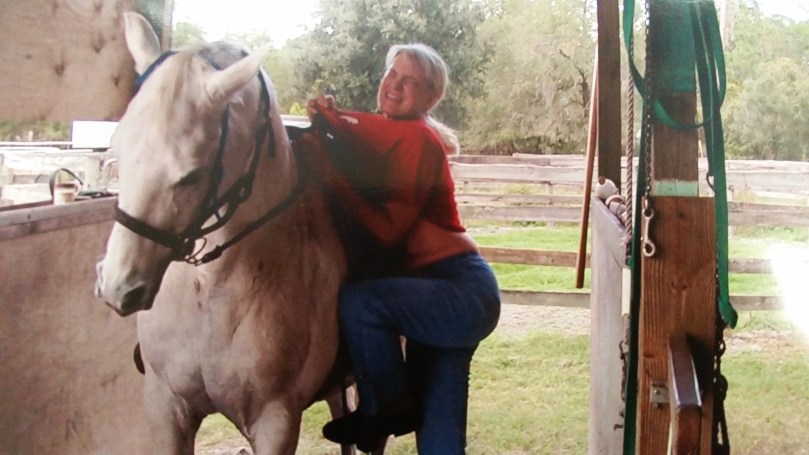
A visual sequence that brings good times and a great horse to mind…
Ghost want to go for a ride? No? This looks like a belt and I think I need it to be tight. Don’t be holding your breath now…Yeah, I’m on. Nice horsey, you knew that was going to happen so don’t act all surprised. Nice horsey, let’s go.Round and round the track we go – you lift your feet so pretty and I haven’t fallen off. We’re good.We are so cool, and I am still firmly in the saddle. Let’s keep it that way, thanks.You are so pretty and white. I am red and blue. We look so red, white and blue together. I make you look good, don’t I? Smile for the camera please.Good ride Ghost. Now let’s get back to the barn before something bad happens…Whaaa!!! Getting off is supposed to be the easy part! Gimme my shirt back!That was embarrassing. I’m outta here. Don’t pretend you’re sad.
I really do have fun riding and am not quite as fall phobic as I make myself out to be. And Ghost was always a good horse. RIP 5-11-2016
I have a closet full of clothes. Some of them I wear almost every week. Some of them I haven’t worn for a long time but I have memories of them as favorites, or I have memories of how much I paid for them that keep me from giving them away. Since I am engaged in the long term project of downsizing, today I decided to wear a dress and make a decision. Does it go or does it stay?
This has been a good day to wear a dress because I intended to stay inside and write. A dress is good for writing. There isn’t a lot else to be done in a dress, comfortably. I often wonder how our pioneer ancestors walked across the country in dresses, not to speak of all the things they usually wore under their dresses to complicate things. I know some of them probably put on a pair of pants if they could find some to fit, but I’m also thinking that pants might not have been all that great back then either.
So, in my dress, which I bought at a garage sale a couple years ago, I sat and wrote all morning. The writing was productive and the dress kept me from getting distracted and going outside. But I gradually got the “knowing” feeling. The dress was not “me”. I took it off and put it in the box to go to Goodwill. It was a useful exercise in paring down.
If I had fewer clothes I would have fewer decisions and wouldn’t that be nice?
Love, whether or animals or people, involves risk. Let me amend that, love involves the certainty of pain and eventual loss, always. Because we know that, every moment that we spend with each other or with a “quasi-human” pet should be filled with awareness and appreciation of life. Over a lifespan, the love we enjoy far outweighs the pain of separation. It leaves us enriched, more experienced, and better able to process what we know will come.
For some reason many of us as children were fascinated by the idea of sitting on a horse. Our mothers set us up on the horse of our choice on the carousel. Maybe we got to ride a real pony around in a circle at the fair. We read Black Beauty, and watched My Friend Flicka. I did all these things. So did my children.
For many of us the fascination wears off. We discover that real horses are bigger than we thought, and stronger than we knew, and less inclined to be caught and gently led, let alone ridden. But for some, like my daughter Julia, the dream goes on, and if horse ownership is denied for lack of money, time or any other practical reason, the dream builds pressure until it explodes. And so, a horse entered the life of our family and had effects that are still in operation today.
Julia, her sister Esther, and I had ridden and worked at a small stable in northern Wisconsin for several summers when the owner brought in a new string of horses she had bought in Minnesota. They had to be ridden a lot and carefully gauged for their trustworthiness before any of the “dudes” were put on them. The owner, Miss Lolly, had one that was her favorite – a nearly white quarter horse mare she called Ghost. She rode her most of the time but occasionally one of her better outriders were asked if they wanted to try her. That was the summer Julia fell in love with Ghost. The next year she bought her, one payment at a time, with her own money.
Julie and Ghost in their first parade, Hayward, Wisconsin.
Logistically, it was crazy. We had moved to Florida and had no place for a horse. So Ghost lived in Wisconsin on Lolly’s farm and she and Julia continued to work together in the summer. But the time came when school and work made the summer trips up north shorter and Julia missed her horse. It was time for Ghost to come to Florida.
We knew little to nothing about trailering a horse over that distance. Our borrowed one-horse trailer was hitched behind a mini-van, of all things, and I have pictures of our travel arrangement that make me wonder how we ever made it. The roughly 30 hour trip had one overnight, as I recall, and lots of stops where we would check on Ghost’s water and hay. Only once did we actually take her out of the trailer briefly and let her walk around at a country exit off the interstate. I think we were worried we wouldn’t be able to get her back in.
Ghost with the new filly Fea.
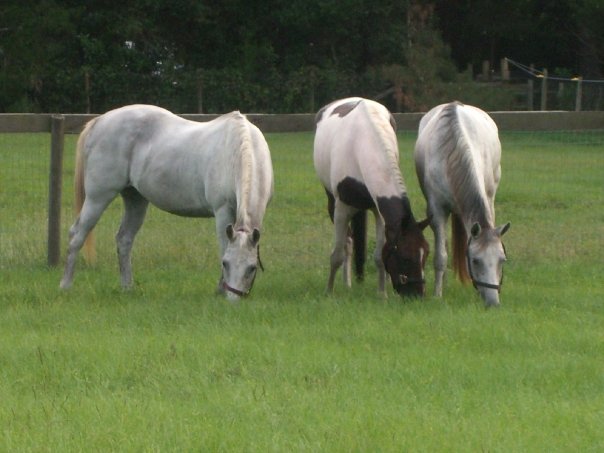
She made it to Florida and to Springrock Farm where she spent a number of years with J.C. Barnhill watching over her. Julie’s regular trips to care for Ghost benefited the horse but also furthered Julie’s interest as she learned how to trim hooves, care for horse teeth, and feed and exercise horses. One of the biggest surprises was when it was discovered that Ghost had come to Florida in foal. Rocker, a pretty paint colt was added to the family. Several years later Ghost was bred to Barnhill’s thoroughbred stallion, Officer, and had a filly. Julie named her Fea, and although she came out brown, she soon was the spitting image of her mom. The family was a herd of three.
Left to right: Fea, Rocker and Mama Ghost in festive dress.
The family spent time at several other properties as the years unfolded, always necessitating Julie to travel daily to watch over, feed and ride. They were her charges, her dependents. Her knowledge and interest in veterinary care of large animals increased and ultimately led her to enter the DVM program at UF, Gainesville. Ghost and the family moved to a small farm there for four years. The next move was to Jacksonville, FL where Dr. Julia began her job with Jacksonville Equine. At the small boarding pasture where her herd now lived, Dr. J. had to deal with Ghost’s problems of advancing age, especially weight loss and inability to compete with other horses for feed. The last few months were a triumph for Ghost and Dr. J. as Ghost was healthy, energetic and looking well nourished. Only a few weeks ago Dr. J. and some friends took her on a trail ride with Rocker and Fea and all did well.
We’ve all heard of the benefits of having pets. There Is even more to a long term, committed relationship to the care and welfare of an animal. It is much like parenting, in that patience is learned, along with so many other skills. Love is practiced through good times and bad. Faithfulness has its demands for both owner and animal. Those demands, decisions and courses of action can be stressful and sudden.
A week ago Ghost had a medical emergency, colic, another name for equine bowel obstruction. It could not be resolved with initial treatment and Dr. J. took her quickly to the UF vet hospital for diagnosis and ultimately, surgery. Given every chance, Ghost was still unable to survive. She has been laid to rest in a quiet corner of her pasture and will not be forgotten.
Ghost, may you be in pastures where the grass is always green and fresh…
I have a talented daughter who is an equine veterinarian. Although I am a registered nurse for people, she occasionally allows me to ride on calls with her as she treats animals. We have adventures. I call myself VetMa. (OK, it’s a bit dramatic. So what?)
I heard the gathering of supplies and the phone conversation as I was waking up. There was no time for breakfast. We were on the road within minutes. It was Saturday morning and the weekend had officially started.
An animal loving family had been nursing their mini calf during the last week. It had been seen by vets locally and at the University. It had been doing well and was being stalled in the house, in the bathroom. At midnight, the night before, it had been standing, chewing calmly on some hay with no apparent problems. This morning the family found things quite different. They were afraid it might be too late.
The scene was not encouraging. When the Doc arrived the calf was lying on the living room floor, swaddled in blankets with a heat lamp on it. A worried looking husband and wife gave her the story. They had found the little animal unresponsive, barely breathing and looking near death. They had no clue what had happened.
A mini calf is about as big as a medium sized dog. The woman was stroking his head, holding it to keep his airway open. The preliminary exam showed a temperature too low to register on the thermometer, unusually cool limbs, barely audible heartbeat and respirations so diminished they were hard to detect. Its eyes were open and glazed. The only sign of life was an occasional struggle and agonizing cry.
The doc is not only an animal lover herself, but also a very compassionate people person. She always tries to give people options even in the most critical looking situations. There weren’t many options to give in this case. There was no apparent course of action and it was doubtful the little guy would survive another trip to the university hospital. She offered to try to decompress the bowel, in case there was a blockage of some sort and talked with the owners about euthanasia as well. She went out to the truck to get her equipment ready should they wish to have treatment. The man came out a moment later with tears in his eyes to say they did not want their animal to suffer any longer.
Hearts break when a precious animal suffers. It is part of the risk of ownership of an animal, that it will get sick or hurt and suffer. A good doc gives owners as much information as possible to make responsible decisions about the care of their animal. Making the decision to not let suffering continue when nothing can be done is difficult but there is also a peace and a feeling that the decision is the right one for the animal. A caring veterinarian helps clients through these times, being as kind, gentle and humane as possible. And that is how the first call of the day ended.
Euthanasia is not something a veterinarian enjoys, but it is part of the job. It is heartbreaking. Every time.
I have a talented daughter who is an equine veterinarian. Although I am a registered nurse for people, she occasionally allows me to ride on calls with her as she treats animals. We have adventures. I call myself VetMa. (OK, it’s a bit dramatic. So what?)
It was Thursday evening, the first of the long weekend on call. It was getting dark. As often happens two emergency calls came in at the same time, but this time the triage decision was easy. The horse with the eye laceration would have to wait, because the one with the heel bulb laceration would not. The heel bulb is the area directly above the hoof of the horse and in this case, the owners reported fairly heavy bleeding. An artery had likely been severed.
The horse was standing in the driveway surrounded by a small crowd of people. A blood soaked wrap was around it’s left front hoof and ankle. It became apparent that there was no lighted barn in which to care for the horse, not even a floodlight over the drive so cars were pointed with headlights shining on the horse.
Almost all work done on large animals that involves pain, requires some degree of sedation and although this patient was standing fairly quietly, he would definitely need something for the treatment ahead. Just like people, animals respond differently to sedatives. The doc estimated the animal’s weight and gave a starting dose before cleaning the wound. As it began to take effect, the bandage was removed.
Lacerations in this area are always going to be contaminated and prone to infection. This one was in the fleshy area in the back of the bulb and there were arteries involved. Just cleaning and examining the area was difficult – a tranquilized horse has trouble standing on three legs so holding it’s leg up in a convenient position proved impossible. Our doc decided to let the horse stand on all four while she worked. That meant working in an unexplainable position close to the ground, nearly under the horse, in the dark with flashlights to guide the way.
The perfect conditions and position for suturing, not.
The area around the laceration was blocked with local anesthetic and scrubbed clean. As the horse shifted its weight the laceration would open and close, each time making the small arterial bleeders spurt blood. It was difficult to see where to tie them off, but little by little the laceration was closed and the bleeding stopped.
While the tranquilizer was still in effect, the doc wrapped the ankle in batting and layers of gauze. A fiberglass cast was applied like a small boot to protect the area and allow the horse to stand and move while the cut healed. As the crowd dispersed, the doc gave instructions for care and dispensed antibiotics (and stretched her aching back).
All fixed up with a small boot cast.
It was back in the truck and on to the next call. Fortunately, the horse with the eye laceration was at an equine event where they had found another vet who was a participant. He was willing to stitch up the laceration so we went home, hoping for a quiet night.
I don’t remember if I did this when I was a child or if others did it to me, but, the memory is there of orange peel being squeezed in my face and of feeling the light, stinging spray of citric acid -my first introduction to citrus zest.
Zest is a great word meaning to enjoy something keenly, with relish, and also a pleasant flavor or exciting quality – that is why it is applied to the outer peel of citrus fruits. The white part beneath, called the pith, is often bitter but the outer peel or flavedo is full of flavor and is used in many ways.
You might find it in orange marmalade, lemon flavored baked goods. I like to keep a lemon in my freezer for recipes calling for lemon zest. A fine grater or special zesting tool can be used to cut the peel. It is often used as a garnish too because of its bright color and full flavor.
Another use, and one of my favorites, is in citrus essential oils. Here is your trivia for the day; when cold pressed, it requires 3,000 lemons to produce a kilo of lemon essential oil. The chemical constituents in this oil, the list is too long to include, have anticancer, antidepressant, antiseptic, antifungal, antioxidant, antiviral, astringent, invigorating, refreshing and tonic properties. All of which might make you think that we should be eating the peeling, not just the lemon. It works for me to put a few drops of the oil in my glass of water.
The next time a server in a restaurant asks you if you would like a slice of lemon in your water or other drink, you might have a good reason to say “yes, please”. Just sayin’…
My food choice for Y is yogurt. I have been eating a lot of it lately since doing a round of antibiotic. It is made with a lot of active bacterial cultures (good ones) that are naturally found in our intestines and which are a vital part of a healthy immune system and digestive system. Because it is more economical I have developed my own way of making yogurt at home. Here is how I do it.
I start with a gallon of 2% milk. Any milk will do but the fat content will make a difference in your finished product.
On the stovetop I heat the milk to 190-200 degrees F.. I have a thermometer which clips to the side of the pan and I watch it closely. The milk needs to be stirred so it doesn’t burn on the bottom of the pan. I don’t let the milk boil.
Heat it slowly, watch and stir (in other words, don’t leave the kitchen or you will have a real mess…)
As soon as the temperature is reached I put the pan in the sink with ice water to cool it down quickly. The thermometer is still on the side of the pan and when it reaches 90-100 degrees F. it is cool enough.
Those are ice cubes, not little fish. The cooling is fast.
Add 3 tablespoons or more of yogurt that you have bought as your starter. It can be any brand that states it has live, active cultures present. Choose a starter that you like because your yogurt will be similar. Stir the starter into your gallon of prepared milk.
I like to transfer the milk to a heavy bowl (I use the removable bowl from my crock pot) that will hold heat well. Cover it and place in a consistently warm place for 7-8 hours. Suggestions for the place: your oven if it has a light that you can turn on. The light bulb will produce enough heat if you keep the oven door closed. OR if you have a water heater in a closet put a towel on it and set the pot on the towel OR put a heating pad set on low on your counter and the pot on top of that with a towel over the whole thing to keep the heat in.
Do not turn on the oven! Just the light.
After 8 hours, the yogurt should have curdled. I like to separate the curd from the whey (which makes Greek yogurt) by taking a large colander which I line with cheesecloth and setting in a container to catch the whey. Pour the yogurt into the colander, wrap the cheese cloth corners over the top, place a plate over it and put something heavy on it to press out the whey and put it in the fridg. Let it set for several hours. The longer you let it drain, the thicker it will be. You can always stir some of the whey back in if it gets thicker wanted.
Enjoy your homemade, unsweetened yogurt with fruit, cereal, or as a spread like cream cheese. It has a milky, soft flavor with just a little tang.










 I don’t remember if I did this when I was a child or if others did it to me, but, the memory is there of orange peel being squeezed in my face and of feeling the light, stinging spray of citric acid -my first introduction to citrus zest.
 My food choice for Y is yogurt. I have been eating a lot of it lately since doing a round of antibiotic. It is made with a lot of active bacterial cultures (good ones) that are naturally found in our intestines and which are a vital part of a healthy immune system and digestive system. Because it is more economical I have developed my own way of making yogurt at home. Here is how I do it.


 I Just Have to Say...