My post on figs triggered a memory in one reader – a restaurant under a fig tree in Portugal! They actually have to warn patrons about the falling figs, and I would suppose if one falls on you it would be yours to eat. They look delicious as you can see in the tiny picture, bottom right.
Thank you Joy! You are a delightful, interactive reader. Just sayin’…
As you may have noticed by now, this alphabet challenge is about a lot more than the alphabet, a lot more than practicing our writing, a lot more than seeing if we can post something consistently for a month. If you will treat it as such, it’s like a month long party with chances to meet and get to know a very eclectic bunch of people. And you can go in your pajamas… How sweet. I hope everyone is enjoying the interaction. I sure am.
A “figgy” picture of two different kinds of dried figs that are commonly available.
If you’re like me and didn’t grow up in a warm climate, your only exposure to figs was a cookie called Fig Newtons. Since growing up (getting bigger anyway…) spending time in California and Florida, I now know that a fig is a fruit about the size of a plum that grows on a small tree or bush and is part of the mulberry family. It can be eaten fresh but since it has to ripen on the tree and doesn’t keep for very long, it’s most often encountered as a dried fruit, a lot like a prune. There are a lot of different varieties with differences in flavor but because they are so perishable you won’t often find them unless you grow them.
The taste of a fig is very mild and that is probably why we see them dried more often than not. Drying concentrates the flavor and makes it more distinctive. The dark ones I have pictured are the variety called Mission figs and the lighter colored ones are California figs. Organic is a good choice, as with any product where you are eating the skins and all.
Nothing too remarkable in their appearance – most dried things are not lovely – but the fruit before being dried is very interesting. Figs can be grown in most any temperate climate. I have been trying to grow figs in Florida, which is not exactly temperate, but even here they survive.. To pollinate and have true seeds they need the help of a little wasp that we don’t have in North America but the plant will produce fruit even without that pollination. Summary: they are easy to grow but do better in loamy soil with adequate water and some pruning. If you don’t get fruit, be patient, it could take a few years. One tip I read for plants that don’t fruit is to add lime to the soil. I need to do this and to prune in the dormant season.
Ooops, missed the dormant season – my fig is already budding out.
Eat figs fresh in salads, or as table fruit. Use them dried on your cereal, in soups, stews, to enrich poultry or lamb, and in baked goods. Here’s a favorite recipe that use the dried figs you would normally find in most grocery store. Give it a go! Fig-Bran Muffins Or, you could always go and buy some Fig Newtons… just sayin’.
Chicken eggs, primarily. Eggs are probably the easiest protein to add to a quick meal, anytime of the day, but certainly for breakfast. They have survived seasons of being bad mouthed for their cholesterol and for harboring salmonella and are presently in pretty good standing.
The marvelous thing about an egg is the balanced pairing of a protein and a fat along with other nutrients in a shell designed to take pressure fairly well. This thin layer of calcium allows the collection, cleaning and transport of eggs, not to mention being pushed out of, sat upon and walked over by the chicken. Packaging genius!
I love that eggs go from raw to safely cooked in practically no time at all. Almost any way you want to apply the heat works well. But there is something to avoid in cooking eggs, that is high heat. Egg protein, which is the clear part that turns white, is denatured by high heat and becomes plasticized.. Don’t walk away from the stove when your eggs are cooking because there are only a few seconds between runny/disgusting and hard like rubber.
I don’t know why people think brown eggs are healthier since brown is only the color of the shell, and we don’t eat that, right? However, anyone who has ever raised chickens knows that chickens who have a happy life running around eating greens and catching bugs have eggs that look markedly different on the inside. Nutritionally there will be a difference. To see exactly how much difference diet can make in the amounts of saturated fat, cholesterol, and vitamins in an egg, you can visit the website Egglands Best and look under health benefits.
Outside shell color says nothing about what’s inside, trust me. Just from a different kind of chicken.
Just so we’re clear on terms, cage free is a step better than eggs with no other delineation, but it still allows for large scale chicken houses where crowded conditions necessitate giving antibiotics. Organic will mean that there are no additives of this kind and usually friendlier living conditions for the birds. And there is a lot to be said for having your own small flock, letting them roam free in your garden (great insect control, btw) and gathering your own eggs. Many urban communities do allow backyard chickens, roosters prohibited for obvious reasons, however, we are not all so blessed.
I was able to raise chickens when we lived on a farm. Sometimes a hen would lay a whole clutch of eggs in some out of the way place. There might be a dozen by the time I found them and they would still be okay to eat, but if you don’t know where your eggs are coming from refrigeration is best. Eggs will be considered “old” after three weeks but still may be safe to eat past that point. Older eggs are easier to peel when hard boiled while fresh eggs will be more difficult. Many people say that adding a tablespoon of vinegar or lemon juice, or a tablespoon of salt and ½ tablespoon of baking soda to the boiling water helps the peel come off easier.
My latest egg cooking experiment was to use my muffin tin, an egg still in the shell in each cup, and roast in the oven for 30 minutes at 350 degrees. The result was like a boiled egg but the husband pointed out the not-so-efficient use of energy. The best method of hard cooking in the shell is to place in pan with water to cover by an inch, bring to a boil over high heat, turn off the heat and let sit for 15-20 minutes and then cool quickly in ice water.
You can also poach eggs (for a somewhat different but good taste experience), scramble them, fry them, or use them in a variety of recipes – the information on them would fill a book. I don’t want to overwhelm you, just sayin’… Just eat them.
The topic today is dandelion. Yes, the little yellow flowers that your kids pick for you in the spring if you’re lucky enough to have a yard, dandelion. But not the flowers, the leaves.
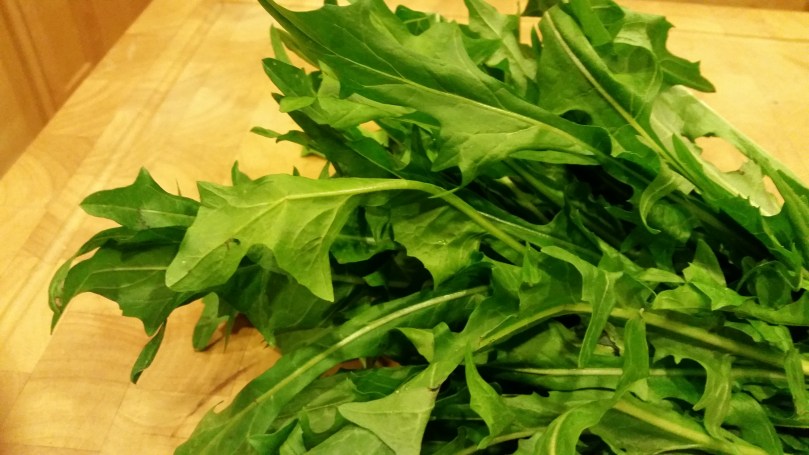
Gorgeous, healthy color. You know there have to be vitamins in there.
I’m writing about them not because I cook or eat them very often. It’s because they are part of the husband’s Pennsylvania Dutch heritage – wilted greens- and because he loves to tell everyone about their French name (story #47 of his). This plant is really kind of marvelous in it’s medicinal properties and was actually listed in the U.S. Pharmacopeia as a diuretic until 1926. It’s been a part of folk medicine in many eastern countries. Nutrient-wise, it’s one of the top four of all green vegetables, and in the top 50 of power herbs. Who would have guessed?
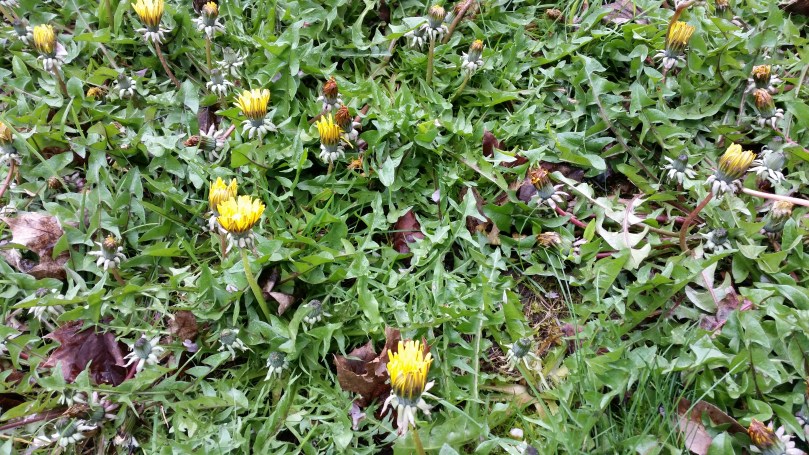
Seriously, they grow everywhere I’ve ever lived, and that’s a lot of places.
I am so impressed by everything this plant contains, and by it’s ability to survive almost anywhere. My theory is that God made this plant with lots of what we need and put it where we could find it easily because we might need it someday. All parts of it can be eaten. The root is being studied because of its cancer fighting properties. I could go on, because reading about it makes you want to go out and get some NOW, but look at this:
1 serving provides this amount of RDA (recommended daily allowance)
9% dietary fiber
19% of vitamin B-6
20% of riboflavin
58% of vitamin C
338% of vitamin A
649% of vitamin K
39% of iron
19% of calcium
and a lot of antioxidants, including lutein and zeaxanthin
And since I did find some in the grocery store this week, we are going to eat wilted dandelion salad tonight. I will cook up some beef bacon to flavor the greens, wilt them and serve over potatoes.
Okay, I won’t go into all of story #47 but the word dandelion comes from “dente de lion” or tooth of the lion which is the pointy shape of the leaves. And “pissenlit” is French for wetting the bed, and that could happen if you eat too much dandelion. Just sayin’…
Feuilles de pissenlit – just a name, or a warning?
I am a big supporter of FOOD. I think it is absolutely remarkable that everything we humans need to live and be in health is found on this planet. It’s almost like it was made for us. In fact, it is exactly like it was made for us. I have never been a food blogger but I have done a stint teaching nutrition for the University of Florida Extension Service. I learned a lot and it was fun. I think I can share some of the fun and interesting things about some of my favorite foods – one each day during this A to Z Challenge. All these foods have some kind of health advantage and most of them are nutrient dense and very good for you. Today, it’s celery.
Look! They’re even shaped like little C’s. A plant with such interesting structure, you have to love it!
.It wasn’t until I started noticing my blood pressure rising that I got serious about eating celery. Before that it was chopped up in soup once in a while or on the veggie tray with other stuff and dip, of course. Now I buy several bunches at a time and always have it cleaned and conveniently ready. It contains a chemical called 3-n-butyl phthalide (you won’t remember this but when it has a name it’s more real, right?) which smooths the muscles in blood vessels, creating better blood flow and a lower pressure. Studies have shown this to be true. My own experience is that it lowers my systolic pressure about 10 points (but this is not a guarantee for everyone). About a cup of chopped celery a day should give results. (http://www.drdavidwilliams.com/foods-that-lower-blood-pressure/)
It’s cool, crunchy, wet and a very pleasant color when it’s fresh (please don’t let it sit forever in the fridg drawer, please…) And you don’t need to do anything fancy with it – just eat it. It’s quick and ready so keep it simple.
*** Important edit! Please do not forget how important and upgrading peanut butter, raisins, or Ranch dressing can be to celery if you don’t mind the added calories. Thank you readers!
Snack time. (Ok, you can have just a tiny bit of dip.)
These yellow fruits grow in my yard, the oneacrewoods, because we have a subtropical climate. They do not like cold weather though, and sometimes a freeze does them in completely. The plants pop up from rhizomes (called a corm) in the ground. Certain types of shoots will produce fruit and others won’t. They need a good gardener. They also need a lot of regular watering and lots of feeding. They are hungry and fast growing.
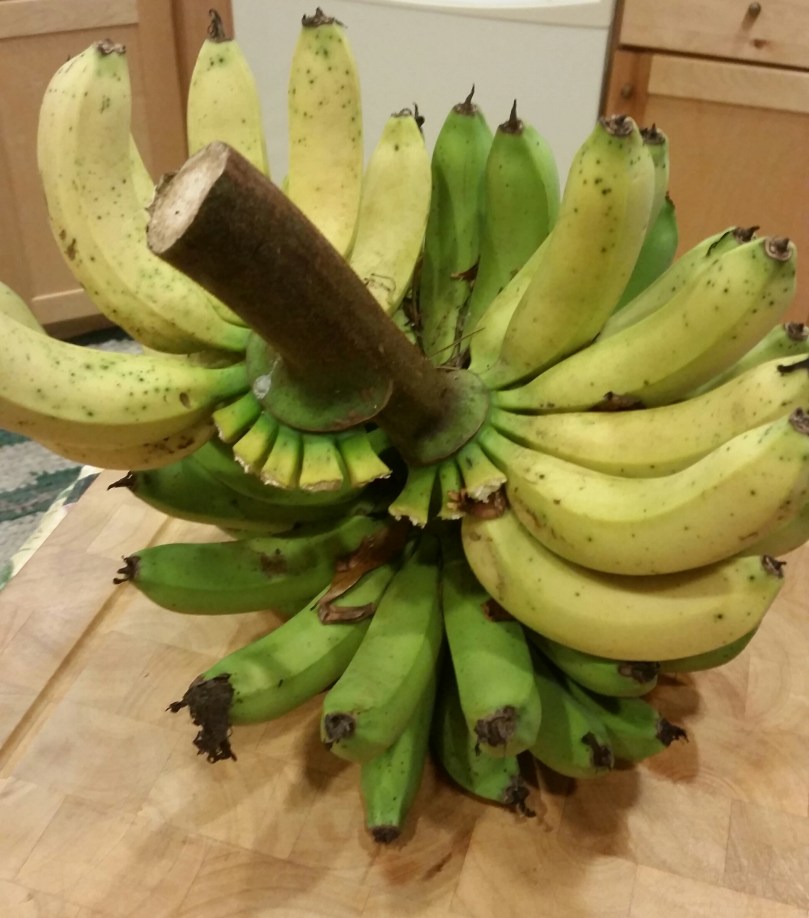
They have a big heavy flower stalk on which the fruit forms. If growing conditions are right, the cluster of bananas can be huge. This cluster had so many that we could not eat them all and had to freeze a lot for banana bread later. The cluster can be picked when the fruit is still green and the ripening is gradual – you can kind of see that in the picture below. Freeze your bananas without the peel in a zip lock bag. It’s handy if you put the amount called for in the recipe in one bag. If you click on the link above you’ll find a recipe for one of my favorites. I like the bread to be very moist but also done all the way to the center, so be sure to bake it the full amount of time and test the center with a toothpick.
The ones at the top ripen first. Clusters are attached in circles on the stem. Isn’t this an interesting arrangement?
I love growing bananas because the flavor is markedly better than the average commercial banana. That being said, I like any banana I can get (except the black ones). Bananas are nutrient dense and about 110 calories for an average sized fruit. They are known for being a good source of potassium, fiber, vitamins B6 and C and manganese. They have wonderful texture (great for baby’s first solid food), and they come packaged so conveniently. Don’t let anyone tell you a bad thing about bananas.
I can remember a time when I thought avocado was a color, but I didn’t know why it was called that (I bought sink mats and a dish drain in avocado green). Times have changed so much that even if a person lives in a cold climate they probably have a grocery store that supplies them with avocados. Otherwise, I assure you, there would not be a Mexican restaurant (guacamole) in Hayward, Wisconsin.
Avocados grow on trees, big ones. You get a clue about this when you find a big, big seed inside your avocado. A common science experiment in grade school is suspending an avocado seed over a glass of water (use toothpicks) and watching it split and start to grow. You will get a tree but it probably won’t have any avocados on it, ever. Most fruiting trees come from grafted plants.
If you love to eat Mexican food, you have eaten avocados. They call it guacamole and it’s wonderful. The ingredients are simple and you can mix up a batch in 10 minutes. Click here for a great recipe.
Mexico has the right climate for growing avocados, tropical or subtropical. South Florida is good too. My brother in the Miami area shared a whole grocery bag full of avocados with us this year. Mmm, buttery goodness, and yes, they are high in fat, but it’s the good kind of fat. The mono saturated fat in avocados can help with the absorption of fat soluble vitamins A, D, E, and K. They are cholesterol free, and can actually help reduce cholesterol.
Avocados are nutrient dense, containing nearly 20 different vitamins and antioxidants. They contribute fiber, folate, lutein, vitamins K, C, B6 and E, and magnesium.
Just when I thought I had put enough into this avocado post I came upon a video which I simply could not ignore. I have not tried this recipe yet but it makes sense to me that a high fat fruit like avocado might make a good ingredient for ice cream. (Cream is a fat, you know) This is a non-dairy frozen dessert made of only three ingredients; coconut milk, avocado and agave nectar for sweetener. Avocado ice cream, I can’t wait to test this one!
One reason I love avocados is that they make a simple no cook meal for me. Just cut one in half, add a little salt and pepper and eat. It even comes with its own bowl, the shell. And they are very pretty inside. That’s why avocado green is still a color, just sayin’…
I am a big supporter of FOOD. I think it is absolutely remarkable that everything we humans need to live and be in health is found on this planet. It’s almost like it was made for us. In fact, it is exactly like it was made for us. There is much to investigate on this topic and although I have never been a food blogger, I have done a stint teaching nutrition for the University of Florida Extension Service. I learned a lot and it was fun. I think I can share that fun with readers.
I love to photograph food (I’m talking mainly about fruits, vegetables and ovo-lacto food items). The colors are often bright and exciting, and there are also unusual shapes and ways that food presents itself. And because we get to eat it after the photographs, there will be an occassional recipe or fun way to eat the food of the day. A lot of my subjects will be nutrient dense and so good for you, but since I also believe food should make us happy there will be a few that fall in the “comfort food” category.
Don’t think that this is an easy theme to alphabetize. Since I want to stick with healthful foods that are as close to unprocessed as possible, the choices are limited. There are tons of letter C foods, but try finding some of the others. I love finding unusual items that might surprise you and inspire you to EAT THIS! Hoping you will check in regularly.



 Chicken eggs, primarily. Eggs are probably the easiest protein to add to a quick meal, anytime of the day, but certainly for breakfast. They have survived seasons of being bad mouthed for their cholesterol and for harboring salmonella and are presently in pretty good standing.






 Eat This!
 I Just Have to Say...