
Weekend on Call: episode 2

I have a talented daughter who is an equine veterinarian. Although I am a registered nurse for people, she occasionally allows me to ride on calls with her as she treats animals. We have adventures. I call myself VetMa. (OK, it’s a bit dramatic. So what?)

I heard the gathering of supplies and the phone conversation as I was waking up. There was no time for breakfast. We were on the road within minutes. It was Saturday morning and the weekend had officially started.

An animal loving family had been nursing their mini calf during the last week.  It had been seen by vets locally and at the University. It had been doing well and was being stalled in the house, in the bathroom. At midnight, the night before, it had been standing, chewing calmly on some hay with no apparent problems. This morning the family found things quite different. They were afraid it might be too late.

The scene was not encouraging. When the Doc arrived the calf was lying on the living room floor, swaddled in blankets with a heat lamp on it.  A worried looking husband and wife gave her the story. They had found the little animal unresponsive, barely breathing and looking near death. They had no clue what had happened.

A mini calf is about as big as a medium sized dog. The woman was stroking his head, holding it to keep his airway open. The preliminary exam showed a temperature too low to register on the thermometer, unusually cool limbs, barely audible heartbeat and respirations so diminished they were hard to detect.  Its eyes were open and glazed. The only sign of life was an occasional struggle and agonizing cry.

The doc is not only an animal lover herself, but also a very compassionate people person. She always tries to give people options even in the most critical looking situations. There weren’t many options to give in this case. There was no apparent course of action and it was doubtful the little guy would survive another trip to the university hospital. She offered to try to decompress the bowel, in case there was a blockage of some sort and talked with the owners about euthanasia as well. She went out to the truck to get her equipment ready should they wish to have treatment.  The man came out a moment later with tears in his eyes to say they did not want their animal to suffer any longer.

Hearts break when a precious animal suffers. It is part of the risk of ownership of an animal, that it will get sick or hurt and suffer. A good doc gives owners as much information as possible to make responsible decisions about the care of their animal. Making the decision to not let suffering continue when nothing can be done is difficult but there is also a peace and a feeling that the decision is the right one for the animal. A caring veterinarian helps clients through these times, being as kind, gentle and humane as possible. And that is how the first call of the day ended.

Euthanasia is not something a veterinarian enjoys, but it is part of the job.  It is heartbreaking. Every time.

Weekend on Call: episode 1

I have a talented daughter who is an equine veterinarian.  Although I am a registered nurse for people, she occasionally allows me to ride on calls with her as she treats animals. We have adventures. I call myself VetMa. (OK,  it’s a bit dramatic. So what?)

It was Thursday evening, the first of the long weekend on call.  It was getting dark. As often happens two emergency calls came in at the same time, but this time the triage decision was easy.  The horse with the eye laceration would have to wait, because the one with the heel bulb laceration would not.  The heel bulb is the area directly above the hoof of the horse and in this case, the owners reported fairly heavy bleeding. An artery had likely been severed.

The horse was standing in the driveway surrounded by a small crowd of people.  A blood soaked wrap was around it’s left front hoof and ankle.  It became apparent that there was no lighted barn in which to care for the horse, not even a floodlight over the drive so cars were pointed with headlights shining on the horse.

Almost all work done on large animals that involves pain, requires some degree of sedation and although this patient was standing fairly quietly, he would definitely need something for the treatment ahead.  Just like people, animals respond differently to sedatives. The doc estimated the animal’s weight and gave a starting dose before cleaning the wound. As it began to take effect, the bandage was removed.

Lacerations in this area are always going to be contaminated and prone to infection. This one was in the fleshy area in the back of the bulb and there were arteries involved.  Just cleaning and examining the area was difficult – a tranquilized horse has trouble standing on three legs so holding it’s leg up in a convenient position proved impossible. Our doc decided to let the horse stand on all four while she worked. That meant working in an unexplainable position close to the ground, nearly under the horse, in the dark with flashlights to guide the way.

20160428_202815-1.jpg
The perfect conditions and position for suturing, not.

The area around the laceration was blocked with local anesthetic and scrubbed clean. As the horse shifted its weight the laceration would open and close, each time making the small arterial bleeders spurt blood. It was difficult to see where to tie them off, but little by little the laceration was closed and the bleeding stopped.

While the tranquilizer was still in effect, the doc wrapped the ankle in batting and layers of gauze. A fiberglass cast was applied like a small boot to protect the area and allow the horse to stand and move while the cut healed. As the crowd dispersed, the doc gave instructions for care and dispensed antibiotics (and stretched her aching back).

20160428_211019-1.jpg
All fixed up with a small boot cast.

It was back in the truck and on to the next call.  Fortunately, the horse with the eye laceration was at an equine event where they had found another vet who was a participant. He was willing to stitch up the laceration so we went home, hoping for a quiet night.

#atozchallenge: Very Late Z

I’ve been sick, really.

I don’t remember if I did this when I was a child or if others did it to me, but, the memory is there of orange peel being squeezed in my face and of feeling the light, stinging spray of citric acid -my first introduction to citrus zest.

Zest is a great word meaning to enjoy something keenly, with relish, and also a pleasant flavor or exciting quality – that is why it is applied to the outer peel of citrus fruits.  The white part beneath, called the pith, is often bitter but the outer peel or flavedo is full of flavor and is used in many ways.

You might find it in orange marmalade, lemon flavored baked goods. I like to keep a lemon in my freezer for recipes calling for lemon zest.  A fine grater or special zesting tool can be used to cut the peel. It is often used as a garnish too because of its bright color and full flavor.

Another use, and one of my favorites, is in citrus essential oils. Here is your trivia for the day; when cold pressed, it requires 3,000 lemons to produce a kilo of lemon essential oil.  The chemical constituents in this oil, the list is too long to include, have anticancer, antidepressant, antiseptic, antifungal, antioxidant, antiviral, astringent, invigorating, refreshing and tonic properties.  All of which might make you think that we should be eating the peeling, not just the lemon. It works for me to put a few drops of the oil in my glass of water.

The next time a server in a restaurant asks you if you would like a slice of lemon in your water or other drink, you might have a good reason to say “yes, please”. Just sayin’…


#atozchallenge: Late Y

My food choice for Y is yogurt. I have been eating a lot of it lately since doing a round of antibiotic.  It is made with a lot of active bacterial cultures (good ones) that are naturally found in our intestines and which are a vital part of a healthy immune system and digestive system. Because it is more economical I have developed my own way of making yogurt at home. Here is how I do it.

I start with a gallon of 2% milk.  Any milk will do but the fat content will make a difference in your finished product.

On the stovetop I heat the milk to 190-200 degrees F.. I have a thermometer which clips to the side of the pan and I watch it closely. The milk needs to be stirred so it doesn’t burn on the bottom of the pan. I don’t let the milk boil.

20160503_150233.jpg
Heat it slowly, watch and stir (in other words, don’t leave the kitchen or you will have a real mess…)

As soon as the temperature is reached I put the pan in the sink with ice water to cool it down quickly. The thermometer is still on the side of the pan and when it reaches 90-100 degrees F. it is cool enough.

20160503_153111.jpg
Those are ice cubes, not little fish. The cooling is fast.

Add 3 tablespoons or more of yogurt that you have bought as your starter. It can be any brand that states it has live, active cultures present.  Choose a starter that you like because your yogurt will be similar. Stir the starter into your gallon of prepared milk.

I like to transfer the milk to a heavy bowl (I use the removable bowl from my crock pot) that will hold heat well. Cover it and place in a consistently warm place for 7-8 hours.  Suggestions for the place: your oven if it has a light that you can turn on. The light bulb will produce enough heat if you keep the oven door closed. OR if you have a water heater in a closet put a towel on it and set the pot on the towel OR put a heating pad set on low on your counter and the pot on top of that with a towel over the whole thing to keep the heat in.

20160503_154710.jpg
Do not turn on the oven! Just the light.

After 8 hours, the yogurt should have curdled. I like to separate the curd from the whey (which makes Greek yogurt) by taking a large colander which I line with cheesecloth and setting in a container to catch the whey. Pour the yogurt into the colander, wrap the cheese cloth corners over the top, place a plate over it and put something heavy on it to press out the whey and put it in the fridg. Let it set for several hours. The longer you let it drain, the thicker it will be. You can always stir some of the whey back in if it gets thicker wanted.

Enjoy your homemade, unsweetened yogurt with fruit, cereal, or as a spread like cream cheese.  It has a milky, soft flavor with just a little tang.

20160504_124058.jpg

#atozchallenge: Late X

The challenge is over today.  My last three posts didn’t make it up in April. Visiting with daughter Julie who is an equine vet, makes life very busy. I am learning that it is a blessing to be able to focus on one thing at a time and really be present in the moment. Unfortunately X, Y and Z were not part of the moment.  So here they are now…

X is for xylitol.  Xylitol is a chemical called a sugar alcohol (the “ol” suffix gives that away).  It is a substance found naturally in many plants. It has lately become a popular choice of sweetener because it does not affect blood sugar the way other sugars do, and it has some anti-viral and anti-bacterial properties that are beneficial in cases of ear infections and tooth decay.

Xylitol is extracted from plants through a process which results in a hydrogenated sugar.  The plants most often used are corn cobs.  The process involves a heavy metal as a catalyst, which is removed later. It is a highly processed substance and there isn’t a lot of information yet on what happens to those who make it a regular part of their diet.  It is known that tolerances differ but that at some level people will experience intestinal discomfort – gas, bloating, diarrhea.

After reading about xylitol, the pros and cons, I am concluding that anytime we try to process something and mass produce it we are stepping into potentially dangerous waters.  Why can’t we just eat food that grows, in the form that is simplest or with cooking that anyone can do at home without a lot of additives? Food is designed to be good for us.  Don’t mess with it.  Just sayin’…

#atozchallenge: Water

20160428_071233.jpgI am so grateful for water. I was thinking about that while washing dishes the other night.  We use water to carry the dirt away from everything we wash – our dishes, our clothes, our cars, our pets, our bodies, everything.  If that were the only benefit of water, that alone would be enough.

The complexity of what water does inside our bodies is another mind boggling subject.  We are composed of 50 – 75% water and all our basic functions depend on having enough of it inside the cells, outside the cells, in the bloodstream. Every biochemical reaction in our bodies takes place in water and we can’t produce it ourselves, nor store adequate amounts of it.  We have to take it in, or we die rather quickly.

And so we have a planet to live on that is watered with a beautiful closed system of purification and re-use of water, that has vast amounts of water stored underground, and seas and oceans, lakes and streams almost everywhere.  It is a perfect match for our needs. That being said, some of us have to work a lot harder for water than others.  Some of us never have to consider how precious our water is and are wasteful of it, taking it for granted.

I’m not going to get real technical about water. I just want everyone to have a chance to think about water and how marvelous it is, in all its forms from rain to snow to steam.  The beautiful clouds in the sky, the inspiring waterfalls that we flock to view, the cool lake that we jump into to cool off, the sprinkler that brings relief to our grass and plants and trees.  Water is, well, kind of miraculous really.  Just sayin’…

#atozchallenge: Vanilla

20160426_224614-1.jpg

Black and white, chocolate and vanilla.  Classics in the world of flavors and although vanilla has some B complex vitamins and several important minerals, it usually gets left in the shadow of all the hype about chocolate.  It’s actually a flavoring found in most desserts, baked goods  and many drinks. It’s also expensive, coming in second behind saffron.  Here’s why…

It’s a bean grown by the only fruit bearing orchid around.  It grows in tropical climates, the flower blooms for only one day and when commercially farmed, has to be pollinated by hand.  The pods turn from green to yellow before being picked. They are left in the sun to dry and wrapped to “sweat” for up to 20 days. Follow this with 4-6 more months of air drying and a bit of fermentation before you get the thin, dark bean in the picture above.  The beans inside the pod are scraped out in powder form.   All this is pretty labor intensive from the sound of it.

You can buy the pods in health food stores.  The extract, formed by dripping alcohol over the beans is found in most groceries.   Vanilla sugar is the last form and many people make it themselves – just cut the beans or even just the pods in thirds and place them in sugar to infuse.

I wanted to picture my favorite vanilla concoction but I went to the freezer and it was gone.  I love, love, love vanilla ice cream with the specks of vanilla bean.  So I’m left with this picture, not nearly as mouth watering.  Ice cream will be on the grocery list this week, just sayin’…

20160426_224918.jpg

#atozchallenge: Unleavened Bread

Long ago, a large tribe of people who had become enslaved in a land they had originally gone to for protection, were forced to leave in a hurry. It takes time for natural yeasts to develop in bread and they didn’t have that time. Their traveling bread was unleavened and it became one of the symbols by which this hasty departure was remembered. You can read a brief recount of this story in the Bible, book of Exodus, chapter 12, verses 31 -42.

This is one incidence of unleavened bread that is historically significant, but since unleavened bread is simply any bread product made without a leavening agent (yeast, baking soda, baking powder for instance) you can find many examples of it worldwide that are in common use.  Tortillas are unleavened bread common in Central America. Roti and chapati are unleavened breads common in India and Southeast Asia.  Most of these breads are flat in form but not all flatbreads are unleavened.

Interestingly this week is the Jewish Feast of Unleavened Bread which many Christians also acknowledge.  I know what it is like to celebrate this holiday and am sharing with you one of my favorite recipes.  It is a delicious sweet bread with a delightful almond flavor.

Almond Unleavened Bread

Mix: 4 eggs (beaten) with 1 cup of sugar and 1 cup of flour

Add: 3/4 cup melted butter or oil

Add in increments: 2 more cups of flour, 1/2 teaspoon vanilla and 1 teaspoon almond extract, and finally 1/2 cup of unsalted, slivered almonds.  Place this thick batter in a greased loaf pan and bake at 350 degrees for 30 minutes until bread is slightly browned on top.  Cool and slice in 1/2 inch slices.  Toast if desired.DSC07700


#atozchallenge: Turmeric

I know we take Sunday off each week in our atozchallenge, but yesterday when I was due to write about T, I was instead taking the opportunity for a long horseback ride through the woods of Pumpkin Hill Preserve (click to see).. What a great Florida park! The schedule gets to forgive me.

The T word is turmeric, a plant which has come to the attention of the health world in the west because of its anti-inflammatory properties.  It is raised commercially in India and other Southeast Asia countries.  The specific chemical in turmeric which helps reduce inflammation and pain is curcumin and if you take it as a supplement for pain, that is the name you should look for.

Turmeric, the spice, is made by taking the rhizome of the plant and drying it, then making a powder from it.  What you have at that point is the spice that you find in many Indian and Asian dishes, yellow in color and having some warm, spicy tones.  Because of its color it’s also used as a dye, something I noticed when traveling in Cambodia and seeing the Buddhist monks in their bright yellow-orange robes.  The spice has long been a part of religious rites in the countries where it is raised too.

Back to curcumin, it comprises only about 3% of turmeric which is not really enough for effective pain relief.  That is why curcumin is concentrated as a supplement.  It is also not utilized easily by the body but when combined with piperine, one of the constituents of black pepper, it’s uptake and utilization is increased by 2000%! Supposedly eating two or three black peppercorns with your curcumin supplement is all it takes.  I have not verified this but it doesn’t sound dangerous to try.  This is a very interesting supplement with other properties as well as the one I’ve mentioned.  Check it out if you are looking for something with anti-oxidant, antimicrobial, and anti-inflammatory properties.

20160422_142653.jpg
My daily dose of curcumin (from turmeric). Nice color, isn’t it?

Read More »

#atozchallenge: Starfruit

20160107_093601.jpgStarfruit or Carambola – you might not have heard of this one if you live in a northern climate. Florida is one of the states where it is grown in the U.S. and it is interesting that one man was responsible for the particular cultivar that is grown commercially and bears his name, Adkin.  He was a backyard horticulturist and his work produced this really, tasty and lovely fruit.
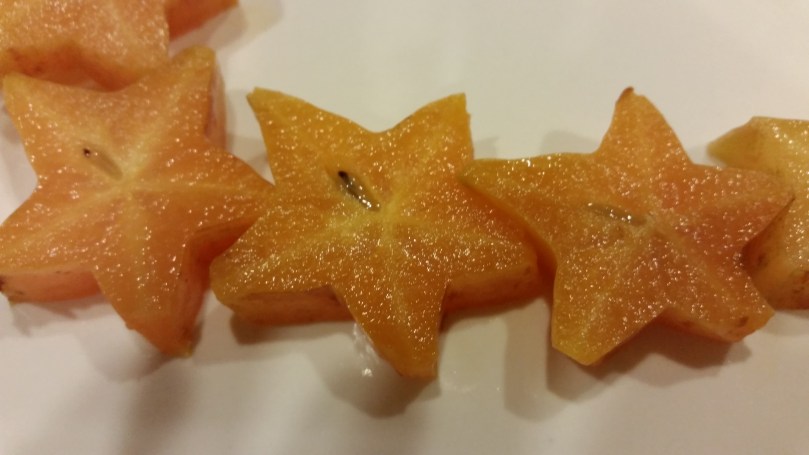
Although this fruit is still relatively rare in many parts of the U.S., I read that it is common in other countries (the Indian subcontinent, Southeast Asia, Indonesia, Malaysia, Guam, Phillipines, China, Taiwan) and has been for hundreds of years.  It has many names.  The Starfruit name is descriptive of the sliced fruit, as you can see.

20160107_093638.jpg
delicious, juicy little stars are very decorative

Starfruit is a little like grapefruit, in that is has substances, caramboxin and oxalic acid, that greatly affect the utilisation of certain medications. Caramboxin is actually a neurotoxin and should not be consumed by people who have kidney disease.  For everyone else the low levels of caramboxin are not dangerous and the health benefits are considerable.  Starfruit is rich in vitamin C, antioxidants, and potassium. It is low in sugar, sodium and acid and has significant antimicrobial activity.

20160107_093734.jpg
this one might be a bit tart since the ridges still have some green

They are ripe when all traces of green have gone and the ridges have turned slightly brown. Further ripening tends to make the fruit soggy and bland.  The taste and texture have been described as having elements of grape, pear, citrus and apple.  They are very juicy and somewhat tart, and even kind of crunchy. I know, it’s hard to imagine all that if you’ve never had them.  My brother has some trees in south Florida and brought us a whole bag of starfruit last winter.  I like them a lot. If you happen across them in your grocery, give them a try.