A to Z Family Stories: S for Summer Swims

Summer is very short in Wisconsin, but often there are a few day of blistering heat and few are prepared with air conditioning. The only good way we had to cool off was to go swimming and our summer life was defined almost as much by the swimming and the lake as it was by the farm. Because of the beautiful area lakes there was an active tourist trade. Summer meant the resorts were full, there were summer jobs of cleaning cabins and babysitting to be had, interesting people to meet, water skiing challenges, and weekend picnics at the beach with friends.

We claimed Round Lake as our own playground. The sandy beach called the Narrows was within walking distance and when we were young it was unregulated and frequented mostly by us locals. Situated on the narrowest part of a peninsula, there was water on both sides of the road, one side being better for swimming and the other side a little more rocky was mostly for boating. The water filling this fairly large lake was clean enough to drink, and very cold. It was our goal to try to go swimming or skiing by Memorial Day but most years, it required a wet suit to be comfortable.

a crude drawing of The Narrows and our Peninsula

Our usual swimming time during the busiest part of summer was evening, right after the last bale of hay went up into the loft – when everyone was still hot, sweaty and dying to get cooled off. Everyone would get into their suits quickly, often neighbor families would stop in on their way, we would load up inner tubes and truck ourselves down to the beach. Ritual dictated that each person run into the water until it got too deep and then dive in quickly. There was no other way to get used to the icy chill. After being in the water a few minutes we all seemed to “get used to” it and didn’t mind. As it got dark, the crayfish in the water and the mosquitoes in the air would get thicker until common sense dictated that we all go home.

There were always a few weeks when visiting relatives were around. My aunt, uncle and cousins from the city would bring their boat up and those were great times when we got to spend hours at the beach with them. My uncle would pull us water skiing behind the boat, always trying to scare us by going over big waves or turning tight circles. We all learned to ski slalom and some of the brothers even went on to kick off the skis and go barefoot. We all have stories about falling, losing our swimsuits as we tumbled in the water, or being dragged and nearly drowned as we tried to “get up”. Skiing is not for the faint of heart.

We would often follow the road to the end of the peninsula, where it curves around and almost forms a complete circle around a small bay. At “the point” as we called it, we would walk the sandbar and swim the channel to the other side. The trees on “the point” have initials carved in them and many memories were made there. I especially remember sitting there looking out at the lake and talking to my mom as we planned my wedding. I wanted to be married at the lake (however it was in January and there was NO SWIMMING.)

Years later my parents moved to a house on the lake. My brothers and I were able to take our families there often and my children have developed their own attachment to Round Lake. That house has been sold again several times but whenever I visit home we take a ride out Peninsula Road and dad makes me drive in to it so he can walk around and look out at the lake (don’t tell the owners please).

Oh yeah, lots of fun at the lake
My girls and their dad enjoying a moment on the dock after a swim.

Everyone in our family has been to some fantastic beaches in the years since childhood but I think we all put Round Lake and our memories of summer swims right up at the top of the list of special places. We all go back and visit, and remember, and maybe you should too. Just sayin’…

The beach at The Narrows,
The beach at The Narrows, “our swimming hole”

A to Z Family Stories: Q for Quiet of a Different Kind

Everyone thinks of the country as such a quiet, peaceful place especially when compared to the sounds of a city with traffic, construction, sirens, and other man made noises. But the quiet in the country is not really the absence of noise at all. The noises are different but they are there, and they are often surrounded by softness, and quiet space that makes them stand out with a clarity that burns them into one’s memory. I want to tell you about some of my favorite noises and the quiet that makes them special.

I start with spring because all things kind of start there. There has been only one year when I actually witnessed a very brief moment – it happens every year but so quickly that one can never predict and catch it. I happened to be on the bank looking out on the ice covering Round Lake. There had been warm days already and the ice was rotten, weak and shot through with melting holes. There was open water around the edges of the lake. A breeze came up and the most marvelous sound began as the ice moved and began to disintegrate. It was a musical, tinkling sound like many small pieces of glass hitting each other and swirling in the water. Shards of ice piled up on the shore and the rest sank into the lake until nothing but open water remained. I watched and listened for about five minutes and it was over. I was in awe.

The earliest bird sound in northern Wisconsin is made by the Red-winged Blackbird as it returns to its nesting area in the marshes. We had several small marshy ponds near our driveway where we would wait each morning for the school bus. The blackbirds would sit on the power lines, and the cattails and sing. They have a rather long and complicated call that is unmistakeable and ends in a high trill. It was always the hallmark of spring for me. About the same time the marshes also became alive with small frogs, spring peepers we called them. There were times when the combination of thousands of high pitched voices would drown out most other noises. This is April and I have just returned from visiting my hometown. We drove around in the country and every time we passed a wet hollow we heard the swell of sound from the peepers.

A couple of years we tapped maple trees in the nearby woods and there were times the sap ran so fast you could hear it dripping into the pails. And of course, there was always the snow melt in the fields. Streams would appear where none were other times of the year and water would rush down the hillsides into the pond. The driveway would become a maze of mud and rivulets to be avoided.

Summer brings sounds of bees buzzing, lazy flies, and breezes through the poplar trees. There is the sound of the waves slapping the rocks on the shores of the spring fed lakes and rivers, and a few man made noises as boats and jet skis skim the waters. On a windy day the woods are full of sounds of leaves turning and branches rubbing. There is a biblical reference to the trees of the field clapping hands and I always thought that was exactly what seemed to be happening.

Autumn sounds are so distinct – lonely sounds. The dry leaves are falling and crunching underfoot. The wind sounds different when it blows through the bare branches. Sometimes corn in the field that didn’t get cut is also brown and dry, rustling in the wind. Geese in large V’s honk their way south, and the crows call to each other.

And finally winter comes. The first heavy snowfall seems to suck up every noise in the woods, and the whole white world becomes insulated. There is a quietness that is tangible, it can be felt. Stepping out on the frozen lake can sometimes create loud booming sounds as the ice cracks. It doesn’t break but the long lines in the ice are dangerous when skates get stuck in them. Many times I remember the sound of the wind during the drama of blizzards – a time when it is a blessing to have shelter and warmth from which to view the storm.

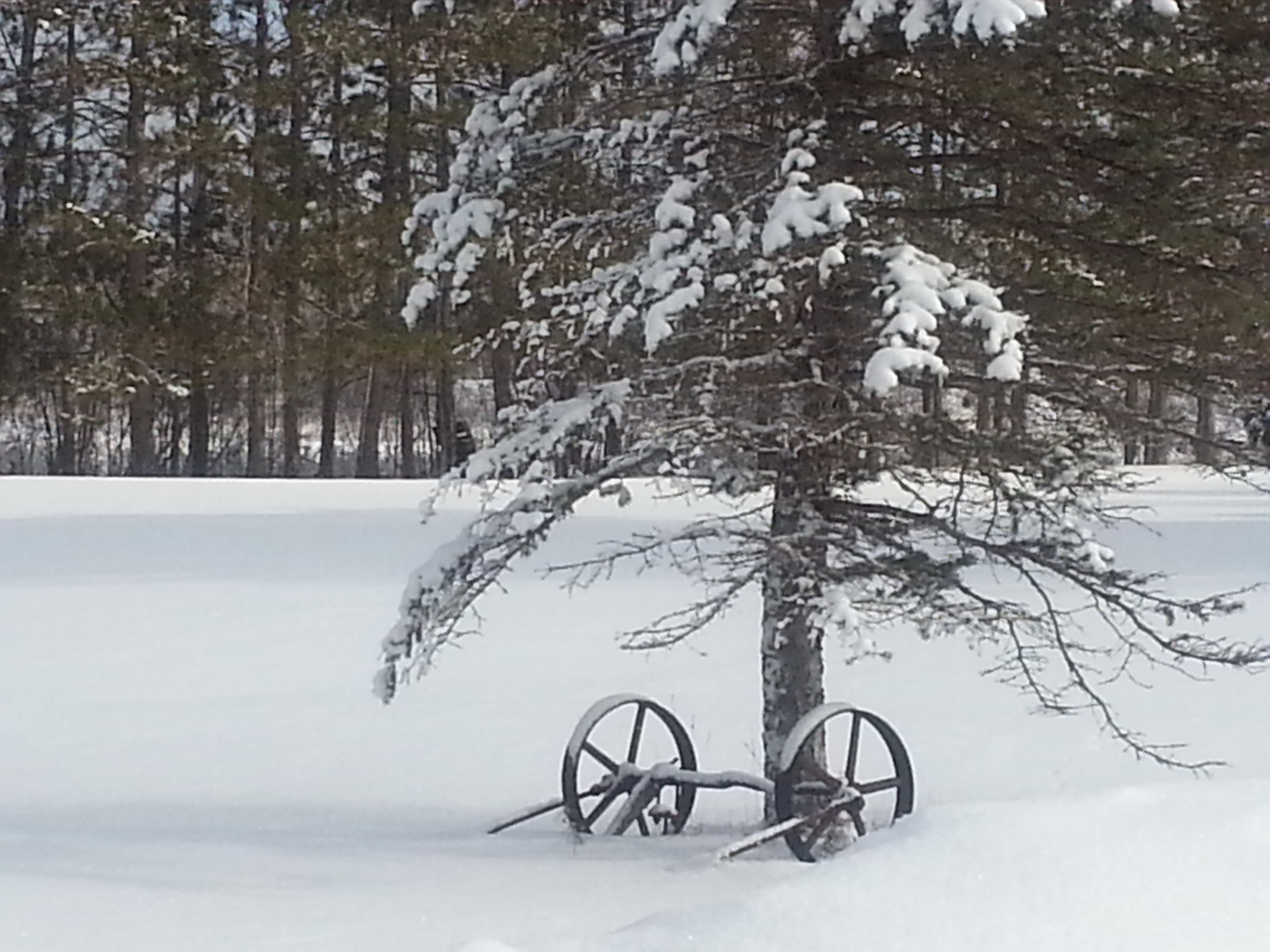
it gets very quiet when snow blankets everything

These are the sounds that I remember from life in the country – the peaceful, quiet country.

A to Z Family Stories: O for (ahem…) Outhouse

An outhouse wasn’t just something found in old cartoons and jokes. People actually used them and considered them a step up from … well, a chamber pot. I remember outhouse days.

My parents moved to a farm the year I was born. It had a two-story house, a barn, a sheep shed and an outhouse. The only water was in the barn and mom called it orange water because it was that rusty. Drinking water and water for washing clothes was brought out from town in large cans. There was electricity in the downstairs of the house only, and of course, no running water or plumbing. No bathroom. Mom was just thrilled to have a house of her own. The kitchen was where all the living was done. There was a bed in the corner. It was a safer time then – no locks on any doors.

The outhouse was one of the best structures on the premises, according to mom. Located just a short jaunt away from the house, it had one small high window for ventilation and a chair height bench inside with two holes, plus a child sized bench with a smaller hole. It was a deluxe model. The door had a hook and eye fastener on the inside and a wooden block handle on the outside that swiveled to hold the door shut.

When I was two and a half, before my brother was born, a bathroom was added which opened into the kitchen. A shallow well was sunk into the basement (dirt) floor and running water was brought into the house. Now there was orange water in both the house and the barn. However, the outhouse was still a common retreat, especially as the family grew. It had it’s own charm.

The farm had been bought from the Olson family. They had a son, Billy or Bob (we’re not sure), who went on to be an artist and a sign painter. Although we can’t be sure, we give him some credit for decorating the outhouse walls. Penciled here and there on the inside were caricatures of people and animals that were really showed quite a bit of talent. I remember looking at those walls, hoping to find a drawing that I had missed, wondering about the artist who had put them there. There was a supply of whatever paper could be spared, mostly catalogs and newspapers. Dad remembers what a treat it was around the time of year when peaches were sold, wrapped in tissue paper in crates. You can guess where the tissue paper went. I remember sweeping the floor and cleaning the outhouse and occasionally hunting down a spider or swatting down a hornet’s nest – not your present day bathroom hazards.

The outhouse stayed for a few years even after it got very little use. Eventually it was in the way and was taken down, the hole filled in, covered over. Another remnant of the past, no longer to be remembered, except of course in an occasional blog post. Just sayin’…

A to Z Family Stories: M for Milk Route

MDuring part of my father’s farming days he supplemented his dairy business with a milk route that carried milk from neighboring farms to a creamery in a nearby town. In those days dairy farmers put all of their cows in the barn at once and milked them with a vacuum system, one or two at a time.
The milk was poured from the milking machine into 10 gallon cans, covered tightly with a lid and cooled in a water tank. Full, the cans weighed 100 lbs. The cows were milked two times a day, which meant a farmer might have five to ten cans or more to be picked up every day. My dad’s job was to drive a truck to all the farms on his route, load the cans in his large truck and drive it to the creamery. Think back breaking work, seven days a week.

We didn’t see dad a lot when we were little – we weren’t usually awake when he went out in the morning and we were in bed already when he came home at night. For this reason, it was a real treat when we got invited to go along on the milk route. Probably because we were prone to bicker with each other, only one of us could go with him at a time.

I remember standing with my mom one morning as we watched dad walk to the truck. I was not happy that I wasn’t getting to go with him and was probably showing some attitude. Suddenly my dad changed direction and was running back toward us and I knew I was not in for anything good. I don’t remember the spanking – just the moment of terror when I realized I had pushed the limit and there was no going back and no hiding. Oddly enough, both parents now say that we were very good kids and they can hardly remember giving spankings at all.

The milk truck was the biggest machine on the farm and when I sat on the wide bench seat with dad it seemed REALLY high, probably because I was really little. One of the best things about the trip was lunch. There were no McDonalds or fast food places. Lunch was made at home by mom, was often egg salad sandwiches (my favorite) wrapped in wax paper, and they always smelled delicious. Mom has always been a food genius when it comes to packing food for people. There would be a little jar of pickles, some fruit, and homemade cookies, always cookies. We usually ate lunch in the truck and it was gone by the time we reached the creamery.

After all the milk cans were unloaded, emptied, washed and reloaded into the truck there was another ritual treat. This particular dairy had a cooler near the entry that was always full of packages of butter, and small cartons of chocolate milk. If we had been good, we got the chocolate milk to drink on the way home and it was the best!

My grandfather also worked delivering milk at one time and my father remembers the same kind of treat would be given to him – it was a family tradition. It was country life. Not many kids get to live the country life, but I did and it was pretty good.

wpid-20150413_141527.jpg

A to Z Family Stories: L for Lamb

These stories are part of who we are and I want them recorded. Not all of them are pretty, but that is ok.  This is a collection of family stories that are told repeatedly anytime the Smith clan congregates during a vacation or a holiday.  I’m sure some of them are told more from my perspective than others but I welcome added insight from those involved.

“The farm”, those words will always mean one place to me and my brothers. It was a 320 acre plot in Sawyer County, Wisconsin about 8 miles from the small town of Hayward. My parents moved there shortly after they were married and my father started trying to make a living being a farmer. He tried numerous types of agri-business while we children were young, before he finally gave it up to become an excavator. The northwoods isn’t conducive to most kinds of farming.

One of the first attempts was the raising of sheep. I was too young to remember much of the actual work and this era probably didn’t last very long. What I do remember and what we sometimes talk about is our pet lamb.

There were times when an ewe (mother sheep for you city dwellers) would either die when giving birth or perhaps she would have twins and reject one of them, which would leave a lamb in need of rescue. The lambs were born in spring or early summer – and you know, lambs are really cute when they are little, really cute. I mean really cute. I won’t say that my brother and I were given this lamb, because we were too young to be responsible for it, but we were regularly allowed to feed it. We regarded it as ours. We named it Lambey Dammey. I know, but we were kids and it rhymed.

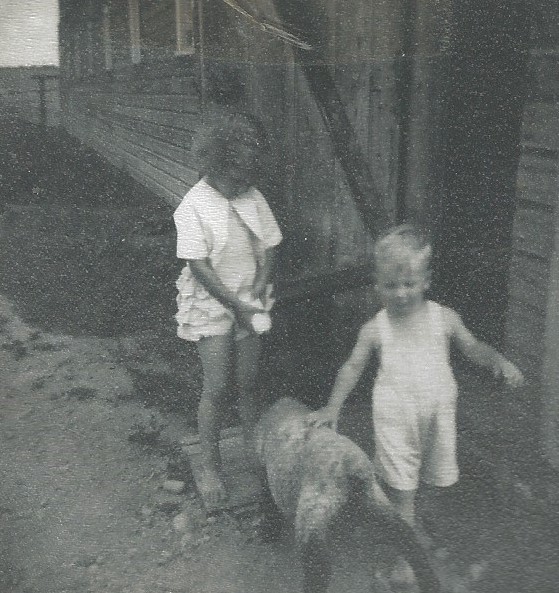
Our lamb, let’s just call him LD, was so cute (I did mention that they were cute, right?) and so much fun for us. When it was time to feed we would be given a bottle of warm milk with a special nipple and told to go find LD. We would call him loudly as we walked around the barn. I know people say sheep are dumb animals, but he would always come running. I think the promise of food makes anyone smart smarter. I was the oldest so I would hold the bottle, at least that’s what the pictures suggest. Much of my early memories are fed by the pictures I’ve seen over and over, and the stories I’ve heard. Here is a picture of me, my brother Ron and LD, the cutest lamb ever. Just sayin’…

PhotoScan (16)

A to Z Family Stories: K for Kitchen Play

Mothers work in kitchens a good deal of the time even if they work outside the home as well.  Long, long ago, before nintendo or play station, or remote control toys children also played in the kitchen while their mothers worked.  This was especially true as my brothers and I were growing up.  We played in the kitchen while mom cooked, baked, washed dishes and ironed clothes.  The radio played, it was warm and cozy since there was always an old-fashioned cook stove or later, a Franklin fireplace to keep us warm.  We emptied drawers, pulled chairs up to the sink to play in the dishwater, and generally got underfoot.  It was very much where we belonged.

Do Moms still work in kitchens?  Do kids still play in kitchens?  Do people still have kitchens?
Do Moms still work in kitchens? Do kids still play in kitchens? Do people still have kitchens?

But my favorite play was “pretend store”.  What better place to do it than the pantry cupboard?  Ours was a double cupboard under the kitchen counter. Two large doors opened up to a joined space with a narrower shelf in the back, and it was not a large space.  Looking at similar spaces now I can’t imagine being small enough to enjoy being in there – but I often have that reaction looking at the places I remember playing.  Crazy, but I know we children did it.

The first step, of course, was to empty the cupboard of all the canned goods and utensils that might be stored there. The next step was to crawl in and set up shop.  The things I wanted to sell would go back in, arranged as the storekeeper wanted them this time. Canned goods, cereal boxes, pots and pans, spoons, measuring cups – ready for business.  This was always a general store so it also sold toys for children (no problem there), clothing for the family (knew where to get that) and ready to eat food which mom would supply.  Paper and pencils for lists and a telephone (toy) for orders that  might be phoned in would always be within reach.  When all was done the final step would be to hang a kitchen towel as a curtain – just shut it in the overhead drawer.

It was such an inviting type of cubby hole that pillow and blanket would eventually find their way in for nap time.  I could have lived there, except I do remember that the shelf was a bit of a problem and I often bumped my head.  When I think about this pastime I have a renewed sense of appreciation for my mom’s patience.  She was probably glad that I was occupying myself with anything that kept me happy.

My children played in the kitchen too, and if I was at home, I would upload a way too cute picture of Esther in a plastic dish pan, boating around the kitchen floor.  I might add that for moms on a budget, don’t tell yourself that kids can’t be entertained with simple, inexpensive things.  They were and they can. Try it.  Just sayin’…

A to Z Family Stories: H for Home Road

These stories are part of who we are and I want them recorded. Not all of them are pretty, but that is ok.  This is a collection of family stories that are told repeatedly anytime the Smith clan congregates during a vacation or a holiday.  I’m sure some of them are told more from my perspective than others but I welcome added insight from those involved.

Northern Wisconsin is pretty much the heart of nowhere. The small town I grew up near was over three hours from a major airport and two hours from any significant shopping, unless Farm and Fleet was your go-to store – it was only an hour away. When the girls were young we made weekly trips to the city of Duluth, Minnesota to meet with friends for a church service. It was an all day journey, often leaving in the dark early hours of winter, with our thermos of cocoa and breakfast food and not getting back until it was dark again. There were rituals of where to stop for lunch (Pizza Hut, cheese pizza with a pitcher of Mountain Dew} and what to listen to on the radio (Prairie Home Companion all the way home…). The two youngsters would often fall asleep in the back, strapped into their car seats.

But there was always a point at which the road began to sound different. There was a slowing, braking and a particular curve to the road. It was almost like the tires knew that there was no longer a white center line, no longer much traffic. It was “home road”. A voice in the back would start the chant, accompanied by rhythmic bouncing in the car seat. Soon they would both be singing the song, “ho-ome road, ho-ome road” in sleepy voices that got stronger over the last couple of miles. It was the song that signaled one more safe trip nearly ended, with the expectation of being done with that long stretch of forced inactivity. It meant homecoming.

On visits home, I never travel that stretch of country road without hearing that little mantra playing through my mind. We don’t live there anymore. It’s not a road that leads to home. But the funny thing is that the song itself has come to be applied to other places that I’ve called home. The same feelings of welcome and relief from travel are felt as I turn into my present long driveway, and in my mind I hear small voices singing the “home road” song. I’m just sayin’ it is a sweet thing to remember.

wpid-20141009_150338.jpg

A to Z Family Stories: F for Fred and Friend

They just showed up one day and started hanging around our back porch for the shelter, I guess.  Fred and Skippy, two dogs probably out having fun, but of course we thought they were homeless, starving, needing love. So we named the big, fuzzy brown one Fred and the short legged black and tan one Skippy, and adopted them as our new farm dogs.  My brothers were always happy to have a dog or two around to play with and this curious looking pair was friendly and seemed to have adopted the boys too.  Then Fred had puppies.

Obviously, the naming came before anyone cared what gender they were, and looking at them it was much easier to imagine the big one being the boy and the little one being the girl. But, no. We don’t talk about Fred very much past this point and I think it’s because he she ran out on us – too much family responsibility I’m guessing.  My brothers decided to raise two of the puppies, again picking noble doggie names for them – Steve and Andy.

Everyone’s memory is kind of fuzzy about what became of Steve and Andy as well.  One of the problems with farm dogs was that they often craved the excitement of chasing cars. That was a problem with this rambunctious pair and likely the cause of their demise. Which brings me back to Skippy, the one we remember most fondly.

It became apparent that Skippy had at one point been someone’s house dog.  He was very comfortable coming in and generally well behaved.  Even mom liked him.  He was always willing to eat leftovers that no one else wanted and that was his main diet.  No one ever thought of buying food specifically for the dog, not on the farm.  There were always other “things” for them to eat.  And here comes the part of the story that we always laugh at when talking about Skippy.

When we milked cows, the milk was poured into a funnel like strainer with a heavy paper filter at the bottom, and into large metal cans.  Washing up the equipment, we always took the filter out and tossed it – into Skippy’s mouth.  He loved the wet, milky circles and pretty much swallowed them whole.  Evidence of this would come in the spring as the snow melted and exposed the little white piles all over the lawn.  They were composed of milk filter material and tin foil, swallowed with his leftovers.

Skippy was an adventurer though.  He considered us his home but the world was his playground and he would be seen at neighboring farms and sometimes out in the woods. He often came back with wounds and bite marks, looking as if he had been fighting with other dogs.  For a small dog, he had an amazing amount of hormonal motivation leading him to wanderlust.  He may have just disappeared, like he came.  No one remembers exactly.  We’ll just say that maybe he and Fred found each other again and lived happily ever after…

A to Z Family Stories: C for Cat Tamers

This is a collection of family stories that are told repeatedly anytime the Smith clan congregates during a vacation or a holiday.  I’m sure some of them are told more from my perspective than others but I welcome added insight from those involved. These stories are part of who we are and I want them recorded. Not all of them are pretty, but that is ok. 

Young ones growing up on a farm had an important job. It was taming the kittens.

Cats are an essential element on a farm. Barns and other farm buildings are like hotels for mice if there are no cats around to keep them in check. Most of our cats were not the pampered, brushed and combed, vaccinated and neutered kind that are fed fancy food. Barn cats were and are excellent hunters who feed on small rodents almost exclusively and travel around the farm at will. And even if some cats were neutered or spayed, there was no guaranateeing that the neighbors cats were, therefore … kittens abounded.

You found them in the hayloft. You knew to look because a cat who had been looking kind of hefty for a while was suddenly skinny. We loved going into the loft to look for kittens because it was the ultimate scavenger hunt. You could follow mama cat if you were wiley enough to not let her know, otherwise you just had to start searching the crevices between the bales and hope you got lucky. The prize was finding that sleeping pile of gorgeous kitten fur, four or five of them most of the time. They were often a variety of colors and patterns, tiger stripe, calico, orange tiger, black and white, or maybe even solid black. It was best to find them when they were very young and let them see you often as they grew, but sometimes the mother would be skeptical of motives and move the family to a new hiding place. So the hunt would resume.

Older kittens were more difficult to deal with. They would instinctively hide and bite and scratch, but if they weren’t tamed they would grow up wild and too many wild ones would result in a cat population growing way out of bounds. Our job as children was to find, tame and help the kittens be people friendly so they could possibly go to a new home.

One time, my brother Stubby (we don’t call him that anymore) had been working on an older kitten and was making some headway when he heard of a family in need of a cat. He very much wanted them to take this kitten and was able, with difficulty, to get it into a box. With glowing reports of how pretty this kitty was he took them to the barn to see their new pet. Unfortunately, every time the box was touched it exploded into a shaking, jumping, growling, banshee shrieking package that was not very inviting. Amazingly, they took it.

As a young mom, I was able to live once again on the farm where I grew up. My own children learned the art of cat taming just like I had. They carried kittens in their arms, dressed them up in doll clothes, put them to sleep in dresser drawers (which was the first place we looked when one was missing) and in general subjected them to all sorts of handling. They were gentle and bomb proof by the time they were grown. Caring for them provided many lessons and so much fun for my own two cat tamers.

Esther and White Necklace (they always had descriptive names)
Julia and Rebel, asleep for the moment.

A to Z Family Stories: B for the Basement

Cool. Dark. Smelling of wet earth and cobwebs.

It was the basement, or more commonly, “the cellar”. It was the place mom went to fetch a jar of green beans, or dad went to see if a fuse had blown, or something had gone wrong with the pump for the well. It was the place in my dreams, and sometimes for real, where we went when funnel clouds were feared and things started flying around in the wind outside. I had watched “The Wizard of Oz” religiously for years and knew the cellar was the place to be.

It was a dangerous place for children, or so we were told (until we were old enough to work at cleaning it). It was the cellar steps that scared our parents the most. The only access to the basement was outside – a cement staircase, worn and a bit jagged, descending down into the ground under our house. Retaining walls on either side were probably meant to hold a door that would keep little children from falling into the abyss, but I don’t remember when our doors disappeared or if they were ever there. I remember playing on the steps. It was a cool retreat in the summer. It was my pretend home where I “cooked” mud pies decorated with dandelions and put my dolls to sleep.

At the bottom of the staircase, was a heavy, ill-fitting door with an unusual latch. I remember worrying about opening it, and then worrying again about being able to get it closed. A door left open might be a nocturnal invitation to a skunk, or something bigger. Who knew? And of course, a small child, mistakenly left behind in the cellar might not be discovered for some time

The floor inside was dirt, uneven with cement scraps and piles of “stuff” that kids couldn’t identify. In one corner was old wooden shelving that held dusty jars of produce, canned and stored from previous years gardens. The other corner housed a pump on a cement block. It dripped water and the dampness and faint smell of mold permeated the room. We knew our water came from somewhere under the pump and whether or not it was working was always of great concern to our parents.

Stories of the cellar would not be complete without mentioning it’s most numerous occupants – the family Arachnidae opiliones, Harvestman, or as we called them “daddy long legs”. Somehow we didn’t fear them as we would a spider. Their long spindley legs made them look too clumsy to be vicious. They were interesting and I watched them often. Others were not content to watch and I’m sure some torture occurred during moments of childhood boredom.

I’m just sayin’, I remember the cellar. It was part of our world, our house. Not many of them left.

Our “daddy long legs” looked like this friendly guy