#atozchallenge: Water

20160428_071233.jpgI am so grateful for water. I was thinking about that while washing dishes the other night.  We use water to carry the dirt away from everything we wash – our dishes, our clothes, our cars, our pets, our bodies, everything.  If that were the only benefit of water, that alone would be enough.

The complexity of what water does inside our bodies is another mind boggling subject.  We are composed of 50 – 75% water and all our basic functions depend on having enough of it inside the cells, outside the cells, in the bloodstream. Every biochemical reaction in our bodies takes place in water and we can’t produce it ourselves, nor store adequate amounts of it.  We have to take it in, or we die rather quickly.

And so we have a planet to live on that is watered with a beautiful closed system of purification and re-use of water, that has vast amounts of water stored underground, and seas and oceans, lakes and streams almost everywhere.  It is a perfect match for our needs. That being said, some of us have to work a lot harder for water than others.  Some of us never have to consider how precious our water is and are wasteful of it, taking it for granted.

I’m not going to get real technical about water. I just want everyone to have a chance to think about water and how marvelous it is, in all its forms from rain to snow to steam.  The beautiful clouds in the sky, the inspiring waterfalls that we flock to view, the cool lake that we jump into to cool off, the sprinkler that brings relief to our grass and plants and trees.  Water is, well, kind of miraculous really.  Just sayin’…

#atozchallenge: Vanilla

20160426_224614-1.jpg

Black and white, chocolate and vanilla.  Classics in the world of flavors and although vanilla has some B complex vitamins and several important minerals, it usually gets left in the shadow of all the hype about chocolate.  It’s actually a flavoring found in most desserts, baked goods  and many drinks. It’s also expensive, coming in second behind saffron.  Here’s why…

It’s a bean grown by the only fruit bearing orchid around.  It grows in tropical climates, the flower blooms for only one day and when commercially farmed, has to be pollinated by hand.  The pods turn from green to yellow before being picked. They are left in the sun to dry and wrapped to “sweat” for up to 20 days. Follow this with 4-6 more months of air drying and a bit of fermentation before you get the thin, dark bean in the picture above.  The beans inside the pod are scraped out in powder form.   All this is pretty labor intensive from the sound of it.

You can buy the pods in health food stores.  The extract, formed by dripping alcohol over the beans is found in most groceries.   Vanilla sugar is the last form and many people make it themselves – just cut the beans or even just the pods in thirds and place them in sugar to infuse.

I wanted to picture my favorite vanilla concoction but I went to the freezer and it was gone.  I love, love, love vanilla ice cream with the specks of vanilla bean.  So I’m left with this picture, not nearly as mouth watering.  Ice cream will be on the grocery list this week, just sayin’…

20160426_224918.jpg

#atozchallenge: Unleavened Bread

Long ago, a large tribe of people who had become enslaved in a land they had originally gone to for protection, were forced to leave in a hurry. It takes time for natural yeasts to develop in bread and they didn’t have that time. Their traveling bread was unleavened and it became one of the symbols by which this hasty departure was remembered. You can read a brief recount of this story in the Bible, book of Exodus, chapter 12, verses 31 -42.

This is one incidence of unleavened bread that is historically significant, but since unleavened bread is simply any bread product made without a leavening agent (yeast, baking soda, baking powder for instance) you can find many examples of it worldwide that are in common use.  Tortillas are unleavened bread common in Central America. Roti and chapati are unleavened breads common in India and Southeast Asia.  Most of these breads are flat in form but not all flatbreads are unleavened.

Interestingly this week is the Jewish Feast of Unleavened Bread which many Christians also acknowledge.  I know what it is like to celebrate this holiday and am sharing with you one of my favorite recipes.  It is a delicious sweet bread with a delightful almond flavor.

Almond Unleavened Bread

Mix: 4 eggs (beaten) with 1 cup of sugar and 1 cup of flour

Add: 3/4 cup melted butter or oil

Add in increments: 2 more cups of flour, 1/2 teaspoon vanilla and 1 teaspoon almond extract, and finally 1/2 cup of unsalted, slivered almonds.  Place this thick batter in a greased loaf pan and bake at 350 degrees for 30 minutes until bread is slightly browned on top.  Cool and slice in 1/2 inch slices.  Toast if desired.DSC07700


#atozchallenge: Turmeric

I know we take Sunday off each week in our atozchallenge, but yesterday when I was due to write about T, I was instead taking the opportunity for a long horseback ride through the woods of Pumpkin Hill Preserve (click to see).. What a great Florida park! The schedule gets to forgive me.

The T word is turmeric, a plant which has come to the attention of the health world in the west because of its anti-inflammatory properties.  It is raised commercially in India and other Southeast Asia countries.  The specific chemical in turmeric which helps reduce inflammation and pain is curcumin and if you take it as a supplement for pain, that is the name you should look for.

Turmeric, the spice, is made by taking the rhizome of the plant and drying it, then making a powder from it.  What you have at that point is the spice that you find in many Indian and Asian dishes, yellow in color and having some warm, spicy tones.  Because of its color it’s also used as a dye, something I noticed when traveling in Cambodia and seeing the Buddhist monks in their bright yellow-orange robes.  The spice has long been a part of religious rites in the countries where it is raised too.

Back to curcumin, it comprises only about 3% of turmeric which is not really enough for effective pain relief.  That is why curcumin is concentrated as a supplement.  It is also not utilized easily by the body but when combined with piperine, one of the constituents of black pepper, it’s uptake and utilization is increased by 2000%! Supposedly eating two or three black peppercorns with your curcumin supplement is all it takes.  I have not verified this but it doesn’t sound dangerous to try.  This is a very interesting supplement with other properties as well as the one I’ve mentioned.  Check it out if you are looking for something with anti-oxidant, antimicrobial, and anti-inflammatory properties.

20160422_142653.jpg
My daily dose of curcumin (from turmeric). Nice color, isn’t it?

Read More »

#atozchallenge: Starfruit

20160107_093601.jpgStarfruit or Carambola – you might not have heard of this one if you live in a northern climate. Florida is one of the states where it is grown in the U.S. and it is interesting that one man was responsible for the particular cultivar that is grown commercially and bears his name, Adkin.  He was a backyard horticulturist and his work produced this really, tasty and lovely fruit.
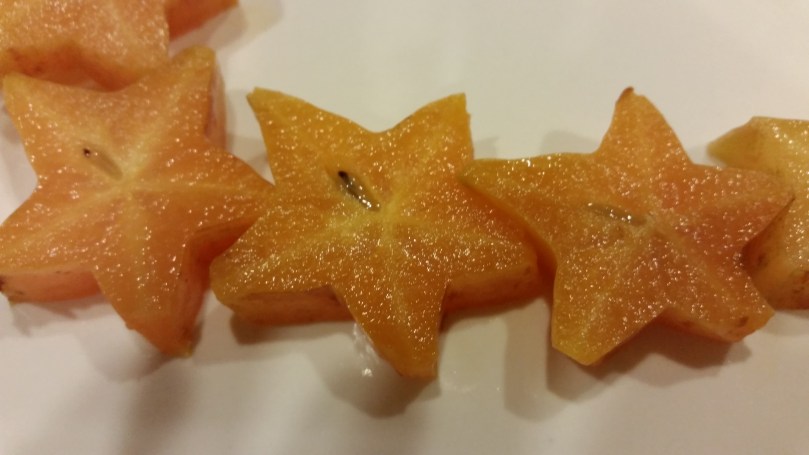
Although this fruit is still relatively rare in many parts of the U.S., I read that it is common in other countries (the Indian subcontinent, Southeast Asia, Indonesia, Malaysia, Guam, Phillipines, China, Taiwan) and has been for hundreds of years.  It has many names.  The Starfruit name is descriptive of the sliced fruit, as you can see.

20160107_093638.jpg
delicious, juicy little stars are very decorative

Starfruit is a little like grapefruit, in that is has substances, caramboxin and oxalic acid, that greatly affect the utilisation of certain medications. Caramboxin is actually a neurotoxin and should not be consumed by people who have kidney disease.  For everyone else the low levels of caramboxin are not dangerous and the health benefits are considerable.  Starfruit is rich in vitamin C, antioxidants, and potassium. It is low in sugar, sodium and acid and has significant antimicrobial activity.

20160107_093734.jpg
this one might be a bit tart since the ridges still have some green

They are ripe when all traces of green have gone and the ridges have turned slightly brown. Further ripening tends to make the fruit soggy and bland.  The taste and texture have been described as having elements of grape, pear, citrus and apple.  They are very juicy and somewhat tart, and even kind of crunchy. I know, it’s hard to imagine all that if you’ve never had them.  My brother has some trees in south Florida and brought us a whole bag of starfruit last winter.  I like them a lot. If you happen across them in your grocery, give them a try.

#atozchallenge: Raspberries, the passion and pleasure

20160421_194041.jpg
Here they are, today’s star

I come from northern Wisconsin, and a particular part of it that is extremely cold for a good long time in the winter.  We have three months of growing weather in a good year. It can freeze yet in May and probably will in September so gardens go in quickly and get down to business. We can’t really do apples, or cherries or plums but berries…  We do them pretty well.
My first berry experiences were with wild berries. We were always on the lookout for bushes on the roadside or in the woods. Recently cleared fields and brush piles were likely berry patches. When we started seeing the right color on the berries it was time to get the pails and gear up.
There were all kinds of perils. There were bears, of course, and poison ivy, wicked thorns everywhere, a constant halo of deer flies and my most dreaded one, hornets. Long pants, long sleeves, big hat and a bucket on your belt in July meant we were hot and slow moving.
Thankfully, by the time I was married and living in Wisconsin again we had learned about cultivated berries and had a large patch in the yard. Much easier, but there were still chores every year – cleaning out the old canes and pruning. There was also the new problem of the guilt when you just couldn’t pick and eat that many raspberries. They are still my absolute favorite berry for eating fresh.
I don’t know how they do it these days since they are soft and perishable, but  my store has fresh berries almost all year long. Does anyone go out in the woods anymore? I don’t know. Your reasons to eat raspberries, in addition to their wonderful flavor, are a low calorie, high fiber, high antioxidant source with lots of vitamin C and B complex vitamins and a number of important minerals.  Interestingly, they are a source of xylitol which I will mention again when we get to letter X.  And they’re pretty.  And red.

Happy Letter R, my friends.

#atozchallenge: Somewhat Uncommon Q

There is an ancient pseudo-cereal called quinoa that is very nutritious, high in protein and fiber, with vitamins and minerals a plenty.  It’s not a true grain, not a grass plant, but a member of the amaranth family and although it cooks up much like rice it is a bit different.  I wish I was practiced at using it and knew exactly how to make it a part of a meal.  I don’t.  But I’ve had some recently and the whole experience was so good, I was willing to try to reproduce it at home.

20150709_204435.jpg
The Columbia Building

Location: high in the sky above Seattle.  It you view the Seattle skyline you will see one dark building that rises above all the rest.  At the top of the Columbia building there is an exclusive area for dining and communing and it is there that I found myself a guest, with my daughter.  You would have to say that she has friends in high places, very high places. I could hardly breathe, looking out the full view glass windows over the harbor and Puget Sound.  In order to calm down I had to purposely not think about where I was and what kind of structure was holding me up.

We were advised about the menu items and ordered vegetarian.  The dishes came out looking perfectly cooked and presented in very attractive ways.  Everything was delicious.  It was a wonderful, relaxing evening in every way (as long as I kept my mind off being 80 stories high and on the same level as jets approaching SeaTac airport…).

20150709_203933.jpg

The quinoa was light and fluffy in a creamy sauce – just wet enough to hold it together and make it easier to eat.  The flavor was mild and slightly of salt, like a good comfort food. I wasn’t sure how to  do this at home but a light cream/celery sauce with the quinoa did a pretty good job.  The food was really great but it had a hard time competing with the view.  Just sayin’…


20150709_185347.jpg
The quinoa is in the upper left, accompanied by asparagus and what may have been garlic mashed potato or cauliflower – I don’t remember which.  

#atozchallenge: Pineapple

20160419_122041.jpg

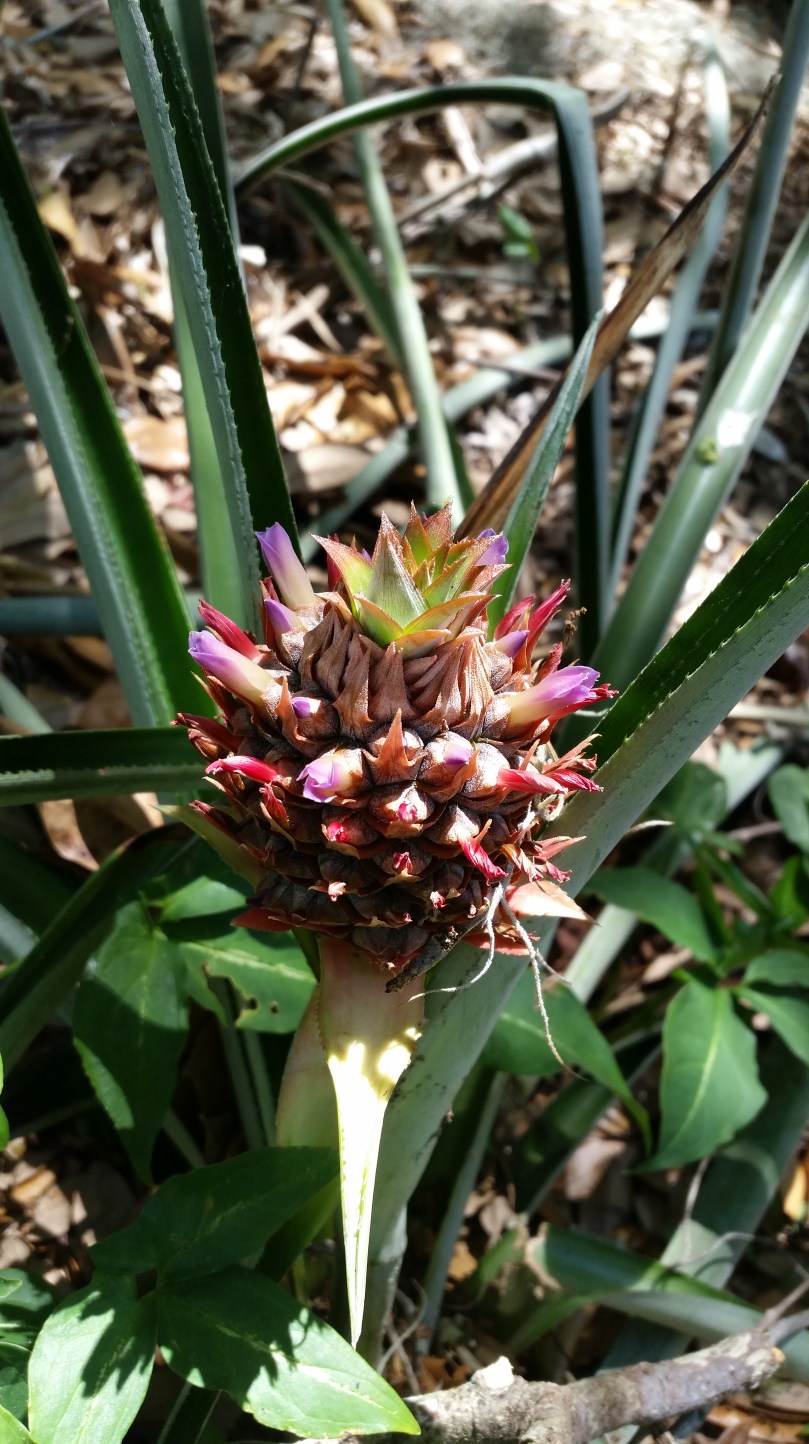
I don’t do anything to deserve the many pretty pineapple plants (couldn’t resist the alliteration) growing in my yard.  They are such a forgiving plant.  I started with fresh pineapples from the store, once long ago, and have not bought very many since then.  The tops get cut off and if they are laid on the ground where they can touch soil, they will find a way to root themselves and survive.  They have a life cycle of about 18 months, so depending on when you plant, you can expect some to be coming ripe every 6 months. Right now I am seeing most of my next batch slightly past the flowering stage.  A few are big enough to be ready probably in June or July.  I do not water or weed, although I’m sure the harvest would be better if I did.

The taste of homegrown is exceptional – I rarely find pineapple in the stores that tastes as good.  As they begin to mature they turn yellow, little by little, and become fragrant.  This is when the critters in my yard start to gnaw on them.  I haven’t figured out how to protect the plants yet although I’ve tried a lot of things (wrapping them in cloth, putting cages over them, making sleeves out of plastic milk jugs…  nothing works).  I’m not even sure who the culprits are, but likely squirrels or rats.  Because I have so many plants, probably 3 or 4 dozen, I usually get enough for us to eat.  But I have to be diligent.  Nothing is more disgusting than watching a nice, big pineapple approach picking time and then on the day I go out to pick it, it is half eaten or lying on the ground picked clean.

This is what I’m getting when I eat my pineapples.  They are high in vitamin C, and B complex vitamins. They have some vitamin A as well.  They have a proteolytic enzyme, bromelain, which is a potent anti-inflammatory, anti-clotting, and anti-cancer substance.  They have a large dose of fruit pectin which is a soluble dietary fiber.  Round it out with good amounts of minerals – especially copper, manganese and potassium.

I just enjoy having my own mini-plantation of pineapples.

20160419_121956.jpg


#atozchallenge: Orange

Another departure from nutrition on this day dedicated to the letter O.  April is National Poetry Month. 

Great Grandfather’s Name

The warmth of orange, the rich shades of color

Taken from the sun, from reds and browns and yellows

And transferred to a child to be his name

What could his parents have wished that name would inspire


Could it have been a name from the land

That of an earl or duke from France

And why would that land be named orange

And why would the child inherit the name


Did the land in France, or some other faraway land

Grow the fruit, the tree named orange that takes

Color from the sun and the earth and makes that

Perfect, round fruit which shares name with the child


The child became a husband, a father, a grandfather

Who had children sit on his lap and wonder at

His beard, and the lingering smell not of orange

But of onion, the poultice for his maladies


Orange and onion, memories meld together

The family stories and the continuing wonder

Of why, and would he want to be remembered

For more, and doubtless he was but always

Also for the name, Orange Scott Warner.

©2016


#atozchallenge: Nuts

Writing is continuing to be hard today.  Between fits of coughing and the husband’s requests for records to finish filing our income tax, I’m going nuts.  We hate filling out our tax reports so much that it is almost assumed that we will be late and filing for an extension.  All those statements with tiny numbers and dates that are nearly impossible to find.  Maybe someone else should do our taxes.

As a treat for myself, knowing that this day was coming, I went to the big box store and bought myself some nuts.  And as a treat for my daughter who is getting tired of nutrition information, all I’m going to say is nuts are good for you, in moderation. It’s not like you can’t go look this stuff up yourself, right?

“Can’t you write a story about nuts?”  she wanted to know. And I’ve been thinking of the myriads of times in my life when nuts have figured prominently.

Back in the 70’s when I got married, Gourmet Magazine ran a layout about a wedding that I admired greatly.  It was very “flower child” oriented, woodsy settings, and a beautiful cream colored cake with several tiers.  And decorating the steps of the tiers were little meringue mushrooms and halved walnut shells.  The walnuts were probably in there somewhere too but it is the shells that I remembered. When the cake was refashioned for my wedding I think the walnut shells were replaced by small pine cones.  So much for prominence.

And much more recently, peanuts have saved me from traffic accidents. (I will slip in the fact that peanuts are legumes, not tree nuts, but they have similar nutritional benefits.) Driving home from work in the midafternoon became difficult for me.  My early rising and active physical work day left me quite tired and I would find myself sleeping at stop lights and perilously close to sleeping while moving slowly in traffic.  For probably a year, I would keep a 2 lb. can of peanuts in the car for those times.  I found out I could not eat and sleep at the same time, and although I often got rather sick from too many peanuts, I always made it home in one piece.

Back to the cashews, it seems lots of people like them.  It’s something about the consistency and the salty way they crush in your mouth.  Last year, shopping in Cambodia with my friends Mike and Trish, we found cashews in the Russian Market.  Somewhere in the middle of this vast place there was a candy and food vendor who had 1 lb.measures of cashews all shrink-wrapped up in shiny plastic and Mike decided to get them.  I was skeptical as I am a little fearful of eating from the Market.  Mike said they were pretty good and he didn’t get sick so my daughter and I went back later to buy ours.  The Russian Market is covered, very crowded, very little moving air and probably 100 degrees F. in the summer. Unless you live in it, it is very easy to get lost in the maze of similar looking booths and tables, meals being cooked on hibachis, children napping in corners. It is such an interesting place. We did finally find our cashews.  Mine were not as good as Mike’s.  I’m sticking to nuts from home. End of story.

20160416_161124.jpg
It’s only a 2 pounder – will be gone in no time at all.